

Restaurants left out of affordability measure

Advertisement
Read this article for free:
or
Already have an account? Log in here »
To continue reading, please subscribe:

Digital Subscription
One year of digital access for only $205*
- Enjoy unlimited reading on winnipegfreepress.com
- Read the E-Edition, our digital replica newspaper
- Access News Break, our award-winning app
- Play interactive puzzles
*First annual payment billed as $205.00 + GST for one year. This annual subscription will automatically renew at $233.00 + GST every 52 weeks (10% off the regular annual price of $259.35). Offer available to new and qualified returning subscribers only. Cancel any time.
To continue reading, please subscribe:
Add Free Press access to your Brandon Sun subscription for only an additional
$1 for the first 4 weeks*
- Enjoy unlimited reading on winnipegfreepress.com
- Read the E-Edition, our digital replica newspaper
- Access News Break, our award-winning app
- Play interactive puzzles
*Your next Brandon Sun subscription payment will increase by $1.00 and you will be charged $17.95 plus GST for four weeks. After four weeks, your payment will increase to $24.95 plus GST every four weeks.
Read unlimited articles for free today:
or
Already have an account? Log in here »
The province is considering expanding tax exemptions on ready-made food and other grocery items to include a wider array of stores, but restaurateurs appear to remain left out of the affordability measure.
The seven per cent provincial sales tax will be taken off all grocery store items starting July 1 as part of the 2026 budget. While many basics are already exempt, the change removes the tax from a number of foods, including prepared meals, hot-and-ready foods, soda and chips.
However, restaurants will still be forced to charge PST, including on take-out meals, and grocery stores need to fit a number of qualifications, including being 280 square metres or larger, to qualify. Those qualifications shut out a number of convenience stores and small local retailers across Winnipeg.
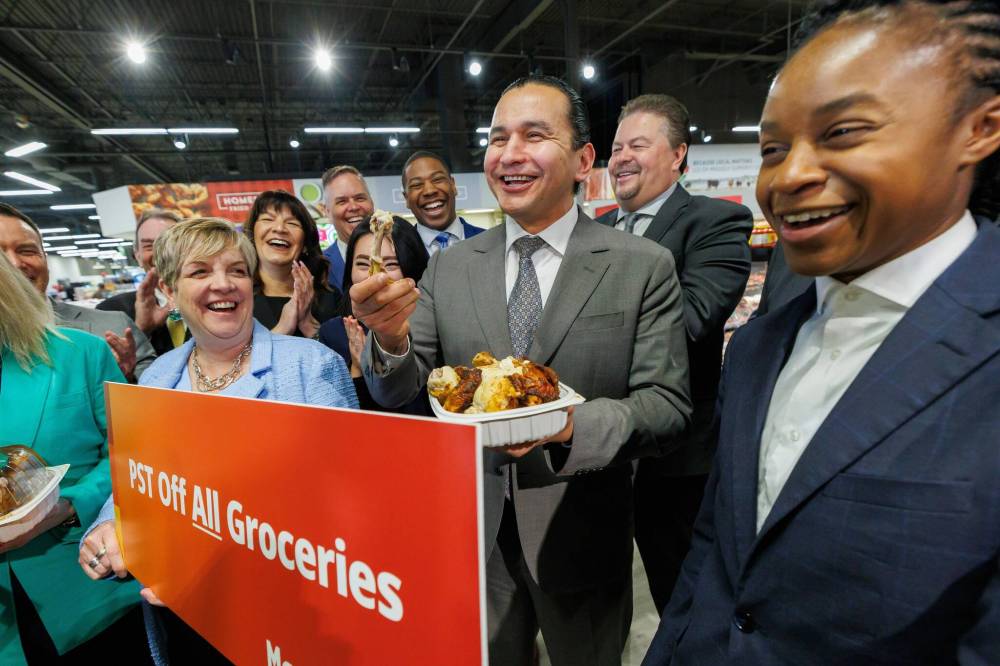
MIKE DEAL / FREE PRESS FILES
Premier Wab Kinew uses a rotisserie chicken to demonstrate the PST exemption on ready-made food and other grocery items in the NDP’s newly-tabled budget, during a March press conference. Restaurants appear to have been left out of the affordability measure.
The question of what actually defines a grocery store, and if it includes convenience stores and mom-and-pop shops, is something the province is hammering out now, Premier Wab Kinew said Friday.
The goal, he said, is for PST to be removed from grocery items “across the board” by Canada Day, and further details may be released in a tax bulletin.
“It’s always a devil-in-the-details-type situation,” Kinew said at an unrelated press conference Friday. “We want to change, when you go to buy food, fill your fridge, fill the cupboards up, we want to take the tax off everything. And now we’re up against implementation details.”
He seemed less open to the idea of changing the exemption to include restaurants.
“If you’re the person who is living in poverty and you can’t afford to go out to the restaurant, you get all your meals from the store, this is there to help you,” he said. “A provincial government can’t do everything.”
Manitoba Restaurant and Food- services Association president Shaun Jeffrey said he and a representative from non-profit Restaurants Canada are meeting with Finance Minister Adrien Sala next week.
He said many restaurants have regular customers who will buy single take-out meals from them rather than the grocery store.
“There was no consultation done on this, and the gaps are huge, they’re massive,” he said. “The restaurant industry, both full-service and quick-service, both rely on take-out services as part of their business.”
The exemption, as it stands now, will cost the province more overall, because the restaurant industry in Manitoba commits more money back into the economy than big-box grocery giants do, he said.
“It’s mind-blowing, is what it is, to make something like this and not take into consideration or factor in the fact that you’re going to be robbing from Peter to pay Paul,” he said.
“And from an industry that has struggled, that was closed during the pandemic, when grocery stores were opening, making record profits.”
The Canadian Federation of Independent Businesses launched an online petition Friday asking the province to expand the PST exemption’s eligibility to include all food retailers, including small convenience stores and dine-in and take-out restaurants.
“We hear consistently that low demand is really limiting businesses’ ability to grow and expand, so they’re just not seeing the same sort of consumer spending that they’re used to, and that’s especially in retail and hospitality,” said Brianna Solberg with the CFIB.
“You want to be encouraging people to go out and support small local retailers and local restaurants, and not creating policies that will disincentivize this.”
In the meantime, the exemptions have left even established local grocers scratching their heads as to whether they’re considered eligible for the exemption.

Food Fare owner Munther Zeid said he’s “getting a lot of mixed messages” on how many of his stores are eligible and said it’s possible he might have to include PST on items at some of his locations and not others.
“I’m looking at it as a small local grocer, (Kinew) should be promoting more of, ‘Hey, go to the local stores — the big block stores, Safeway, Sobeys, Walmart, Costco, sorry, you’re not included in this thing,’” he said.
“But then at the same time, they’re going to go, why would we invest in Manitoba if we’re not going to be PST exempt, like the smaller guy? It’s a double-sided sword. Damned if he does and if he doesn’t. But, it (should be) either all or nothing.”
— with files from Gabrielle Piché
malak.abas@freepress.mb.ca
Malak Abas is a city reporter at the Free Press. Born and raised in Winnipeg’s North End, she led the campus paper at the University of Manitoba before joining the Free Press in 2020. Read more about Malak.
Every piece of reporting Malak produces is reviewed by an editing team before it is posted online or published in print — part of the Free Press‘s tradition, since 1872, of producing reliable independent journalism. Read more about Free Press’s history and mandate, and learn how our newsroom operates.
Our newsroom depends on a growing audience of readers to power our journalism. If you are not a paid reader, please consider becoming a subscriber.
Our newsroom depends on its audience of readers to power our journalism. Thank you for your support.
Malak Abas is a city reporter at the Free Press. Born and raised in Winnipeg’s North End, she led the campus paper at the University of Manitoba before joining the Free Press in 2020. Read more about Malak.
Every piece of reporting Malak produces is reviewed by an editing team before it is posted online or published in print — part of the Free Press‘s tradition, since 1872, of producing reliable independent journalism. Read more about Free Press’s history and mandate, and learn how our newsroom operates.
Our newsroom depends on a growing audience of readers to power our journalism. If you are not a paid reader, please consider becoming a subscriber.
Our newsroom depends on its audience of readers to power our journalism. Thank you for your support.
Advertisement Advertise With Us
Advertisement Advertise With Us