Peru election highlights lack of plans to tackle illegal mining despite growing environmental crisis
Advertisement
Read this article for free:
or
Already have an account? Log in here »
To continue reading, please subscribe:

Digital Subscription
One year of digital access for only $205*
- Enjoy unlimited reading on winnipegfreepress.com
- Read the E-Edition, our digital replica newspaper
- Access News Break, our award-winning app
- Play interactive puzzles
*First annual payment billed as $205.00 + GST for one year. This annual subscription will automatically renew at $233.00 + GST every 52 weeks (10% off the regular annual price of $259.35). Offer available to new and qualified returning subscribers only. Cancel any time.
To continue reading, please subscribe:
Add Free Press access to your Brandon Sun subscription for only an additional
$1 for the first 4 weeks*
- Enjoy unlimited reading on winnipegfreepress.com
- Read the E-Edition, our digital replica newspaper
- Access News Break, our award-winning app
- Play interactive puzzles
*Your next Brandon Sun subscription payment will increase by $1.00 and you will be charged $17.95 plus GST for four weeks. After four weeks, your payment will increase to $24.95 plus GST every four weeks.
Read unlimited articles for free today:
or
Already have an account? Log in here »
Hey there, time traveller!
This article was published 11/04/2026 (185 days ago), so information in it may no longer be current.
BOGOTA, Colombia (AP) — Peruvians head to the polls Sunday to elect a new president and Congress, but illegal mining — a major driver of deforestation and mercury pollution — has received little attention on the campaign trail, even as it spreads deeper into the Amazon and Indigenous territories.
Experts warn the gap reflects a broader failure to confront what has become the country’s largest illicit economy, with growing impacts on the environment, public health and Indigenous communities.
“Political parties don’t understand that illegal mining has become the country’s main criminal activity and the one that moves the most money,” said environmental lawyer César Ipenza. “There is either ignorance about what this represents for the country — or, in some cases, parties are already part of this economy.”
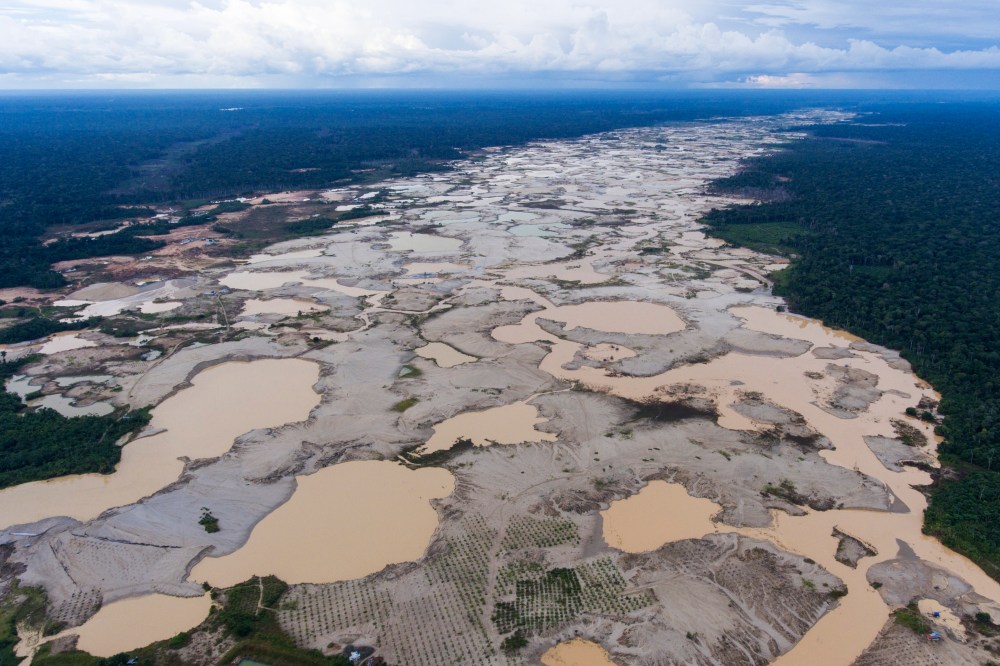
According to projections by the Peruvian Institute of Economics, illegal mining generated more than $11.5 billion in 2025 and over 100 tons of gold exports — rivaling the formal sector and surpassing drug trafficking.
Some candidates’ proposals, including former ministers and technocratic candidates such as Jorge Nieto and Alfonso López Chau, include measures such as gold traceability, financial intelligence and protections for environmental defenders, but these remain fragmented and fall short of a comprehensive strategy.
Others — including candidates from influential conservative and populist parties, such as Keiko Fujimori, Rafael López Aliaga and César Acuña — focus on security, economic growth or extractive development without directly addressing illegal mining or its links to corruption and territorial control in the Amazon. In some cases — including those of Ricardo Belmont and Carlos Álvarez, both media figures turned political candidates — plans omit the issue entirely.
“Illegal mining and illicit economies are not being prioritized in government plans,” said Magaly Ávila, director of environmental governance at Proetica, a Peruvian anti-corruption group, noting that around 64% of party platforms fail to meaningfully address the issue, while only about 5% do so “clearly and explicitly.”
A March analysis by Peru’s Observatory of Illegal Mining reinforces those concerns, finding that only 12 of 36 registered political parties present specific proposals, while others offer only general statements without concrete measures or do not address the issue at all.
Shortcomings of past plans
Peruvian authorities have previously announced operations and strategies to combat illegal mining, though experts say enforcement remains limited. The Associated Press contacted several government entities for comment on the issue of illegal mining and Indigenous protections but did not receive a response by the time of publication.
Peruvian lawmakers have repeatedly extended a temporary registry that allows informal miners to continue operating while seeking formalization, a system critics say has been widely abused and has helped illegal mining expand.
At the same time, recent legislative changes have undermined the capacity of prosecutors and judges to pursue organized crime, including illegal mining networks, according to rights groups.
Analysts say the measures reflect political pressure from small-scale miners, who have staged protests to demand looser regulations, complicating efforts to tighten enforcement.
The protests appear highly organized, suggesting the involvement of more powerful actors behind the scenes, said Julia Urrunaga, Peru program director at the Environmental Investigation Agency (EIA).
Soaring gold prices causes mining to deepen into Amazon
Illegal mining has grown rapidly in recent years, fueled by soaring gold prices, which have climbed to around $4,500 to $5,000 per ounce — making even small amounts of gold highly valuable. Once concentrated in regions such as Madre de Dios, the activity has spread into other parts of the Amazon and beyond.
“The price of gold has reached historic highs, and that has obviously driven illegal mining to expand,” Ipenza said. “The state does not have the capacity to respond or pursue this activity.”
Illegal mining operations often rely on mercury to extract gold, contaminating rivers and entering the food chain through fish.
“In Amazonian river communities, between 50% and 70% of the diet is fish,” said Mariano Castro, Peru’s former vice minister of environment. “So exposure increases exponentially, and mercury is highly toxic, with serious neurological impacts.”
Environmental and health experts warn contamination in some regions already exceeds safety standards, posing long-term risks.
Expected expansion throughout the Amazon “will bring contamination, transnational criminal groups and direct impacts on Indigenous and local populations,” Ipenza said.
Illegal mining already “puts at risk our health, biodiversity and ways of life,” said Tabea Casique, a board member of AIDESEP, Peru’s largest Indigenous organization.
“Most political parties are not taking this problem into account or presenting concrete proposals,” she said.
Weak enforcement
Former vice minister Castro called state efforts “insufficient” and said lawmakers have also weakened legal tools to prosecute illegal mining, including reducing penalties and limiting the ability to treat such operations as organized crime. Gaps in oversight allow illegally mined gold to enter legal supply chains, often through processing plants where it is laundered.
Ipenza called for the government to better control small-scale processing plants and for stronger coordination across government agencies — including customs, financial intelligence units and prosecutors — to track gold flows and identify illegal activity.
Analysts say weak traceability systems are a central vulnerability.
“There is no real way to trace mining production in Peru,” said EIA’s Urrunaga. “Authorities hold fragmented pieces of information, but there is no system — and apparently no political will — to connect them.”
“We are talking about more than $12 billion in illegal gold exports,” she added. “How can this be happening in almost total impunity?”
Experts warn that failing to act will make the problem harder to contain. The next government will face growing pressure to confront a crisis that they say is already spiraling.
“Authorities cannot fulfill their responsibility to protect citizens if they continue to normalize an activity that causes significant harm,” Castro said.
___
The Associated Press’ climate and environmental coverage receives financial support from multiple private foundations. AP is solely responsible for all content. Find AP’s standards for working with philanthropies, a list of supporters and funded coverage areas at AP.org.