City could freeze water rates if high usage continues Nearly $70M in unexpected revenue poured in last year
Read this article for free:
or
Already have an account? Log in here »
To continue reading, please subscribe:

Digital Subscription
One year of digital access for only $205*
- Enjoy unlimited reading on winnipegfreepress.com
- Read the E-Edition, our digital replica newspaper
- Access News Break, our award-winning app
- Play interactive puzzles
*First annual payment billed as $205.00 + GST for one year. This annual subscription will automatically renew at $233.00 + GST every 52 weeks (10% off the regular annual price of $259.35). Offer available to new and qualified returning subscribers only. Cancel any time.
To continue reading, please subscribe:
Add Free Press access to your Brandon Sun subscription for only an additional
$1 for the first 4 weeks*
- Enjoy unlimited reading on winnipegfreepress.com
- Read the E-Edition, our digital replica newspaper
- Access News Break, our award-winning app
- Play interactive puzzles
*Your next Brandon Sun subscription payment will increase by $1.00 and you will be charged $17.95 plus GST for four weeks. After four weeks, your payment will increase to $24.95 plus GST every four weeks.
Read unlimited articles for free today:
or
Already have an account? Log in here »
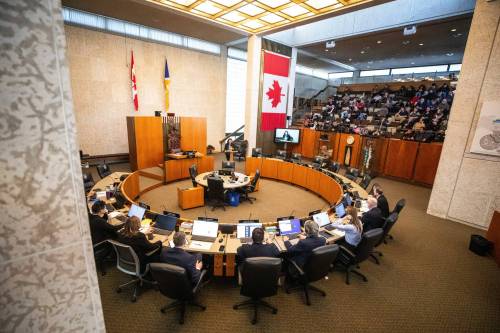
A surge in water use boosted city revenues in 2025 and, if it continues, might help ease the pinch of future utility bill hikes.
The City of Winnipeg has long warned Winnipeggers could pay much more to turn on their taps and flush their toilets in future years, since water and sewer rates will help fund a nearly $3.1-billion upgrade to the north end sewage treatment plant.
However, water use shot up 8.1 per cent last year, raising $67 million more revenue than expected, a financial update noted.

Coun. Jeff Browaty said the city will review water and sewer rates going forward to see if freezing them could be an option in future years.
“It is quite a bit of additional revenue … We’ll be able to, perhaps, pay for a little bit more of (the north end plant upgrade) with cash, as opposed to having to borrow (money). And, maybe, there’s an opportunity to review rates going forward as well,” said Browaty, city council’s finance chairman.
The city links the increased water use to multiple factors, including population growth, dry summer weather and more accurate billing (due to more old meters being replaced).
The drier summer led people to water lawns and gardens more, while Winnipeg’s population has grown steadily over the past three years, said Browaty (North Kildonan).
The city will closely monitor water use to figure out if last year’s surge was an anomaly or continuing trend, which will help determine if rates can hold steady, he said.
“This is certainly a positive variance. (And) when it comes to affordability for residents, last year’s (water and sewer rate) increases hit people hard,” said Browaty.
On April 1, 2025, a hefty sewer rate hike of $168.03 for a sample household took effect for the rest of the year. The same day, Winnipeg’s annual per-home garbage fee rose to $254 (prorated to $190.50) from $93 the previous year. The property tax also rose 5.95 per cent last year, which cost a sample home $386.50 more.
Later in 2025, city council approved another $44 increase to the annual water and sewer rate, which was effective Jan. 1, and a $68 hike to follow in 2027.
A city news release also indicated future rates will be reviewed following the increased water use.
“It is quite a bit of additional revenue.”
“This budget variance will be used to fund significant capital investments, such as the north end (sewage) treatment plant, reducing the need for debt. We will consider changes in water billing or consumption habits as part of our annual review of water rates,” it stated.
The revenue boost was noted in a broader city budget update.
Overall, the City of Winnipeg ended 2025 with a $14.3-million deficit in its tax-supported operating budget, based on unaudited numbers up to Dec. 31 of last year.
The shortfall will be covered by the city’s financial stabilization reserve, which will drop to $25.9 million after that transfer, well below a council-imposed minimum balance of $85.1 million set for that year.
Browaty noted the stabilization reserve was greatly depleted during the COVID-19 pandemic and has only partially recovered since.
A finance report blames the 2025 deficit on a late-year surge in snow-clearing costs, reduced planning, property and development revenues and an unbudgeted legal settlement payment, among other cost pressures.
In October, city council approved a $7-million settlement in lawsuits filed by three First Nations men who were wrongfully convicted of killing a restaurant worker in 1973.
Finance officials note city departments also met a collective target to save $51.8 million during 2025.
Cost-cutting measures, debt deferral, the removal of the federal carbon tax and a boost in interest rate earnings helped meet that target.
“This is certainly a positive variance.”

The figure included $20.5 million of vacancy management savings, as well as $26.2 million of savings from other cost-cutting measures and a separate $5.1-million savings target met by the Winnipeg Police Service.
Winnipeg’s planning, property and development department came in $6.1 million over budget, largely because its revenues fell short of expectations. The public works department fell $2.4 million short for the year, largely due to the cost to clear heavy snowfall in December.
Other losses from the city’s asset and project management department and the Winnipeg Fire Paramedic Service added to the deficit.
joyanne.pursaga@freepress.mb.ca
@joyanne_pursaga

Joyanne is city hall reporter for the Winnipeg Free Press. A reporter since 2004, she began covering politics exclusively in 2012, writing on city hall and the Manitoba Legislature for the Winnipeg Sun before joining the Free Press in early 2020. Read more about Joyanne.
Every piece of reporting Joyanne produces is reviewed by an editing team before it is posted online or published in print — part of the Free Press‘s tradition, since 1872, of producing reliable independent journalism. Read more about Free Press’s history and mandate, and learn how our newsroom operates.
Our newsroom depends on a growing audience of readers to power our journalism. If you are not a paid reader, please consider becoming a subscriber.
Our newsroom depends on its audience of readers to power our journalism. Thank you for your support.
Related Articles
City’s hopes for buyer to reopen inner-city pool drying up






History
Updated on Monday, April 13, 2026 4:48 PM CDT: Adds clarification
Updated on Monday, April 13, 2026 6:02 PM CDT: Adds details