

Wealth of musical talent providing the sounds of silents

Advertisement
Read this article for free:
or
Already have an account? Log in here »
To continue reading, please subscribe:
Digital Subscription
One year of digital access for only $1.44 a week*
- Enjoy unlimited reading on winnipegfreepress.com
- Read the E-Edition, our digital replica newspaper
- Access News Break, our award-winning app
- Play interactive puzzles
*Billed as $5.77 plus GST every four weeks. After 52 weeks, price increases to the regular rate of $19.95 plus GST every four weeks. Offer available to new and qualified returning subscribers only. Cancel any time.
To continue reading, please subscribe:
Add Free Press access to your Brandon Sun subscription for only an additional
$1 for the first 4 weeks*
- Enjoy unlimited reading on winnipegfreepress.com
- Read the E-Edition, our digital replica newspaper
- Access News Break, our award-winning app
- Play interactive puzzles
*Your next Brandon Sun subscription payment will increase by $1.00 and you will be charged $17.95 plus GST for four weeks. After four weeks, your payment will increase to $24.95 plus GST every four weeks.
Read unlimited articles for free today:
or
Already have an account? Log in here »
The score will be settled in real time on Saturday at the inaugural Winnipeg Silent Movie Festival, with local musicians set to provide live, improvised soundtracks to 10 films released between 1912 and 1929.
In order to meet the challenge, Mycze Cutler will rely on an instrument that predates any of the festival’s selections from the pre-sound era: a Casavant pipe organ, installed at the Crescent Fort Rouge United Church in 1911, one year before Lillian Gish made her film debut.
Used every week for worship, the Quebec-made instrument — equipped with strings, flutes and horns, as well as more than 2,000 pipes — will be employed by Cutler to improvise live scores to the festival’s closing projections, The Haunted House and One Week, both starring the inimitable Buster Keaton.
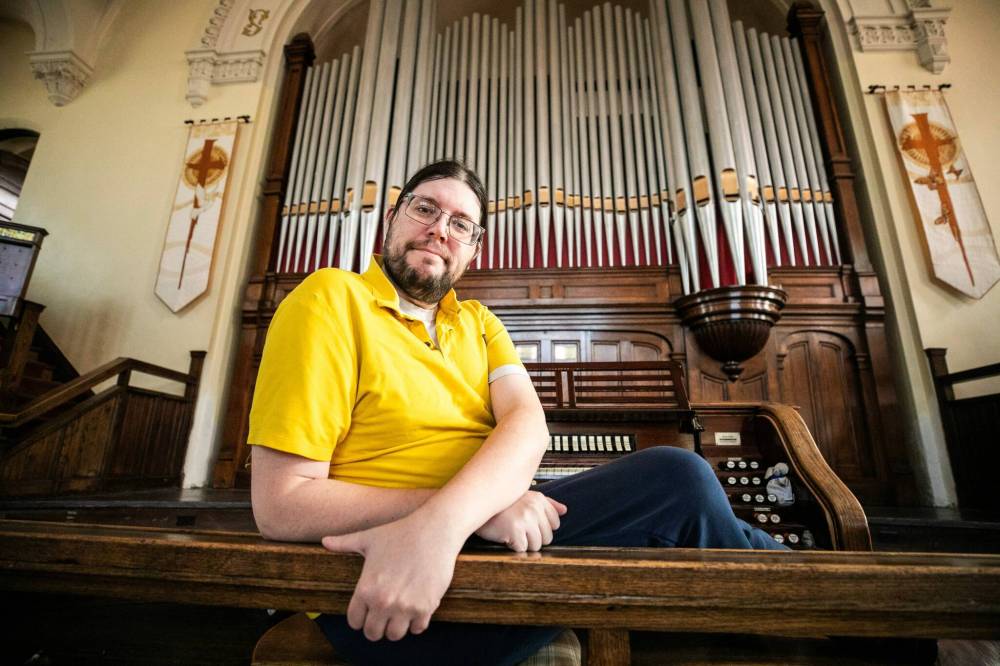
MIKAELA MACKENZIE / FREE PRESS
Mycze Cutler, musical director at the Crescent Arts Centre, will be playing the organ to accompany the moving images Saturday at the inaugural Winnipeg Silent Film Festival.
Cutler, the church’s music director, is used to improvising during services depending on the mood of the day’s hymns and the content of the sermon. As an accompanist for upcoming run of The Pirates of Penzance (opening April 24) from the musical theatre program of the Manitoba Theatre for Young People, Cutler has a clear plan to follow.
In the silent-film medium, Cutler combines both skill sets, drawing on thematic foundations and his emotional reflexes to enhance the storytelling on screen, however he sees fit.
“The biggest challenge with any improvisation is to get it out of my brain. There’s a very rapid translation to my fingers and toes to the rest of the world,” says Cutler, who last year used the Casavant organ for an EDM concert.
He’ll review the films beforehand, but he knows that when the reels start spinning, “very little will come out the way I actually planned it.”
That’s part of what caused festival co-organizer Grant Simpson to fall in love with the artistry of silent film accompaniment nearly 50 years ago.
In 1979, the Nanaimo, B.C.-raised pianist moved to Dawson City, Yukon, for a nighttime gig playing at Diamond Tooth Gerties Gambling Hall. During the day, Simpson had nothing to do, so he wandered into the city’s museum, where he heard the sound of a Beckstein grand.
In an auditorium, the museum was running silent film reels with live accompaniment by a man named Fred Bass.
“He was pretty ancient, but he was masterful,” recalls Simpson, who moved to Winnipeg in 2018 after more than 40 years at the helm of the Frantic Follies Vaudeville Revue in Whitehorse.
To organize the festival, Simpson has partnered with local violinist Miriam Neuman. The duo, who play a monthly silent film series at Crescent Fort Rouge and Gordon King United, will open the festival on Saturday at 2 p.m., improvising the music for The Electric House, another Keaton vehicle.
“The most common comment I get from audience members after we play a movie is, ‘After a while, I forgot it was you playing, because I was so involved in the movie,’” says Neuman.

“It’s deeply satisfying to hear people laughing or gasping at all the right spots.”
Other accompanists who will play the inaugural festival include Konko, a quartet featuring Kelly Castle, Matt Allen, Garethe Wesley and Jaxon Haldane. They’ll play along with Un Chien Andalou, a legendary surrealist collaboration between Luis Buñuel and Salvador Dali, and The Cameraman’s Revenge, a Russian stop-motion film from 1912 starring beetles and grasshoppers in an unexpected love triangle.
Annie Avery, a pianist from Yukon, will accompany the footage from Keaton’s The Goat and Falling Leaves by Alice Guy-Blaché, a French filmmaker who is considered the first woman to direct. Local bluegrass artist Tim Osmond will give the juice to a montage of Abbott and Costello chase scenes.
The festival will run from 2 p.m. to 8 p.m., with admission by donation at the door.
winnipegfreepress.com/benwaldman
If you value coverage of Manitoba’s arts scene, help us do more.
Your contribution of $10, $25 or more will allow the Free Press to deepen our reporting on theatre, dance, music and galleries while also ensuring the broadest possible audience can access our arts journalism.
BECOME AN ARTS JOURNALISM SUPPORTER
Click here to learn more about the project.
Ben Waldman is a National Newspaper Award-nominated reporter on the Arts & Life desk at the Free Press. Born and raised in Winnipeg, Ben completed three internships with the Free Press while earning his degree at Ryerson University’s (now Toronto Metropolitan University’s) School of Journalism before joining the newsroom full-time in 2019. Read more about Ben.
Every piece of reporting Ben produces is reviewed by an editing team before it is posted online or published in print — part of the Free Press‘s tradition, since 1872, of producing reliable independent journalism. Read more about Free Press’s history and mandate, and learn how our newsroom operates.
Our newsroom depends on a growing audience of readers to power our journalism. If you are not a paid reader, please consider becoming a subscriber.
Our newsroom depends on its audience of readers to power our journalism. Thank you for your support.
If you value coverage of Manitoba’s arts scene, help us do more.
Your contribution of $10, $25 or more will allow the Free Press to deepen our reporting on theatre, dance, music and galleries while also ensuring the broadest possible audience can access our arts journalism.
BECOME AN ARTS JOURNALISM SUPPORTER
Click here to learn more about the project.
Ben Waldman is a National Newspaper Award-nominated reporter on the Arts & Life desk at the Free Press. Born and raised in Winnipeg, Ben completed three internships with the Free Press while earning his degree at Ryerson University’s (now Toronto Metropolitan University’s) School of Journalism before joining the newsroom full-time in 2019. Read more about Ben.
Every piece of reporting Ben produces is reviewed by an editing team before it is posted online or published in print — part of the Free Press‘s tradition, since 1872, of producing reliable independent journalism. Read more about Free Press’s history and mandate, and learn how our newsroom operates.
Our newsroom depends on a growing audience of readers to power our journalism. If you are not a paid reader, please consider becoming a subscriber.
Our newsroom depends on its audience of readers to power our journalism. Thank you for your support.
Advertisement Advertise With Us
Advertisement Advertise With Us