Gatorade, inventor of the sports drink, is getting a rebrand targeting non-athletes

Advertisement

Advertise with us

Sixty years after it invented sports drinks, Gatorade is making a surprising pivot: It’s no longer focusing primarily on athletes.

Read this article for free:


or

Already have an account? Log in here »

To continue reading, please subscribe:

Subscribe and receive a limited-edition Free Press branded hat or tote.

Digital Subscription

One year of digital access for only $205*

  • Enjoy unlimited reading on winnipegfreepress.com
  • Read the E-Edition, our digital replica newspaper
  • Access News Break, our award-winning app
  • Play interactive puzzles

*First annual payment billed as $205.00 + GST for one year. This annual subscription will automatically renew at $233.00 + GST every 52 weeks (10% off the regular annual price of $259.35). Offer available to new and qualified returning subscribers only. Cancel any time.

To continue reading, please subscribe:

Add Free Press access to your Brandon Sun subscription for only an additional

$1 for the first 4 weeks*

  • Enjoy unlimited reading on winnipegfreepress.com
  • Read the E-Edition, our digital replica newspaper
  • Access News Break, our award-winning app
  • Play interactive puzzles
Start now

*Your next Brandon Sun subscription payment will increase by $1.00 and you will be charged $17.95 plus GST for four weeks. After four weeks, your payment will increase to $24.95 plus GST every four weeks.

Sixty years after it invented sports drinks, Gatorade is making a surprising pivot: It’s no longer focusing primarily on athletes.

PepsiCo, Gatorade’s parent company, said Thursday that the brand wants to broaden its reach to non-athletes who are looking for ways to hydrate, whether they’re on a long flight, going for a walk or nursing a hangover. New packaging highlights the specific ways Gatorade’s various drinks and powders work and the research behind them.

The change reflects U.S. consumers’ booming interest in beverages with perceived health benefits. Jack Doggett, a food and drink analyst with the consulting firm Mintel, said his research indicates 60% of consumers who buy sports drinks aren’t athletes but want the functional ingredients those drinks provide, like electrolytes for hydration and carbohydrates for energy.
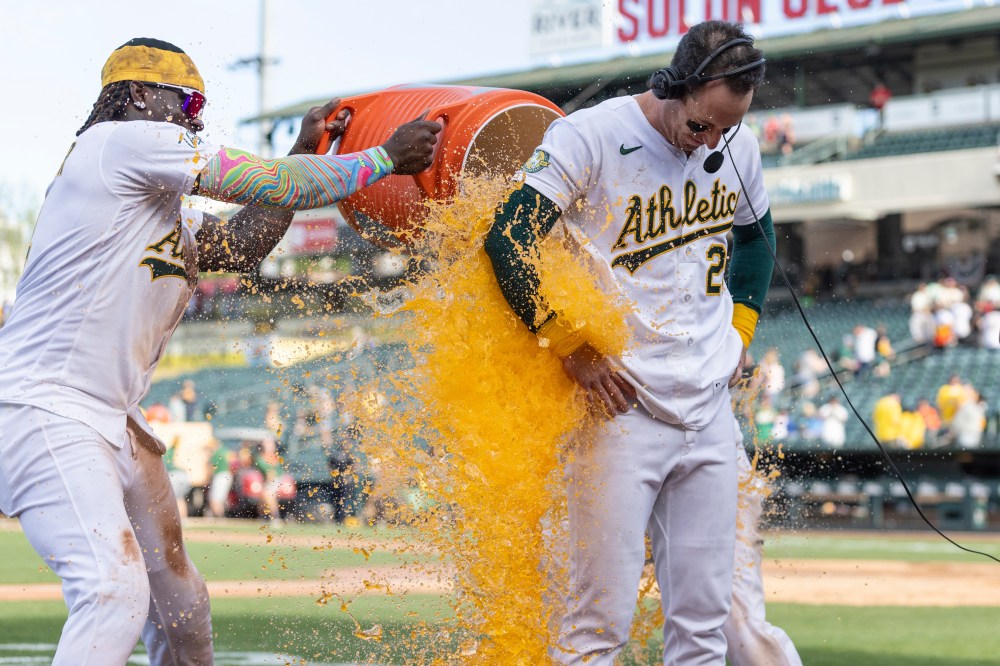
Athletics' Lawrence Butler, left, and Max Muncy dump Gatorade on Brent Rooker, right, after he hit a walk-off three-run home run during the tenth inning of a baseball game against the Houston Astros Sunday, April 5, 2026, in West Sacramento, Calif. (AP Photo/Sara Nevis)

“People are using these drinks more for wellness and daily maintenance,” Doggett said. “It’s easy to say that the wellness consumer is the young consumer, but older generations are also drinking these drinks for hydration.”

Unit sales of sports drink mixes, like powders from Liquid I.V., Skratch Labs and Gatorade, rose nearly 20% in the year ending March 22, according to Circana, a market research company. Bottled water sales were flat in the same period.

Crowded shelves

Sensing that growth potential, new sports and hydration brands are crowding store shelves. Mike Del Pozzo, president of U.S. beverages at PepsiCo, said 150 new brands have entered the space in the last few years.

“That puts a lot of risk on the category and pressure from a credibility perspective,” Del Pozzo said. “Some that are coming in are building on the science that we created. And we’re like, ‘Well, geez, we should be doing that. We should be talking more overtly about the science and the business and why we believe we’re future-forward.”

Del Pozzo said Gatorade will now clearly label products that it says can hydrate better or faster than water. A new drink, Gatorade Longer Lasting, which will go on sale next year, blends glycerin and electrolytes to help the body stay hydrated for longer than water alone.

PepsiCo’s approach with Gatorade echoes moves made by some of its rivals. Powerade, a sports drink owned by Coca-Cola Co., received brighter, clearer packaging in 2023 that promoted an increase in electrolytes. Last fall, Powerade began selling Power Water, a zero-sugar, electrolyte-enhanced drink aimed at non-athletes.

Liquid I.V., which was founded as a sports drink mix in 2012, was acquired by Unilever in 2020 and has remade itself into a wellness and hydration brand. LMNT also had non-athletes in mind last fall when it introduced a smaller, 12-ounce version of its sparkling electrolyte drink.

Sean Harapko, a beverage sector leader with Ernst & Young Americas, said consumers have so many beverage choices that companies must clearly define their products and explain why people should choose one over another. Americans are trying to live healthier lives, he said, but they’re collecting information from many different sources and defining for themselves what that looks like.

Gatorade’s origins
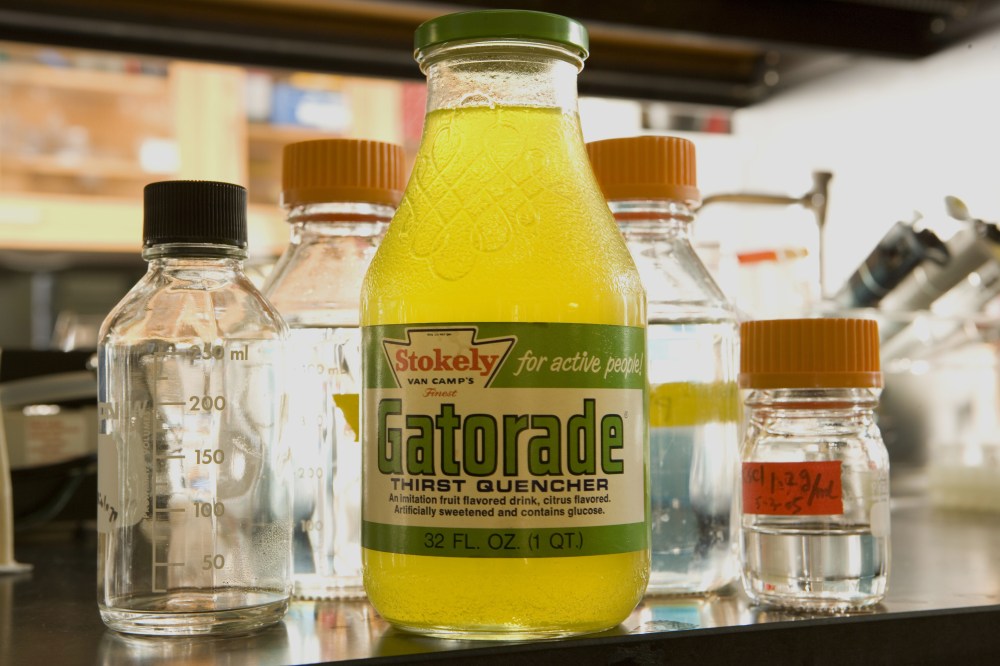
This undated photo provided by University of Florida Archives via PepsiCo on Friday, April 10, 2026, shows a Gatorade sports drink. (University of Florida Archives via PepsiCo via AP)

Gatorade was born in 1965, when the football coach at the University of Florida asked Dr. Robert Cade, a physician and professor at the school, why his players were losing so much weight during games but not urinating. Cade realized the players were sweating out electrolytes – another word for minerals like sodium, potassium and magnesium – and upsetting the body’s chemical balance.

Cade came up with Gatorade, a drink containing salt to replace electrolytes, sugar to improve energy and lemon juice for flavor. Quaker Oats acquired Gatorade’s parent company in 1983 and established the Gatorade Sports Science Institute two years later. PepsiCo became Gatorade’s owner when it bought Quaker Oats in 2000.

Del Pozzo said Gatorade will continue to meet athletes’ needs. Gatorade Thirst Quencher, for example, has 48 grams of sugar and 18% of the recommended daily amount of carbohydrates, which athletes need to maintain energy. But Del Pozzo notes that Gatorade Lower Sugar, which went on sale last month and has 75% less sugar, is one of the company’s biggest sellers in recent history.

Del Pozzo said lower-sugar versions aimed at non-athletes, as well as the removal of artificial colors from Gatorade’s lineup, is bringing customers into the brand.

“I think there were people that said, ’I didn’t exercise or I’m not out in the heat or I am not sweating.’ The reality is, everybody is sweating and dehydrated from the moment they wake up and many just don’t know it,” he said.

But Travis Masterson, an assistant professor at Pennsylvania State University’s College of Health and Human Development, said the average non-athlete gets the sodium they need from their diet. Athletes sometimes need a reminder to drink, he said, because their bodies are under stress. But for average people, the thirst signal is a good indicator.

“Gatorade 100% has a place, but is it going to be necessary for everybody? Do you need to hydrate faster or longer?” he said. “The average person doesn’t need all the extra stuff.”

Report Error Submit a Tip

More Stories

Gatorade, inventor of the sports drink, is getting a rebrand targeting non-athletes

Dee-ann Durbin, The Associated Press 5 minute read Preview

Gatorade, inventor of the sports drink, is getting a rebrand targeting non-athletes

Dee-ann Durbin, The Associated Press 5 minute read Thursday, May. 7, 2026

Sixty years after it invented sports drinks, Gatorade is making a surprising pivot: It’s no longer focusing primarily on athletes.

PepsiCo, Gatorade’s parent company, said Thursday that the brand wants to broaden its reach to non-athletes who are looking for ways to hydrate, whether they’re on a long flight, going for a walk or nursing a hangover. New packaging highlights the specific ways Gatorade’s various drinks and powders work and the research behind them.

The change reflects U.S. consumers’ booming interest in beverages with perceived health benefits. Jack Doggett, a food and drink analyst with the consulting firm Mintel, said his research indicates 60% of consumers who buy sports drinks aren’t athletes but want the functional ingredients those drinks provide, like electrolytes for hydration and carbohydrates for energy.

“People are using these drinks more for wellness and daily maintenance,” Doggett said. “It’s easy to say that the wellness consumer is the young consumer, but older generations are also drinking these drinks for hydration.”

Read
Thursday, May. 7, 2026

Piece of Winnipeg’s magic history disappears

Kelly-Anne Riess 5 minute read Preview

Piece of Winnipeg’s magic history disappears

Kelly-Anne Riess 5 minute read Saturday, Oct. 10, 2026

A piece of Winnipeg’s magic history has vanished, and internationally renowned escape artist Dean Gunnarson is offering a $500 reward to anyone who can make it reappear.

The plaque marked the birthplace of what has become the world’s largest organization of professional and amateur magicians, the International Brotherhood of Magicians, which was founded in Winnipeg more than a century ago.

Gunnarson said fellow magician and local magic historian Bruce Thompson discovered the disappearance Tuesday while on his way to work.

Thompson returned to inspect the site and found what appeared to be evidence it had been forcibly removed.

Read
Saturday, Oct. 10, 2026

Puzzles Palace

1 minute read Monday, Jul. 27, 2026

To solve our puzzles, please subscribe with this special offer: |

Collaros turns back the clock in crucial win over Stamps

Taylor Allen 7 minute read Preview

Collaros turns back the clock in crucial win over Stamps

Taylor Allen 7 minute read Yesterday at 7:14 PM CDT

It was around this time seven years ago that the Winnipeg Blue Bombers officially became Zach Collaros’s team.

Making his first start in blue and gold after being acquired via trade, Collaros ran backwards to escape a collapsing pocket before rolling to his right and firing a perfect pass to Darvin Adams in the back corner of the south end zone during a home game against the Calgary Stampeders.

The play marked the beginning of the Collaros era in Winnipeg.

And a similar play Saturday night, once again against the Stampeders, served as a reminder that the 38-year-old pivot isn’t done just yet.

Read
Yesterday at 7:14 PM CDT

Manitoba e-scooter legislation changes set to impose speed limit, age restrictions, sidewalk ban

Matthew Frank 5 minute read Preview

Manitoba e-scooter legislation changes set to impose speed limit, age restrictions, sidewalk ban

Matthew Frank 5 minute read Updated: Yesterday at 5:14 PM CDT

People riding e-scooters and other personal electric vehicles in Manitoba will have to strap on a helmet, stay off sidewalks and follow new age limits once new provincial rules for the devices take effect next year.

The vehicles, which also include electric skateboards, hoverboards and unicycles, will fall under The Highway Traffic Act starting in 2027, according to the province’s website. E-bikes are excluded from the new rules, according to the province’s frequently-asked-questions page.

All riders must be at least 16 years old and wear properly fitting helmets — that goes for passengers, too, the province said.

The proposed new legislation sets a speed limit of 25 km/h and would prohibit personal electric vehicles from sidewalks unless signs specifically allow sidewalk use. Riders would be using shared paths or roads with speed limits of 50 km/hr or less. They won’t be allowed to operate the vehicles under the influence of alcohol or drugs and they must use hand signals and obey traffic signs.

Read
Updated: Yesterday at 5:14 PM CDT

A Life's Story: Writer built bridges with genuine curiosity, compassion for diversity of religious practices

Janine LeGal 6 minute read Preview

A Life's Story: Writer built bridges with genuine curiosity, compassion for diversity of religious practices

Janine LeGal 6 minute read Saturday, Oct. 10, 2026

Brenda Suderman knew how to make people feel comfortable. For a journalist, that character trait is a real strength, and it made people trust and appreciate her.

Whether covering musicals, worship spaces, the effects of pandemic shutdowns, death rituals and practices of different traditions, the discovery of the burial of 2,284 infants in unmarked graves, or any other of the countless topics she wrote about in her four- decade career, Suderman did it with genuine interest and care.

Born and raised in Winkler, Suderman grew up on a farm. Much of her childhood was spent in gardens and sugar beet fields.

Baptized at 16, she became a member of the Winkler Bergthaler Mennonite Church. The restrictions against women at the time contributed to planting the seeds of Suderman’s feminist perspective.

Read
Saturday, Oct. 10, 2026