What to know about Cameroon’s separatist violence that the pope seeks to end
Advertisement
Read this article for free:
or
Already have an account? Log in here »
To continue reading, please subscribe:

Digital Subscription
One year of digital access for only $205*
- Enjoy unlimited reading on winnipegfreepress.com
- Read the E-Edition, our digital replica newspaper
- Access News Break, our award-winning app
- Play interactive puzzles
*First annual payment billed as $205.00 + GST for one year. This annual subscription will automatically renew at $233.00 + GST every 52 weeks (10% off the regular annual price of $259.35). Offer available to new and qualified returning subscribers only. Cancel any time.
To continue reading, please subscribe:
Add Free Press access to your Brandon Sun subscription for only an additional
$1 for the first 4 weeks*
- Enjoy unlimited reading on winnipegfreepress.com
- Read the E-Edition, our digital replica newspaper
- Access News Break, our award-winning app
- Play interactive puzzles
*Your next Brandon Sun subscription payment will increase by $1.00 and you will be charged $17.95 plus GST for four weeks. After four weeks, your payment will increase to $24.95 plus GST every four weeks.
Read unlimited articles for free today:
or
Already have an account? Log in here »
Hey there, time traveller!
This article was published 16/04/2026 (183 days ago), so information in it may no longer be current.
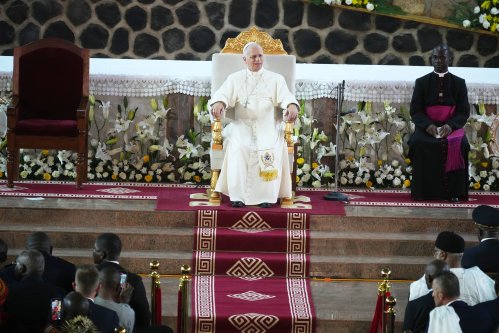
YAOUNDE, Cameroon (AP) — Pope Leo XIV arrived in Cameroon’s northwestern city of Bamenda on Thursday to lead a peace meeting in a region battered by separatist violence that has claimed thousands of lives since it started nearly a decade ago.
The event, which is part of the pope’s programs for his tour of four African nations, seeks to highlight the interfaith movement that has been seeking to end the conflict and care for its many traumatized victims.
Clashes have intensified in recent years between the government’s forces and separatist militias demanding secession from Cameroon, which comprises eight French-speaking regions and two English-speaking regions.

Here’s what to know:
What is the conflict about?
Cameroon’s western regions have been plagued by fighting since English-speaking separatists launched a rebellion in 2017 with the goal of breaking away from the French-speaking majority and establishing an independent state. The conflict has killed more than 6,000 people and displaced over 600,000 others.
It started in the aftermath of World War I, when Cameroon was split under British and French colonial control. At its independence in 1960-1961, the two territories reunited and formed a federal state, with the French-speaking section constituting about 80% both in territory and population.
The English-speaking population currently makes up about 20% of the roughly 30 million people and say they’re marginalized by the French-majority government under President Paul Biya, in power for over 40 years and currently the world’s oldest leader.
Tensions spiked in 2016 when the government attempted to impose French in English-speaking regions’ schools and courts, igniting protests that security forces violently repressed.
Separatist leaders based abroad
The conflict features various separatist groups whose leaders are mostly based abroad, many after being blacklisted by the Cameroonian government.
Analysts have said their cover abroad could be complicating peace effort at home because they would operate with ease to raise funds and issue instructions to their followers engaging with Cameroonian forces
In September 2024, Norway charged Lucas Ayaba Cho, commander of the Ambazonia Defense Forces, a key actor in the conflict, with incitement to commit crimes against humanity, an accusation he contested.
Last December, a federal jury in the U.S. convicted two individuals for conspiracy to provide funds and equipment to the separatist fighters.
In March, Belgium arrested four people as part of its investigations into Belgian residents suspected of being among the separatist leaders and raising money for the movement.
Military solution?
Cameroon’s government has taken several steps to address the violence, but a permanent solution still feels far off.
A national dialogue in 2019 led to the granting of special status to the northwest and southwest regions and proposals on governance, justice and education, but many such proposals have not been implemented. A disarmament, demobilization and reintegration program has also been faulted as lacking transparency and being limited in its reach.
The government at first viewed the conflict as an agitation by “a few misguided” groups in the Anglophone region, said Colbert Gwain Fulai, a civil society leader based in Bamenda.
It still does not acknowledge the marginalization claims and mostly frames the conflict as one more in need of a military solution than a political one, said Fulai.
The separatist leaders, meanwhile, seem “determined to double down, wagering on the absence of sustained peace efforts,” the Crisis Group said last year. Some have also developed cross-border alliances with separatists across the border in Nigeria who also seek to create an independent state.
Mixed feelings over the pope’s peace meeting
The pope’s visit and the peace meeting have been received with a mixed feeling of hope and doubt among residents and local leaders. That’s because such a peace meeting between the government and the separatists is rare, the last major one held in 2022.
Lucas Asu, a spokesperson for the Ambazonia Governing Council separatist group, said they are committed to a peaceful settlement of the conflict through dialogue and accused the government of avoiding talks.

Cameroonian authorities did not immediately respond to a request for comment.
Mother-of-three Morine Ngum, whose husband was shot dead as a separatist fighter in 2022, said any real progress must begin with the government.
“I see them (the government) using this crisis as an advantage. It brings them more profit. They just want to use this pope coming to cover up things,” Ngum said.
———
Asadu reported from Abuja, Nigeria.
The Free Press acknowledges the financial support it receives from members of the city’s faith community, which makes our coverage of religion possible.