‘News’ unfit to print Shaky sources, cooked-up quotes, ersatz imagery — welcome to your new AI-driven local media world
Read this article for free:
or
Already have an account? Log in here »
To continue reading, please subscribe:

Digital Subscription
One year of digital access for only $205*
- Enjoy unlimited reading on winnipegfreepress.com
- Read the E-Edition, our digital replica newspaper
- Access News Break, our award-winning app
- Play interactive puzzles
*First annual payment billed as $205.00 + GST for one year. This annual subscription will automatically renew at $233.00 + GST every 52 weeks (10% off the regular annual price of $259.35). Offer available to new and qualified returning subscribers only. Cancel any time.
To continue reading, please subscribe:
Add Free Press access to your Brandon Sun subscription for only an additional
$1 for the first 4 weeks*
- Enjoy unlimited reading on winnipegfreepress.com
- Read the E-Edition, our digital replica newspaper
- Access News Break, our award-winning app
- Play interactive puzzles
*Your next Brandon Sun subscription payment will increase by $1.00 and you will be charged $17.95 plus GST for four weeks. After four weeks, your payment will increase to $24.95 plus GST every four weeks.
Read unlimited articles for free today:
or
Already have an account? Log in here »
Emma Kelly and James Sinclair have been busy.
Over an eight-hour span on Monday, April 6, the correspondents for Boring News published 164 local news stories about dozens of communities across Canada — from British Columbia to Nunavut to Nova Scotia.
The pair has churned out tens of thousands of articles since the Boring News website launched in early December, including 3,600 stories about 24 different cities, towns and First Nations in Manitoba.
That’s a blistering workload for a news outlet with only two journalists. But Kelly and Sinclair aren’t journalists and they didn’t write these stories.
AI-generated images routinely appear in articles produced by Boring News, a tech-driven newcomer to the Manitoba media landscape.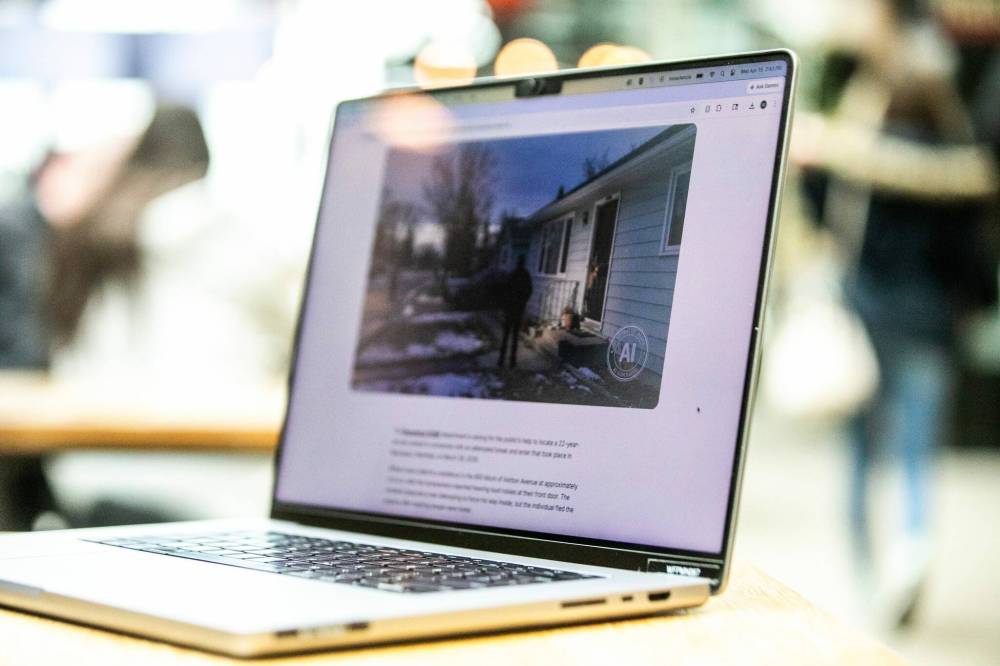
Kelly is the co-founder of Upfeat Media, a Winnipeg tech company that made its mark in online coupon aggregation and is now expanding into the growing artificial intelligence-powered news business. Her credentials include a degree in business studies from the University of Ulster and a postgraduate diploma in accounting.
Sinclair has worked periodically in content creation at Upfeat since 2018, according to his LinkedIn profile, and is currently a temporary contract employee.
These are the public faces of a technology company that has ushered in a fraught era of fake news in Manitoba — one that has the potential to disrupt the media landscape near and far.
Boring News is positioned as an altruistic alternative to mainstream media. Its landing page is minimalistic and interactive, with a snappy tagline: “No clickbait. Just the facts.”

The outlet also proclaims a lofty mission to “provide fact-driven coverage to hundreds of Canadian communities, many of which have limited or no access to local news.”
It’s a laudable goal considering the rapid decline of journalism nationally.
According to data from the Local News Research Project, more than 600 newspapers, radio stations and television outlets have closed in Canada since 2008, turning many rural and northern areas into news deserts devoid of credible local reporting.
Boring News claims to be working to mitigate this drought with factual, transparent coverage that reflects the perspectives of residents in the communities it serves, as stated in the company’s journalistic code.
In practice, however, the content regularly fails to clear that bar.
To capture a cross-section of the outlet’s coverage area in the province, the Free Press analyzed 270 stories about four communities in southern, central and northern Manitoba — Winkler, Beausejour, Norway House Cree Nation and Thompson — published to boringnews.ca and its sibling site thethompsonnews.ca in January.
All of the text and images were AI-generated and based on information pulled from publicly available online sources, such as government media releases, community event listings, social media posts and legitimate news articles.
The Free Press found numerous cases of inaccurate information, misleading headlines, fabricated quotes and questionable imagery.
Upfeat CEO and founder Matthew Tate is up front about the errors peppered throughout his news products.
Upfeat co-founder Emma Kelly (left) and CEO Matthew Tate in 2022.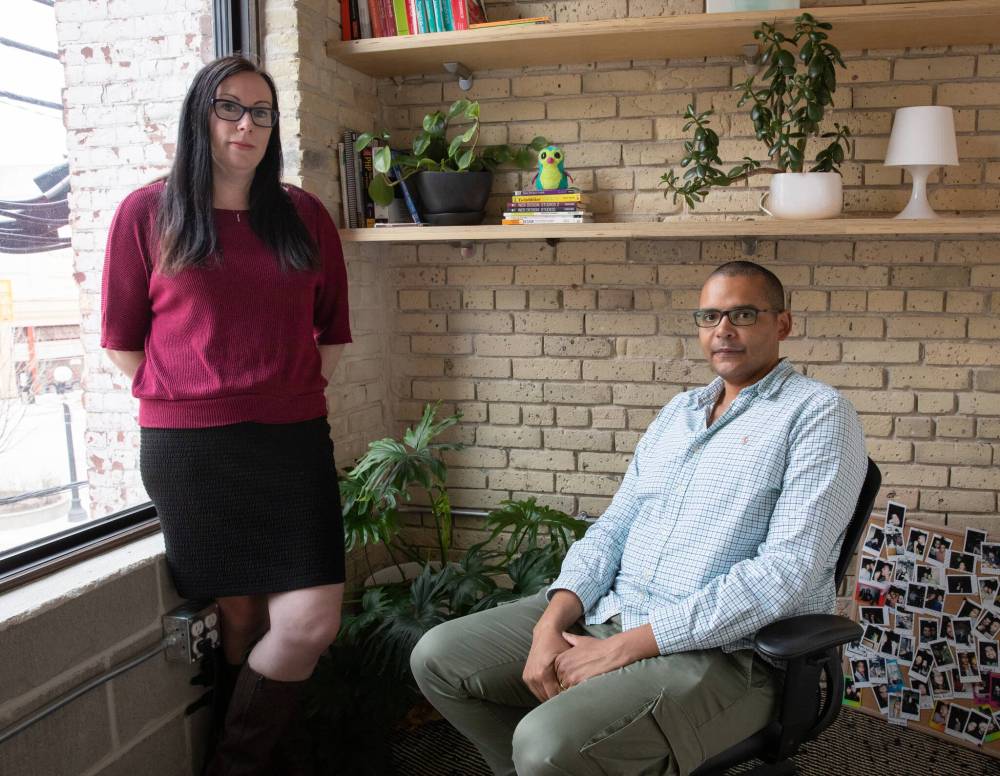
“AI is inherently inaccurate and the amount of work that we have to do to correct things is significant,” Tate said during an in-person interview at a Winnipeg coffee shop last week.
“In the last 90 days, we’ve done 17,000 stories, and there’s been 89,000 manual edits to those stories,” he said, noting Boring News has a staff of seven people, including Kelly and Sinclair.
That’s an error rate of about five per story, many of which are just a few hundred words in length or shorter. The site has also received corrections from readers who have discovered the content online.
Errors are expected due to the site’s infancy, said Tate, who describes Boring News as an experiment in the early stages of development, not as a full-fledged news product.
Yet, the website is publicly available online and often appears on the first page of Google results when searching for news related to the communities in its coverage zones.
It’s also promoted on the landing page of Upfeat’s website. In January, Tate made a LinkedIn post announcing the launch of Boring News, with no mention of its experimental nature.
At the same time, Upfeat has released identical Boring News-branded sites internationally and is generating content for 62 communities in the United Kingdom and 31 in Australia, in addition to the 101 locations in Canada.
“AI-assisted. Mostly accurate. Getting better every day.”
For Tate, launching despite known imperfections was imperative.
“Waiting for perfection before trying to do something useful felt like the wrong call,” he wrote in a followup email.
After the Free Press interviewed Tate on April 7, disclaimers were added to the bottom of every story and all of the content posted prior to February was deleted. Ambiguous references to Kelly’s and Sinclair’s reporting qualifications were removed.
The Boring News tagline was also updated to read: “AI-assisted. Mostly accurate. Getting better every day.”
The Free Press reached out to multiple people quoted and named in Boring News stories, none of whom were aware of the coverage.
“It’s a disconcerting feeling to have words attributed to you that you never said,” said Ashley Myers, director of library services at Brokenhead River Regional Library in Beausejour.
Ashley Myers, director of library services in Beausejour, was stunned to find out she was quoted in a Boring News story while never being interviewed.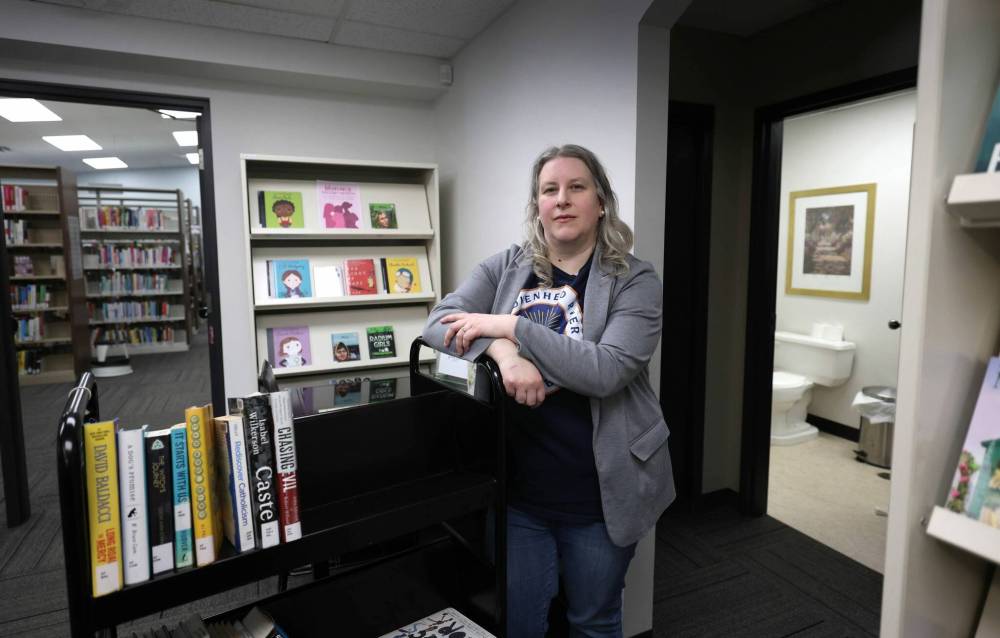
Myers was quoted in a Jan. 30 Boring News story about accessibility upgrades to the library’s washroom.
The article, which has since been deleted, included details about the project’s scope, likely pulled from a request for proposals, and a fake statement attributed to Myers that describes the renovation as being “about ensuring that a mother with a stroller or a veteran in a wheelchair can use our facilities with the same dignity as any other patron.”
The emotionally charged comment is “definitely not anything I would say, the way it’s written,” said Myers, speaking to the Free Press over the phone.
The story bore James Sinclair’s byline and was illustrated by an AI-generated approximation of an institutional-looking bathroom. The toilet was surrounded by six inconvenient grab bars, with a secondary sink in the hallway. An empty wheelchair was stationed outside the door.
The image was a far cry from the simple universal bathroom at the Brokenhead library.
“They’re not even using real pictures from the community or doing any kind of groundwork that actually gives you real information about the community,” Myers said.

Boring News has targeted areas with none or a small number of local news outlets. The venture’s goal is volume.
“The only way Boring News works is if we can cover as many communities as possible,” Tate said.
Angela Misri is an assistant professor of journalism at Toronto Metropolitan University who studies AI and the news. She describes Boring News as AI news slop and expects to see much more slop coming online over the next few months as tech start-ups try to capitalize on new AI developments.
“Local news is unfortunately going to be competing with that until things settle out,” said Misri, who is also co-director of the Local News Research Project. “It’s going to become way worse before it becomes better.”
While chatbots, designed to simulate human conversation, led the mainstream AI revolution, AI agents (a.k.a. agentic interfaces) are at the forefront heading into the next frontier.
These systems work autonomously and have the ability to execute complex tasks, make decisions and predict answers without human input. Agentic interfaces use large language models, or LLMs, which are trained on vast amounts of text pulled from books, articles and other sources of human writing. Some major tech startups have been sued for the unauthorized use of copyrighted material in their AI training models.
“It’s going to become way worse before it becomes better.”
Boring News is powered by Borealis, Upfeat’s agentic AI tool designed to scan the web for ideas and is touted for its ability to produce fully formed stories “faster than any human could.” The company asserts the content is then reviewed by a real human prior to publication.
Upfeat is also selling subscriptions to its Newsroom Agent — a simplified version of Borealis geared towards individual journalists, newsrooms and content creators. Subscriptions are priced at between $99 and $999 a month.
The Free Press signed up for a free trial to test how the Newsroom Agent functions.
To get started, users can compile a list of websites pertinent to their beats or they can ask the AI to do so. The agent monitors those links for new information and creates story suggestions complete with headlines, coverage angles and background research pulled from other online sources. Users can then generate stories for publication. The entire process takes minutes.
Misri says that while AI can have useful applications in journalism, she doesn’t see the value in a tool that scrapes publicly available information from the internet. She believes newsrooms would be better served by products that can create transcripts and parse data.
“That’s what I would be spending my time and money on,” she said.
In testing, the Free Press found Upfeat’s Newsroom Agent had poor news judgment and poor fact-checking abilities, often including outdated, incorrect or unrelated information in background research.
It also had a tendency to turn paraphrased comments into direct quotes. If asked to generate a news story with quotes when none existed, the software invented them.
“It’s misinformation. In politics, it’s so finicky, the wording of things…”
These same issues persisted in Boring News articles reviewed by the Free Press, many of which have since been scrubbed from the site.
In a Jan. 16 Boring News story about measles vaccinations, Norway House residents were directed to the Norway House Indian Hospital, a facility that closed last September. An article about Winkler’s library referred to a staff member who had retired months earlier. Another confused the Beausejour Senior Hockey League in the Maritimes with a league in Manitoba.
Statements from unidentified officials appeared regularly. Headlines often framed regional news as hyper-local events, such as provincial funding announcements with no connection to the location referenced in the story.
Ike Friesen, reeve of the RM of Stanley, expressed concerns about the website’s accuracy after viewing several stories about Winkler, which is surrounded by his southern Manitoba municipality. The articles about bylaw changes, farm grants and census participation contained mismatched details from multiple sources, he said.
“It’s misinformation,” Friesen said. “In politics, it’s so finicky, the wording of things… you have to put the right context and words out there and the correct information so you don’t stir up issues in the community.”
Coverage by The Thompson News was of equally low quality.
Upfeat launched The Thompson News in January 2025 as a pilot project. The homepage has the look and feel of a legitimate news site, with a masthead, a carousel of top news items and web sections dedicated to different topics.
Potentially libellous
The site is the third Google result when searching for “Thompson, Manitoba,” appearing just below the City of Thompson’s website.
Much of the content is similar to that of Boring News: weather updates, garbage and recycling schedules, community events, job postings.
There were also stories pulled from social media and framed as news, some of it potentially libellous.
A Jan. 12 article, which has been deleted, detailed a heated conversation on a community Facebook group about a Thompson auto dealership. The business was named and complaints containing allegations of wrongdoing were republished anonymously. A disclaimer confirmed the information had not been verified.
Another story posted a week later hailed a local welding company’s heroic roadside repair of a customer’s trailer. The source? A glowing customer testimonial on the company’s website.

The majority of images on Thompson News are AI-generated. Despite Upfeat’s assertion that it does not use AI “to create ‘fake’ news photos of specific local crimes, accidents or events,” the Free Press found the opposite to be true.
Many of the visual hallucinations on the thompsonnews.ca and boringnews.ca sites are absurd: a dirty janitor’s broom sweeping a curling rock, disembodied arms packing grocery bags, construction workers fixing curbs with their hands.
Others are ghoulish, depicting the aftermath of deadly highway car crashes, police raids and First Nation residents fleeing wildfires. Stories about Indigenous communities were often paired with culturally inappropriate imagery — such as West Coast Salish-style artwork or a ribbon skirt made to look like a knee-length tutu.
The Free Press also found examples of fictional public officials, including a politician with a strong resemblance to Premier Wab Kinew. The only images on Thompson News verified to be real were mugshots of crime suspects and photos of missing persons provided by the RCMP.
While Thompson News images were clearly labelled as AI-generated, the ones on the Boring News site were not. Upfeat has started adding AI watermarks since it was contacted by the Free Press.
“We’re not trying to mislead people,” Tate said of the images and the decision to forgo AI labels with Boring News. “It’s just a question of, like, do we put effort into that, or do we put effort into making sure that, as much as possible, our stories are factually correct?”
None of the articles reviewed contained original reporting. The most accurate and highest quality content was often based on coverage by legitimate local news organizations, such as the Free Press, CBC Manitoba and Global News, with credit given inconsistently.
In January, the Winnipeg Sun republished stories and images from Thompson News on its website. The content has since been removed and the details of the partnership are unclear. Sun publisher Kevin Klein did not respond to requests for comment.
Boring News regularly pulls quotes and ideas from PembinaValleyOnline, a regional outlet operated by Golden West Broadcasting, which has radio stations and news websites in five rural Manitoba communities.
Golden West president Brett Adnum isn’t surprised an AI-generated news site has cropped up in Manitoba. Like many in the news industry, Adnum is keeping a close eye on the potential benefits and pitfalls of AI.
“It can certainly help us be able to do more, but it’s not going to ever replace our reporters that live in the community,” he said. “AI is not going to be calling up the mayor and… getting an original interview.”
Adnum doesn’t consider Boring News a competitor and he doesn’t believe an AI news site would get much traction in rural areas, where local connections are paramount.
“They’re not trusted,” he said.
“AI is not going to be calling up the mayor and… getting an original interview.”
Recent polling by Probe Research showed that more than half of Manitobans hold a negative view of AI. Another Probe poll commissioned by the Free Press found that Manitobans have a relatively high level of trust in local, Canadian-owned news sources, with most believing their communities function better with the presence of strong local news outlets.
Regardless of public opinion, news remains an attractive business model for tech entrepreneurs.
The AI boom is taking place within the context of the attention economy, which has turned clicks, views and online engagement into a commodity. To compete with search engines and social media platforms, AI companies need to provide users with high-quality information.
But that information is expensive to produce.
News organizations are huge drivers of original online content. They cover breaking news events, analyze current affairs and investigate topics of public interest — all of which require significant investments of time, money and staff.
“Journalism is at its core a human craft,” said Brent Jolly, president of the Canadian Association of Journalists.
Without human oversight, he added, AI news sites run the risk of eroding public trust in journalism.
“When you take shortcuts or try to circumvent practices and standards, things will go wrong,” Jolly said. “And when the public sees that, I worry that they won’t distinguish between what these sites do and what real bona fide news organizations do.”
“I worry that they won’t distinguish between what these sites do and what real bona fide news organizations do.”
Legacy media companies have struggled to adjust financially as the traditional advertising-based business model has collapsed, leading to mass layoffs and closures across the industry.
By cutting out the expense of human reporters, AI news companies can offer their product for free and operate with fewer overhead costs, which can be further subsidized through the sale of online advertising.
Both of Upfeat’s news products promote ad opportunities and business partnerships, but neither website has turned a profit, said Tate, who is guarded about the business model.
“If we can make something that actually matters to people and is useful to them, then I think revenue falls from that. It’s not really a great business plan, to be honest with you,” he said.
During his interview with the Free Press, Tate blamed the issues with his news products on a lack of resources.
Upfeat launched in 2015 and was named one of Canada’s top growing companies in 2022 by the Globe and Mail, which pegged its revenue at between $10 and $25 million at the time.
If left unchecked, AI-generated news could pose an existential threat to democracy, according to Aengus Bridgman, director of the Media Ecosystem Observatory, which studies the impact of digital media on Canadian society.
“Simply put, AI models and the way that they package and provide news strips all of the value from the original journalism, and so the incentive for original journalism collapses,” said Bridgman, a Winnipeg-born associate professor at McGill University.
“If at some distant point in the future people become misinformed or uninformed at scale, democracy stops working,” he said.
Aengus Bridgman, director of the Media Ecosystem Observatory, warns that AI’s erosion of traditional journalism’s values is a threat to democracy.
The MEO recently released the findings of a large-scale audit of how AI models ChatGPT, Gemini, Claude and Grok use and distribute Canadian journalism.
The study found that while these models absorb and regurgitate large amounts of Canadian news, they rarely credit or push users back to those primary sources of information, effectively stealing content and traffic from legitimate news sites.
Bridgman said tech entrepreneurs should consider the possible downstream effects of this practice. If original journalism continues to be degraded, the information available to AI bots will be of increasingly lower quality, threatening the usefulness of AI itself.
“If you’re not in the business of production, you’re in the business of extraction. And you’ve got to think carefully about that,” he said.
“This is a responsibility and you have to be intentional in your information consumption.”
Tate sees his creations as more virtuous than those of other tech companies.
“The reality is that AI-generated misinformation is already out there. Bots are already producing content at scale on social media, reaching orders of magnitude more people than we do,” he wrote in an email. “…That’s the landscape we’re operating in. We didn’t create it, but we’re trying to do something more responsible within it.”
To address the proliferation of AI news sites, Bridgman and the MEO recommend the federal government add AI companies to Bill C-18, the Online News Act, which requires major digital platforms to pay Canadian news outlets for use of their content. When the act was introduced in 2023, Meta retaliated by blocking Canadian news on its social media platforms, including Facebook and Instagram. The block continues today.
Other suggestions include updating the copyright act to address AI training and creating regulatory guardrails that dictate how AI models credit source material.
For consumers of news, Bridgman advises voting with your views.
“This deeply matters,” he said. “This is a responsibility and you have to be intentional in your information consumption.”
— with files from Marsha McLeod
eva.wasney@freepress.mb.ca
How this story was produced
The Free Press became aware of Boring News and The Thompson News in January.
Reporters Eva Wasney and Marsha McLeod analyzed all the stories published that month about four Manitoba communities to create a record of factual errors and quotes attributed to named individuals.
Questionable content was fact-checked against its source material, with some organizations contacted directly when no source could be found.
A number of people named, quoted at length or connected to the subject matter of stories were contacted for interviews. The Free Press also reached out to experts in journalism, artificial intelligence and digital media for their assessment of Upfeat’s news products. Interviews were conducted over the phone, via Zoom and in-person.
Those who did not respond to requests for comment were, in some cases, contacted more than once.
Interviews were transcribed using an AI transcription service. Quotes were reviewed and confirmed with the original recording prior to inclusion.
Staff and freelance photographers captured original images to illustrate the story, including Free Press photographer Ruth Bonneville, who travelled to Beausejour to photograph the town’s library. News photos aim to reflect real-world events and people, as such only minor colour correcting and toning is allowed. Removing or generating content is a no-no.
A minimum of three editors read and proofed this story prior to publication. It was laid out for print by a graphic designer and assembled for the web by a member of the digital news team.

Eva Wasney covers environmental issues in Manitoba for The Narwhal in partnership with the Winnipeg Free Press. Read more about Eva.
Every piece of reporting Eva produces is reviewed by an editing team before it is posted online or published in print — part of the Free Press‘s tradition, since 1872, of producing reliable independent journalism. Read more about Free Press’s history and mandate, and learn how our newsroom operates.
Our newsroom depends on a growing audience of readers to power our journalism. If you are not a paid reader, please consider becoming a subscriber.
Our newsroom depends on its audience of readers to power our journalism. Thank you for your support.
History
Updated on Friday, April 17, 2026 9:25 AM CDT: Changes web headline
Updated on Friday, May 1, 2026 12:05 PM CDT: Corrects Sinclair's job status; clarifies responses to request for comment