

Mustard farmers face cross-pollination risk

Advertisement
Read this article for free:
or
Already have an account? Log in here »
To continue reading, please subscribe:
Monthly Digital Subscription
$1 per week for 24 weeks*
- Enjoy unlimited reading on winnipegfreepress.com
- Read the E-Edition, our digital replica newspaper
- Access News Break, our award-winning app
- Play interactive puzzles
*Billed as $4.00 plus GST every four weeks. After 24 weeks, price increases to the regular rate of $19.95 plus GST every four weeks. Offer available to new and qualified returning subscribers only. Cancel any time.
Monthly Digital Subscription
$4.99/week*
- Enjoy unlimited reading on winnipegfreepress.com
- Read the E-Edition, our digital replica newspaper
- Access News Break, our award-winning app
- Play interactive puzzles
*Billed as $19.95 plus GST every four weeks. Cancel any time.
To continue reading, please subscribe:
Add Free Press access to your Brandon Sun subscription for only an additional
$1 for the first 4 weeks*
*Your next subscription payment will increase by $1.00 and you will be charged $16.99 plus GST for four weeks. After four weeks, your payment will increase to $23.99 plus GST every four weeks.
Read unlimited articles for free today:
or
Already have an account? Log in here »
Genetically modified crops may have gained widespread adoption among farmers since their introduction 30 years ago, but they remain a polarizing force within the farming community.
Because GM technology still struggles to achieve full market acceptance, many farmers reap the benefits at the expense of a few others who lose relatively small but important markets.
For example, nearly 100 per cent of the commercial canola produced in Canada comes from varieties that are herbicide-tolerant, which is most often a result of GMO traits.
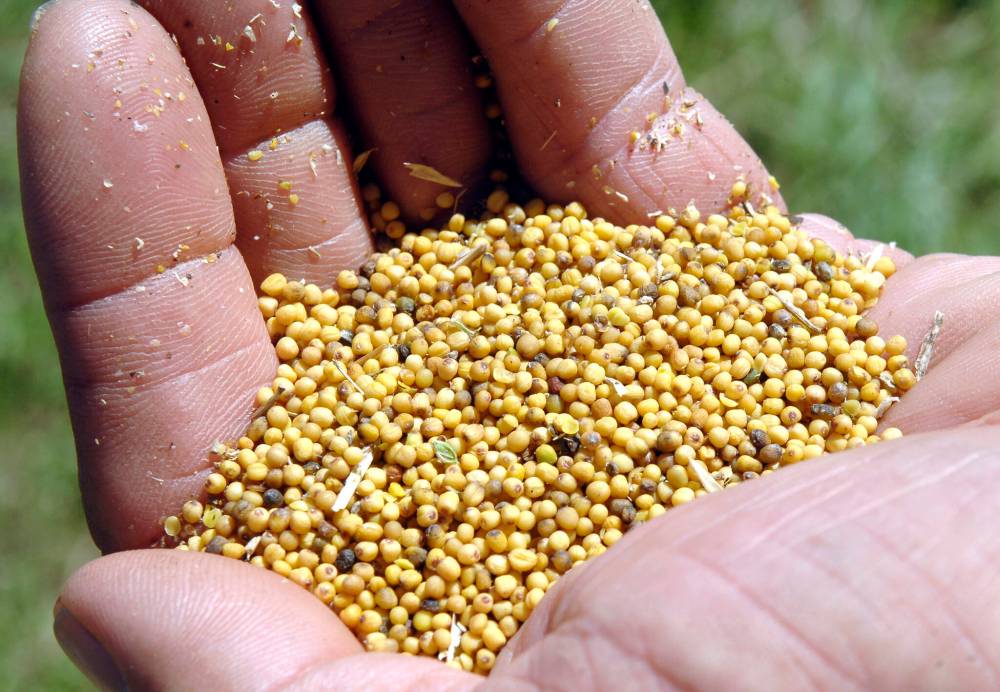
Mike McCleary / The Associated Press files
A new genetically modified canola has the potential to push into areas previously too hot and dry for it — areas mustard (above) thrives in.
Their widespread use makes it impossible for organic farmers to grow canola that is certifiably free of GM contamination, thanks to Prairie winds that move pollen easily from one field to another.
So organic farmers have given up trying to grow canola, even though serving the organic market would be lucrative and having the crop in their rotation would help them manage weeds and disease.
Some have turned to growing mustard instead, a close relative to canola in the Brassica family and sold into the condiment industry to slather on hot dogs and many other food items.
Mustard is also a popular crop among regular farmers (who grow using herbicides) located primarily in southern Saskatchewan. Growing conditions there tend to be hotter and drier than canola prefers. Brown and oriental mustard varieties thrive under such conditions.
Canada now produces nearly half of the global supply of mustard and is the world’s leading exporter, with sales of around $200 million. Granted, that’s peanuts compared to Canada’s $43-billion canola industry — but not for the affected farmers.
Mustard farmers are currently facing off against their canola-growing neighbours and multinational chemical giant BASF over the pending release of a herbicide-tolerant canola variety that has borrowed genes from its mustard cousin to be better adapted to hot, dry growing conditions.
Called InVigor Gold, this GM canola potentially expands the canola-growing area in Western Canada to include droughty southern Saskatchewan and Alberta growing conditions. That’s a boon to the canola sector, which is chronically short of supply.
But the risk of cross-pollination with regular mustard varieties is high, which could lock Canadian mustard exports out of key markets in the European Union and Japan that so far have refused to budge on their unwillingness to accept GMOs into their food chain.
What to do about it was a hot topic on the winter meeting circuit this year, particularly among Prairie mustard growers.
With publicly funded research in decline, producers know it’s a dangerous game to ask companies investing in research and development to back off. The risk is they will take those investments elsewhere, leaving farmers short of varieties suited to this region’s growing conditions and climate.
Canada’s regulatory system for new crop technologies reviews the scientific evidence to determine whether they pose a risk to food, livestock feed or the environment. But it doesn’t consider market acceptance.
Farmers have collectively in the past pushed companies developing GM crops to pause new options because of the risk to export markets. Wheat genetically modified to tolerate applications of glyphosate was shelved in the early 2000s because the market risk outweighed the potential benefits.
The flax industry tried to put a genetically modified variety called Triffid back into the bottle in the late 1990s for the same reasons, even though it had been through the regulatory process and approved for production.

Traces of it mysteriously surfaced in flax exports a decade later, creating a trade crisis because of many customers’ zero-tolerance for its presence in their shipments.
Given the potential sales to canola growers, it’s unlikely the mustard growers’ concerns will be enough to convince BASF to back away from Invigor Gold. According to industry reports, the company expects to release these varieties into the U.S. market within the next couple of years and potentially bring it to Canada by 2030.
It’s equally unlikely that markets still refusing to accept genetically modified crops will suddenly change their minds. It’s a case of the customer is always right — even if it doesn’t make sense. They are the buyer.
With no compromise in sight, some farmers will win. Others will lose.
Laura Rance-Unger is editor emeritus for Glacier FarmMedia. She can be reached at lrance@farmmedia.com
Laura Rance is editorial director at Farm Business Communications.
Our newsroom depends on a growing audience of readers to power our journalism. If you are not a paid reader, please consider becoming a subscriber.
Our newsroom depends on its audience of readers to power our journalism. Thank you for your support.
Laura Rance is editorial director at Farm Business Communications.
Our newsroom depends on a growing audience of readers to power our journalism. If you are not a paid reader, please consider becoming a subscriber.
Our newsroom depends on its audience of readers to power our journalism. Thank you for your support.
Advertisement Advertise With Us
Advertisement Advertise With Us