

Nurse practitioners fill void as menopause clinic to open in 2027

Advertisement
Read this article for free:
or
Already have an account? Log in here »
To continue reading, please subscribe:

Digital Subscription
One year of digital access for only $205*
- Enjoy unlimited reading on winnipegfreepress.com
- Read the E-Edition, our digital replica newspaper
- Access News Break, our award-winning app
- Play interactive puzzles
*First annual payment billed as $205.00 + GST for one year. This annual subscription will automatically renew at $233.00 + GST every 52 weeks (10% off the regular annual price of $259.35). Offer available to new and qualified returning subscribers only. Cancel any time.
To continue reading, please subscribe:
Add Free Press access to your Brandon Sun subscription for only an additional
$1 for the first 4 weeks*
- Enjoy unlimited reading on winnipegfreepress.com
- Read the E-Edition, our digital replica newspaper
- Access News Break, our award-winning app
- Play interactive puzzles
*Your next Brandon Sun subscription payment will increase by $1.00 and you will be charged $17.95 plus GST for four weeks. After four weeks, your payment will increase to $24.95 plus GST every four weeks.
Read unlimited articles for free today:
or
Already have an account? Log in here »
Some Manitoba women are paying close to $400 to access medically necessary menopause treatment from nurse practitioners who aren’t funded by the province.
“It’s a needed service that has plenty of gaps to access,” said Ashley Carruthers, chief executive officer of the Nurse Practitioners Association of Manitoba.
Premier Wab Kinew acknowledged the need at a news conference Monday to announce a $5.2-million plan to revive the menopause clinic by fall of 2027.
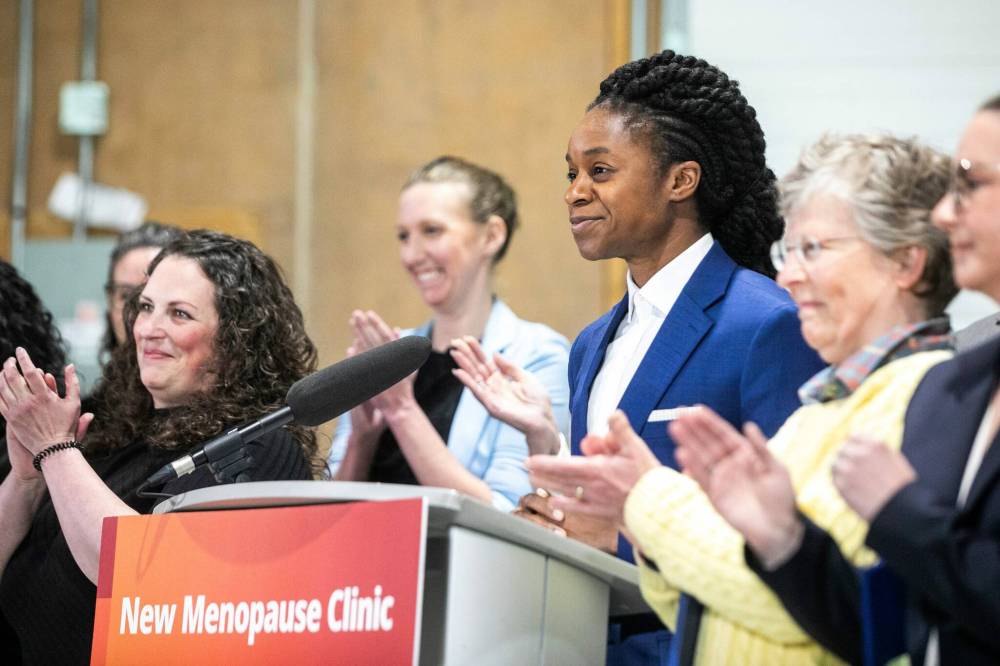
MIKAELA MACKENZIE / FREE PRESS
Health minister Uzoma Asagwara, pictured at the announcement of the future Manitoba Menopause Clinic on Monday, says nurse practitioners around the province will be “integral” to the new clinic, but wouldn’t commit to a new funding model for nurse practitioners.
For now, many women must wait for access to treatment or pay a nurse practitioner.
Winnipeg’s Menopause Practice Inc. has five nurse practitioners who treat close to 4,000 women. It charges $385 for an initial appointment and $250 for the first follow-up visit.
“There’s definitely the demand,” clinic co-founder and director Melina Elliott said Wednesday.
“We hear that their family doctors aren’t really able to provide them with the guidance that they’re looking for; there’s a long wait oftentimes if they’re getting referred to someone else.”
Elliott said she’s not worried about competition from the provincial clinic expected to open next fall because the need is so great.
“Women make up 51 per cent of the population. Every one of us will go through menopause at some point in our lives.” She welcomed the province funding hormone replacement therapy to menopausal women and said she looks forward to the opening of the provincial menopause clinic in south Winnipeg.
“As women, we need to be able to access practitioners who are knowledgeable and experts in this to help support us through this time in our lives,” Elliott said. “We shouldn’t be white-knuckling it through 15 years of our life. We should be able to thrive in this time.”
Carruthers said the province should come up with a funding model for nurse practitioners who provide menopause care.
“They’ve made known that they see value in menopause health care, but they’re not offering any solutions to help those patients that are seeing a nurse practitioner, so that they don’t pay out of pocket,” the nurse practitioner said.
“They see it as an equivalent to necessary care, because otherwise why would they be spending millions of dollars on creating a clinic that focuses on that population?”
Health Minister Uzoma Asagwara said nurse practitioners around the province will be “integral” to the new provincial menopause clinic and part of a multidisciplinary team. “No matter where women live in Manitoba, they’re going to be connected to menopause (care),” the minister said in an interview Wednesday.
The nurse practitioners who charge patients for menopause care have stepped up to fill a “massive void” that was created when the former Progressive Conservative government closed the Mature Women’s Centre nearly a decade ago, Asagwara said.
“Our government has stepped already in many ways to right those wrongs and to invest in women’s health care,” said Asagwara, who wouldn’t commit to a new funding model for nurse practitioners who provide primary care.
A new interpretation of the Canada Health Act that took effect April 1 requires provinces to ensure that patients aren’t charged for medically necessary care when a service would otherwise be covered if provided by a physician. Health funding transfers could be clawed back if a province doesn’t comply.
Asagwara said that won’t happen in Manitoba.
“Our commitment is to make sure that we align with the Canada Health Act. We believe in a strong, universal public health-care system,” the minister said.
“We also know that it’s so important to work with all of our health-care provider partners to make sure that health care is accessible and that it is meeting the needs of Manitoba women. That’s the approach we’re going to continue to take.”
Other provinces recognize the value of having nurse practitioners provide primary care and have updated their funding models, Carruthers said.
“It’s clear that there’d be less money involved,” she said. “We’re seeing it in Ontario, we see it in Alberta, we see it in Saskatchewan and, now, Newfoundland. It’s just amazing that we’re going to be the last province standing that’s not going to recognize the need as well as the value of the nurse practitioner and how they can close some of these fractured gaps that we have in health care.”

An estimated 130,000 to 150,000 Manitobans don’t have a primary care provider. Because of outdated funding models, the province is failing to fund nurse practitioners for essential services that would otherwise be publicly covered if provided by a physician, Carruthers said.
“We’re neglecting to see who can provide that care and how it can be provided to help to serve women of all ages,” she said.
The province should fund nurse practitioners for providing primary care to Manitobans, said PC health critic Kathleen Cook.
If Manitoba doesn’t come up with a funding model to pay for their services, it risks losing skilled nurse practitioners to other provinces, said Cook.
carol.sanders@freepress.mb.ca
Carol Sanders
Legislature reporter
Carol Sanders is a reporter at the Free Press legislature bureau. The former general assignment reporter and copy editor joined the paper in 1997. Read more about Carol.
Every piece of reporting Carol produces is reviewed by an editing team before it is posted online or published in print — part of the Free Press‘s tradition, since 1872, of producing reliable independent journalism. Read more about Free Press’s history and mandate, and learn how our newsroom operates.
Our newsroom depends on a growing audience of readers to power our journalism. If you are not a paid reader, please consider becoming a subscriber.
Our newsroom depends on its audience of readers to power our journalism. Thank you for your support.
Carol Sanders
Legislature reporter
Carol Sanders is a reporter at the Free Press legislature bureau. The former general assignment reporter and copy editor joined the paper in 1997. Read more about Carol.
Every piece of reporting Carol produces is reviewed by an editing team before it is posted online or published in print — part of the Free Press‘s tradition, since 1872, of producing reliable independent journalism. Read more about Free Press’s history and mandate, and learn how our newsroom operates.
Our newsroom depends on a growing audience of readers to power our journalism. If you are not a paid reader, please consider becoming a subscriber.
Our newsroom depends on its audience of readers to power our journalism. Thank you for your support.
Related Articles
NDP announces menopause clinic to open next year




Advertisement Advertise With Us
Advertisement Advertise With Us