

Where did political ethics go?
Advertisement
Read this article for free:
or
Already have an account? Log in here »
To continue reading, please subscribe:
Digital Subscription
One year of digital access for only $1.44 a week*
- Enjoy unlimited reading on winnipegfreepress.com
- Read the E-Edition, our digital replica newspaper
- Access News Break, our award-winning app
- Play interactive puzzles
*Billed as $5.77 plus GST every four weeks. After 52 weeks, price increases to the regular rate of $19.95 plus GST every four weeks. Offer available to new and qualified returning subscribers only. Cancel any time.
To continue reading, please subscribe:
Add Free Press access to your Brandon Sun subscription for only an additional
$1 for the first 4 weeks*
- Enjoy unlimited reading on winnipegfreepress.com
- Read the E-Edition, our digital replica newspaper
- Access News Break, our award-winning app
- Play interactive puzzles
*Your next Brandon Sun subscription payment will increase by $1.00 and you will be charged $17.95 plus GST for four weeks. After four weeks, your payment will increase to $24.95 plus GST every four weeks.
Read unlimited articles for free today:
or
Already have an account? Log in here »
Somewhere along the line, politicians have learned that they can lie with impunity. Not just being misleading or dissembling or answering questions evasively, but outright lying.
Lying and cheating used to be disqualifying for politicians — now, it seems to be a new skill.
Perhaps it’s something politicians in Canada are learning from the success of U.S. politicians like President Donald Trump — that if you lie brazenly and repeatedly enough, enough people will believe you to elect you and keep you in office.
The Canadian Press files
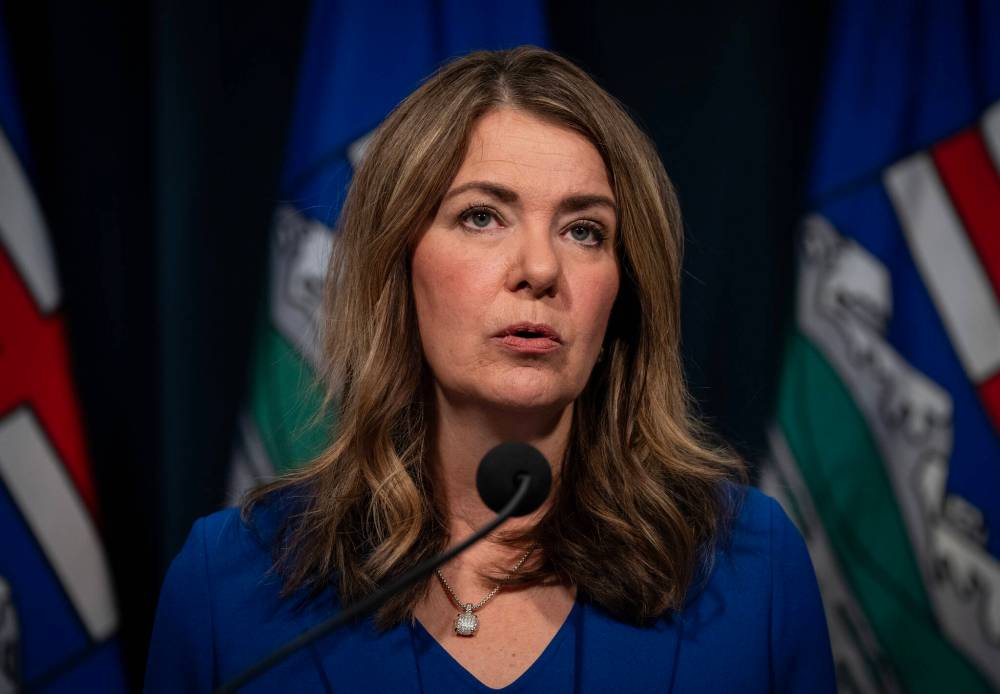
Alberta Premier Danielle Smith
More and more, even in Canada, politicians are becoming almost imperial in their use of power — even moving to exercise self-created powers that politicians from earlier times would be ashamed to be caught using.
Part of it may be the result of a shrinking and ever-more fragmented media: politicians are no longer as effectively called to account for their misdeeds because a significant number of citizens get their information online, often through social media, and often from providers who have their own agendas for what they choose to cover.
Another part may be the fact that it can be extremely expensive to launch a legal action against a provincial government.
Yet another cause may be simple indifference to politics and governance on the part of Canadians.
By far, the best example of the worst is in Alberta, with the government of Danielle Smith now importing another recent method from south of the border.
Unsatisfied with the results of an independent committee tasked with redrawing Alberta’s electoral map, Smith is planning to install a committee controlled by her own government members to redraw the map on their own. This, after the original committee heard from thousands of Albertans about the way they thought the map should be redrawn.
Increasing population in Calgary meant that the area should have more seats, because it’s unfair to have a vote in one seat count for more than a vote in a different seat: for that reason, districts, urban or rural, have comparable population numbers. But the committee was also limited by the government to making a maximum of 89 electoral districts — meaning to preserve fairness, there would be increased seats in urban Alberta, while rural Alberta would lose two seats.
Traditionally, such commissions make a unanimous report, and the legislature accepts it. In this case, two committee members picked by Smith’s UCP issued a minority report, and Smith is not willing to accept the majority report.
Smith argues that her concerns are to “preserve representation in rural Alberta,” which is, surprise, surprise, the area where the UCP finds the heart of their support.
There’s a reason why such redistricting commissions are independent: it keeps government insiders from redrawing the maps in their own favour.

The process of rigging electoral districts is known as gerrymandering, and in U.S. politics, it’s led to electoral districts that meander all over the map to ensure the government of the day protects its own interests, not the interests of voters as a whole.
It’s past time that we find a way to rein in governments that brazenly put their own interests ahead of the public they were elected to serve. They are answerable to us, and should answer — honestly, fairly and despite what those answers mean to their future electability.
Think of it this way: we elect politicians to govern for the term that they are elected to govern. That’s it.
Then an election comes along, and we do it all over again.
Anyone we do elect should be doing the very best they can to represent our interests during their term — but they should not be using any means possible, ethical or not, to ensure that they will be elected the next time, and the time after that.