Honolulu Traffic Cams Catch Speeders. But Most Don’t Get Tickets
Advertisement
Read this article for free:
or
Already have an account? Log in here »
To continue reading, please subscribe:

Digital Subscription
One year of digital access for only $205*
- Enjoy unlimited reading on winnipegfreepress.com
- Read the E-Edition, our digital replica newspaper
- Access News Break, our award-winning app
- Play interactive puzzles
*First annual payment billed as $205.00 + GST for one year. This annual subscription will automatically renew at $233.00 + GST every 52 weeks (10% off the regular annual price of $259.35). Offer available to new and qualified returning subscribers only. Cancel any time.
To continue reading, please subscribe:
Add Free Press access to your Brandon Sun subscription for only an additional
$1 for the first 4 weeks*
- Enjoy unlimited reading on winnipegfreepress.com
- Read the E-Edition, our digital replica newspaper
- Access News Break, our award-winning app
- Play interactive puzzles
*Your next Brandon Sun subscription payment will increase by $1.00 and you will be charged $17.95 plus GST for four weeks. After four weeks, your payment will increase to $24.95 plus GST every four weeks.
Read unlimited articles for free today:
or
Already have an account? Log in here »
More than 500,000 drivers sped through Honolulu intersections during a five-month trial of speed enforcement cameras last year and got stern warnings in the mail.
But now that camera enforcement has formally begun, hardly anyone has been ticketed for speeding.
The Hawaiʻi Department of Transportation issued only 17 speeding tickets in the first four months of the speed camera program. Two of those were dismissed when the motorists contested them in court.
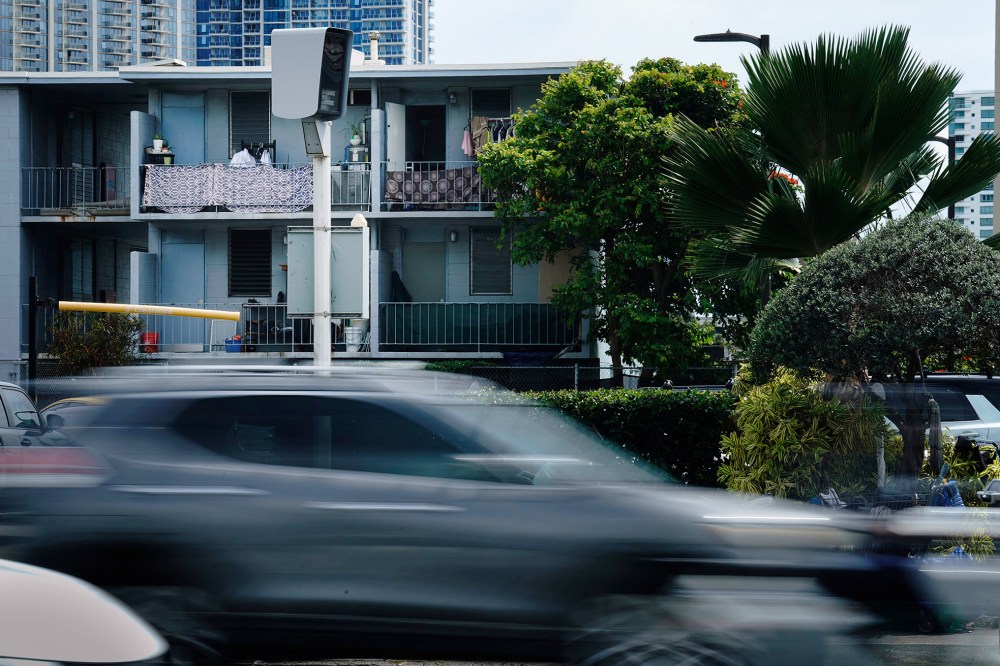
Even though the cameras are capable of catching far more violators, the state is targeting only the worst of the worst speeders because the projected surge in tickets would overwhelm police and court staff and the judiciary’s information systems.
The slow rollout presents something of a conundrum: The program was meant to be financially self-sustaining for at least a decade, with revenue from citations covering all operating costs. With ticket fees trickling in more slowly, the transportation department is seeking $6.6 million in state funding in the next fiscal year to pay for camera upgrades and improvements to the court information system.
Ultimately, the transportation department is trying to push ahead with plans to significantly expand the number of traffic cameras on Oʻahu. The department is asking for money to expand the program to 177 cameras across all four major islands, with half of them located on Oahu.
State transportation director Ed Sniffen told lawmakers earlier this year that over 60,000 speeding citations per month would be generated from 17 cameras at 10 Honolulu intersections when they are operating at full capacity.
Honolulu police normally issue between 3,000 and 4,000 speeding-related citations per month, according to legislative reports. That traditional enforcement continues.
The citations need to be sent out within 10 days according to statute, adding a time pressure to the processing that must include review of videos and photos by HPD’s traffic division, after preliminary screening by a third-party vendor.
The potential for the torrent of citations to also overwhelm the court system was identified as a concern by the Hawaiʻi judiciary over a year ago. The agency had asked lawmakers to hold off on implementing the program until 2027 so that it could figure out a plan for handling the increase.
Sniffen told the Senate Ways and Means Committee on Jan. 15 during a budget briefing that for now “we’ve worked with the judiciary so that we don’t blow up their systems,” and that the plan now is to roll out cameras at the rate of about 10 new Honolulu intersections every year.
In the meantime, Sniffen revealed the transportation department is only ticketing extreme speeders, not just those slightly over the limit, to restrict the number of tickets sent out.
Sniffen and department spokespeople have declined to say what the agency’s threshold is, but court dockets show that the motorists fined for speeding so far had been clocked at more than 20 m.p.h. over the set limit.
State law permits tickets from cameras to be issued starting at 11 m.p.h. over the posted limit. Sniffen said that the current threshold ensures that only the “most dangerous drivers were targeted.” That speed threshold will drop as the capacity for processing more tickets expands. They were not limiting the issuing of red-light infractions, he said.
Sniffen was unavailable for interview last week, but six weeks after the system began issuing speeding citations Dec. 15, the transportation department awarded a 10-year contract worth approximately $160 million to Arizona-based Verra Mobility to “expand, operate and maintain the camera program.”
It’s unclear whether the cost of implementing such an expansion has been clearly determined.
In an email last week, state judicial spokesman Brooks Baehr confirmed that the courts had been working with the transportation department to more efficiently integrate the citations transmitted by the cameras into their information system –– a process that used to be completed manually.
“To date, the Judiciary has been able to successfully process citations generated by the automated red light and speed camera systems. But it also recognizes that a significant increase in citation volume will present operational challenges that would need to be addressed,” he said.
Maj. Herbert Soria of HPD’s Traffic Division said in an email that three personnel are assigned to review citations, and staffing is adequate at this time.
“But, as the program continues to develop,” Soria said, “the need for additional staffing can be reassessed.”
Checkered History Of Red Light Cameras
“The judiciary is right to be concerned here,” said Alex Guirguis, who is co-founder of the Seattle-based company Off The Record that connects drivers to lawyers who dispute traffic tickets and parking violations. “Like Uber for lawyers,” he said.
Guirguis, who lives in Honolulu, said the automated system can create a structural mismatch between the two branches of government.
“Automated cameras generate citations at volumes that court systems just were not designed to handle,” he said. “A typical officer will issue 30 to 50 traffic tickets a day. An automated camera can issue hundreds of tickets a day.”
Guirguis said his company data show that automated ticketing has created a backlog in court systems. In New York, which has had a red light camera system since 1992, “it takes over three years to resolve a traffic ticket.”
Some jurisdictions, like California, have chosen to throw out tickets within a certain timeframe just to reduce the administrative backlog.
Hawaiʻi is a relative newcomer to the use of red light cameras, but some lawmakers have already proposed the program could be extended to detect expired registration and safety tags on moving vehicles.
Legislation that would have enabled that expansion was killed in the Senate this week.
Any extra enforcement would come with an additional administrative burden.
“Without fail every time a state has started a red light camera program in some small defined manner it has always increased into something more and that’s what we’re seeing here,” Gurguis said.
While 23 states including Hawaiʻi currently have red light camera programs, their use is by no means universal and they remain politically unpopular.
That’s particularly true under the Trump administration. A U.S. Department of Transportation spokesman told the Washington Post that it did not want road safety dollars being used to subsidize expanding red light camera systems because they are “unfair revenue schemes.”
In fact eight states –– Maine, Mississippi, Missouri, New Hampshire, New Jersey, South Carolina, Texas, West Virginia and Wisconsin –– forbid their use, the National Conference of State Legislators reported.
Other states have tried, canned and restarted programs for various reasons.
The city of Phoenix which first installed red light cameras in 2001, had to abandon the program in 2019 amidst the fallout from a bribery scandal involving its red light camera vendor Redflex Traffic Systems. The Federal Bureau of Investigation found that the Arizona company had paid a Chicago official $600,00 in bribes to be the preferred red light contractor there.
But Phoenix has just reactivated a red light camera system, following a surge in accidents and fatalities.
Traffic research over the last 15 years generally supports the theory that the programs can reduce certain kinds of accidents and associated injuries. National Highway Traffic Safety cites a 2015 study showing they can “reduce roadway fatalities and injuries by 20% to 37%.”
That reduction was similar to the findings in a 2020 review of available research from nearly 40 studies that linked red light cameras with a 24% reduction in right-angle, or “t-bone” collisions.
However, that same review found evidence they can also increase the risk of rear-end crashes as other drivers hard brake to avoid hitting vehicles that stop to avoid running the red light. Automatic sensor technology in newer vehicles is reducing the frequency of those kinds of accidents.
The introduction of 15 cameras in San Francisco last year resulted in a 70% decline in speeding at those locations six months into operation, the city’s Municipal Transportation Agency found.
Red Light Camera Hotspots
Red light traffic cameras have been operating at 10 Honolulu intersections since 2022, but Nov. 1 was the start of a new phase of enforcement that included issuing citations for speeding too.
The locations were identified following a department traffic and engineering study completed in November 2022. In the first three years of the pilot, as the cameras were being brought online, the state issued 1,800 citations to drivers for blowing through red lights.
As of November, all cameras were in operation, and enforcement was ramped up. Between Nov. 1 and Feb. 24, 2,041 citations were issued to registered owners after vehicles were caught on camera running red lights –– an average of 17 offenses per day.
Police and transportation agencies in Hawai’i say motorists running red lights are major contributors to the state’s accident rate, causing 1,900 crashes between 2015 and 2020, according to the transportation department.
It’s still early in the Hawaiʻi program but Sniffen told legislators in January that there had been a 62% reduction in red-light running since the program started, “and we’re starting to see reductions in speed”. And, according to the department’s most recent report on the program to the Legislature, the installation of the cameras has already resulted in a 70% reduction in major crashes at the 10 sites in urban Honolulu.
Incidents at just four Honolulu intersections are responsible for over half of all the red-light- running citations during the first 116 days of the expanded camera enforcement program.
The intersection of McCully Street and Algaroba Street in Mōʻiliʻi triggered the most red light signal citations with 372 issued.
The McCully Street corridor is a busy feeder for the H1 freeway west toward the airport and that intersection is the meeting point of a major arterial road and a local street. It also has a posted speed limit of 25 mph, the standard for residential areas.
McCully and Algaroba was closely followed by the intersection of Ward Avenue and King Street with 358 red light citations issued. Both streets are arterial, and Ward also operates with contraflow during peak morning times. The department’s crash data also shows a high number of pedestrian and cyclist injuries at that location.
One intersection was the source of half of the speeding citations issued in the four months –– the intersection of Pali Highway and School Street.
That’s where the speed limit on the Pali Highway drops from 30 mph to 25 mph. Court records show however that eight drivers were ticketed for speeds more than double those posted limits.
While noting the benefits of camera programs, an American Civil Liberties Union report on road safety strategies released last week said that red light cameras can disproportionately impact low-income households.
The speeding tickets can generate fines of between $177 and $317, depending on the speed clocked, and the red lights citations are $97.
Sen. Donna Kim raised that issue in the Ways and Means Committee hearing in January, saying that constituents were telling her they felt being picked on because six of the 10 cameras currently active, including the Pali Highway/School Road intersection, are in her Kalihi district.
Sniffen said it was the department data that resulted in the selection of those locations.

“If cameras are concentrated in neighborhoods like Kalihi, which is a working-class residential community, the cost falls overwhelmingly on the locals,” Guirguis, from Off The Record, said. “If you have a daily commuter passing the same camera twice a day, they have a different exposure than a tourist who’s driving through it once, or not at all.”
Any red light camera programs should also include provisions for a proportion of the revenue to be directed at road safety measures that may have lacked sufficient funding, the ACLU said.
In greater Los Angeles, a proportion of the red light camera revenues must be spent on other measures like traffic calming for the camera funding to continue.
___
This story was originally published by Honolulu Civil Beat and distributed through a partnership with The Associated Press.