

‘Two ways of calculating’: Trump defends his mathematically impossible calculations on drug prices
Advertisement
Read this article for free:
or
Already have an account? Log in here »
To continue reading, please subscribe:
Digital Subscription
One year of digital access for only $1.44 a week*
- Enjoy unlimited reading on winnipegfreepress.com
- Read the E-Edition, our digital replica newspaper
- Access News Break, our award-winning app
- Play interactive puzzles
*Billed as $5.77 plus GST every four weeks. After 52 weeks, price increases to the regular rate of $19.95 plus GST every four weeks. Offer available to new and qualified returning subscribers only. Cancel any time.
To continue reading, please subscribe:
Add Free Press access to your Brandon Sun subscription for only an additional
$1 for the first 4 weeks*
- Enjoy unlimited reading on winnipegfreepress.com
- Read the E-Edition, our digital replica newspaper
- Access News Break, our award-winning app
- Play interactive puzzles
*Your next Brandon Sun subscription payment will increase by $1.00 and you will be charged $17.95 plus GST for four weeks. After four weeks, your payment will increase to $24.95 plus GST every four weeks.
Read unlimited articles for free today:
or
Already have an account? Log in here »
WASHINGTON (AP) — President Donald Trump, who helped push the term “ fake news ” into the mainstream, now seems to have a new favorite subject: fake math.
During a Thursday event announcing a deal with drugmaker Regeneron to lower the cost of its pharmaceutical products, Trump defended his past claims that prices on prescription medications had been cut by well over 100% — something that is mathematically impossible without manufacturers dropping prices to zero and then presumably paying consumers to use their product.
Trump acknowledged having boasted that his efforts to lower drug prices had reduced what consumers pay by “500%, 600%.” But he added, “We also sometimes say 50%, 60%” and called it a “different kind of calculation” that could go up to “70, 80 and 90%.”
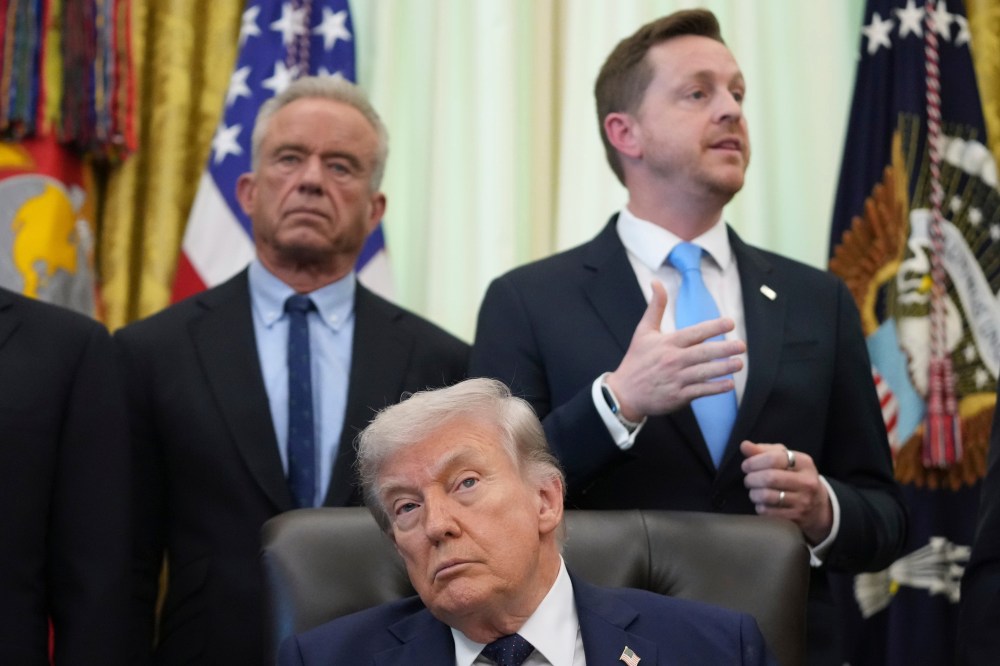
“People understand that better,” Trump said. “But they’re two ways of calculating” and “either way, it doesn’t make any difference.”
There could indeed be two ways of calculating such things — but the difference is very important. One is correct. The other is nonmathematical.
It was one of several times Trump used his own — but incorrect — math during the drug pricing event. He claimed the 7 1/2-week-and-still-going Iran war actually fell within the four- to six-week timeline he predicted early on. The president also brought up the crowd size for his 2017 inauguration — a subject that led onetime top Trump adviser Kellyanne Conway to unwittingly make the phrase “ alternative facts ” famous.
Trump’s incorrect take on percentages — something he has long repeated — came just after his health chief, Robert F. Kennedy Jr., brought up the issue on his own during the same Oval Office event Thursday.
Kennedy noted that he was reminded of his exchange the previous day with Sen. Elizabeth Warren, D-Mass., at a congressional hearing when she said that claiming price cuts exceeding 100% might suggest “companies should be paying you to take their drugs.”
Kennedy said during the hearing that Trump “has a different way of calculating.”
On Thursday, Kennedy argued that drug manufacturers had raised prices on popular medications by more than 100% and that Trump was then cutting the price down substantially — meaning he was wiping out percentages of costs worth more than 100%.
“If the drug was $100, and it raised the price to $600, that would be a 600% rise,” Kennedy said — even though that’s incorrect. Six hundred is indeed 600% of the original 100 value, but the increase from one to the other is actually only 500%.
Kennedy then continued, “And the president used that mathematical device.”
But no such device exists for the way Trump characterizes it — at least not when math is done correctly.
Something can increase in price by more than 100%. A product that increases from $1 to $2.10 has increased by 110%. But prices cannot be reduced by more than 100% without being pushed to a value of $0 — or reduced 100% of the full price — and then into negative territory, where consumers presumably would need to be paid for using a product.

In a subsequent question-and-answer session with reporters during the price announcement event, meanwhile, Trump offered another dash of fake math for how long the war in Iran, which began Feb. 28, had been going on.
Asked about the war having exceeding the four to six weeks he originally suggested it would last, Trump argued that he’d actually met his own timeline because Iran’s military was “decimated” by then.
The U.S. and Iran agreed to a ceasefire this month, and Trump announced this week that he was extending it. But neither side says the war is over, and a conclusion that hasn’t been achieved certainly didn’t occur in the four to six weeks that have already elapsed.
Trump also brought up his 2017 inaugural crowd size issue on Thursday, when talking about renovations at the Lincoln Memorial Reflecting Pool. He noted that Martin Luther King Jr. had drawn hundreds of thousands of people to the National Mall for his “I Have a Dream” speech in 1963 and claimed: “I had the same exact crowd. Maybe a little bit more,” arguing that pictures of both events backed him up.
“I actually had more people,” Trump added. “But that’s OK.”