

The wide-brimmed Sombrero galaxy is revealed in all its splendor by a telescope in Chile
Advertisement
Read this article for free:
or
Already have an account? Log in here »
To continue reading, please subscribe:
Digital Subscription
One year of digital access for only $1.44 a week*
- Enjoy unlimited reading on winnipegfreepress.com
- Read the E-Edition, our digital replica newspaper
- Access News Break, our award-winning app
- Play interactive puzzles
*Billed as $5.77 plus GST every four weeks. After 52 weeks, price increases to the regular rate of $19.95 plus GST every four weeks. Offer available to new and qualified returning subscribers only. Cancel any time.
To continue reading, please subscribe:
Add Free Press access to your Brandon Sun subscription for only an additional
$1 for the first 4 weeks*
- Enjoy unlimited reading on winnipegfreepress.com
- Read the E-Edition, our digital replica newspaper
- Access News Break, our award-winning app
- Play interactive puzzles
*Your next Brandon Sun subscription payment will increase by $1.00 and you will be charged $17.95 plus GST for four weeks. After four weeks, your payment will increase to $24.95 plus GST every four weeks.
Read unlimited articles for free today:
or
Already have an account? Log in here »
CAPE CANAVERAL, Fla. (AP) — The Sombrero galaxy and its glowing halo of stars have never looked this good.
The U.S. National Science Foundation’s NOIRLab released the latest photo of the popular hat-shaped galaxy on Friday. A telescope in Chile observed it four years ago, but the color imaging was not completed until this week.
Located approximately 30 million light-years away, this spiral galaxy — formally known as Messier 104 — is one of the largest in the constellation Virgo cluster. It’s an estimated 50,000 light-years across. A light year is about 6 trillion miles.
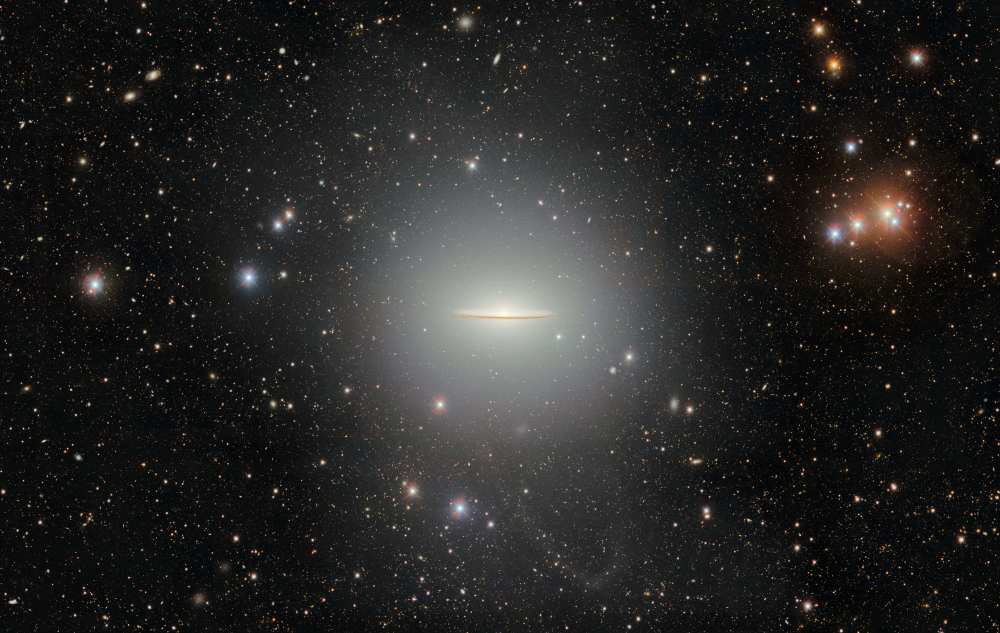
Captured in incredible detail, the galaxy’s stellar halo appears to be triple the size of the sombrero itself.
A dark energy camera on the telescope also caught a stream of stars pouring out of the galaxy’s southern edge. Scientists believe the stars in this stream, as well as the halo, were ripped from other galaxies in a long-ago collision.
Astronomers discovered the galaxy back in the 1700s.

___
The Associated Press Health and Science Department receives support from the Howard Hughes Medical Institute’s Department of Science Education and the Robert Wood Johnson Foundation. The AP is solely responsible for all content.