

‘It’s really awful’
Unruly new tenants unpack fear, safety concerns for seniors in low-income 55-plus North End building

Advertisement
Read this article for free:
or
Already have an account? Log in here »
To continue reading, please subscribe:

Digital Subscription
One year of digital access for only $205*
- Enjoy unlimited reading on winnipegfreepress.com
- Read the E-Edition, our digital replica newspaper
- Access News Break, our award-winning app
- Play interactive puzzles
*First annual payment billed as $205.00 + GST for one year. This annual subscription will automatically renew at $233.00 + GST every 52 weeks (10% off the regular annual price of $259.35). Offer available to new and qualified returning subscribers only. Cancel any time.
To continue reading, please subscribe:
Add Free Press access to your Brandon Sun subscription for only an additional
$1 for the first 4 weeks*
- Enjoy unlimited reading on winnipegfreepress.com
- Read the E-Edition, our digital replica newspaper
- Access News Break, our award-winning app
- Play interactive puzzles
*Your next Brandon Sun subscription payment will increase by $1.00 and you will be charged $17.95 plus GST for four weeks. After four weeks, your payment will increase to $24.95 plus GST every four weeks.
Read unlimited articles for free today:
or
Already have an account? Log in here »
On a quiet weekday morning, residents of a seniors building in north Winnipeg who ventured from their rent-geared-to-income suites were on high alert.
Elderly and disabled residents at the Canadian Polish Manor say their sense of safety and community has been shattered in the past year by drug use and crime since younger residents with addictions and other issues moved in.
“I’ve never been frightened in my life and now I am,” said Agnes Breton, 73. “I’ve been here 11 years and this is the first year my daughter is at me to move out,” she said Wednesday. “It’s really awful.”
MIKAELA MACKENZIE / FREE PRESS
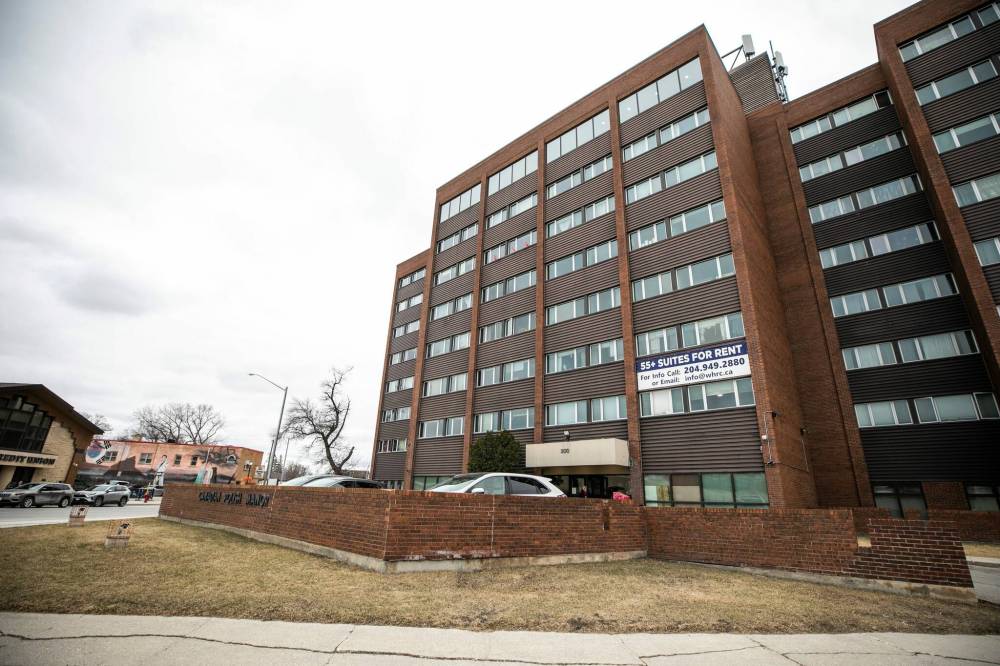
The Canadian Polish Manor on Selkirk Avenue where elderly and disabled residents say their sense of safety and community has been shattered by drug use and crime since younger residents with addictions and other issues moved in.
Frieda Campbell, 69, said she and some other neighbours barricade the entrance to their suites, because intoxicated people and gang members roam the hallways banging on doors. Recently, someone discharged pepper spray, prompting Campbell to call 911 as she struggled to breathe.
Breton, who uses a walker, says she’s hyper-vigilant navigating the hallways and elevator. When she does go out, her daughter escorts her to and from her suite, and once confronted a man urinating in the hallway.
In the last year, the lobby has been plastered with posters warning residents to watch their laundry so it’s not stolen, along with names and photos of people who’ve been banned from the 55-plus block.
The intercom system at the front entrance hasn’t worked for weeks, so residents are required to go downstairs to let visitors in or accept deliveries.
“I’m scared of being banged over the head when my prescription comes,” Breton said. The women said there’s evidence of drug dealing in the building, with intoxicated people inside, others appearing to have overdosed in the stairwell and customers whistling or screaming from the street to be let inside.
Allison Bailey, who also uses a walker, said last week she was accosted at the entrance and shoved out of the way by non-residents “tailgating” — trying to get inside. The 62-year-old said if she tries to stop an intruder from entering, she could be charged with assault.
“I’ve never been frightened in my life and now I am… I’ve been here 11 years and this is the first year my daughter is at me to move out… It’s really awful.”
“I feel for these tenants,” said James Heinrichs, executive director of the Winnipeg Housing and Rehabilitation Corp., which manages the Canadian Polish Manor and close to 50 other social-housing buildings.
The organization is reviewing security at the Selkirk Ave. building, which has 169 of the 1,800 units managed by the non-profit corporation, set up 49 years ago to develop and manage inner-city housing.
Extending the hours of a security guard who now watches over the place overnight is under consideration in the building where residents don’t pay rent of more than 30 per cent of their income.
“We don’t have a huge budget,” said Heinrichs.
Security is being reviewed at the building, where residents are advised not to try to stop an intruder and to call police. He acknowledged that a call about someone sneaking past a resident into the building may not be very high on the police priority list.
“They are overwhelmed with situations they’re dealing with on a daily basis,” he said.
“They are overwhelmed with situations they’re dealing with on a daily basis.”
Wednesday morning, Bailey and neighbours Campbell and Breton watched as a new tenant wearing a short bathrobe and appearing too young to be a senior opened a back door next to the dining area and let a young man with a bike inside.
“What are you looking at?” she hissed at the wary elderly women. “That’s my son.”
“Welcome to the Polish Manor,” Bailey quipped. She and her neighbours say their safety is being sacrificed in an effort to house the homeless.
They’re not alone, said Erika Wiebe of the Right to Housing Coalition’s seniors working group. A growing number of low-income seniors living in social housing are bearing the brunt of the provincial government’s homelessness strategy, the retired community development worker said.
“This is a huge problem,” she said. “People are moving (in) who are wreaking havoc.”
Wiebe pointed to 22 Strauss Dr. in west Winnipeg, a Manitoba Housing 55-plus block where residents interviewed by the Free Press in 2025 described many of the same safety concerns as seniors at 300 Selkirk. Younger people with addictions and mental-health issues move in — often after being homeless — and refuse treatment and the other wrap-around supports they need.
“What type of situation does that put us in as landlords? We want to do the best we can… Some things are beyond our control.”
“There has to be a better option for high-acuity people who haven’t learned to live independently,” Wiebe said, adding that moving them into a 55-plus building with vulnerable seniors shouldn’t be happening.
Just north of downtown, the Canadian Polish Manor is surrounded by poverty, addictions and homelessness, which are growing challenges right across Canada.
“We work with a lot of social services agencies trying to house people,” Heinrichs said. “We don’t know where a lot of these people come from but one of the things we expect is social service agencies are there are with supports.”
While the two dozen agencies WHRC works with are all trying their best to help, there’s not much they can do if a tenant cancels the support provided to them.

“What type of situation does that put us in as landlords? We want to do the best we can,” Heinrichs said. “Some things are beyond our control.”
The non-profit corporation can’t tell tenants who they can invite into the building or control someone falling back into addiction, he said.
MIKAELA MACKENZIE / FREE PRESS
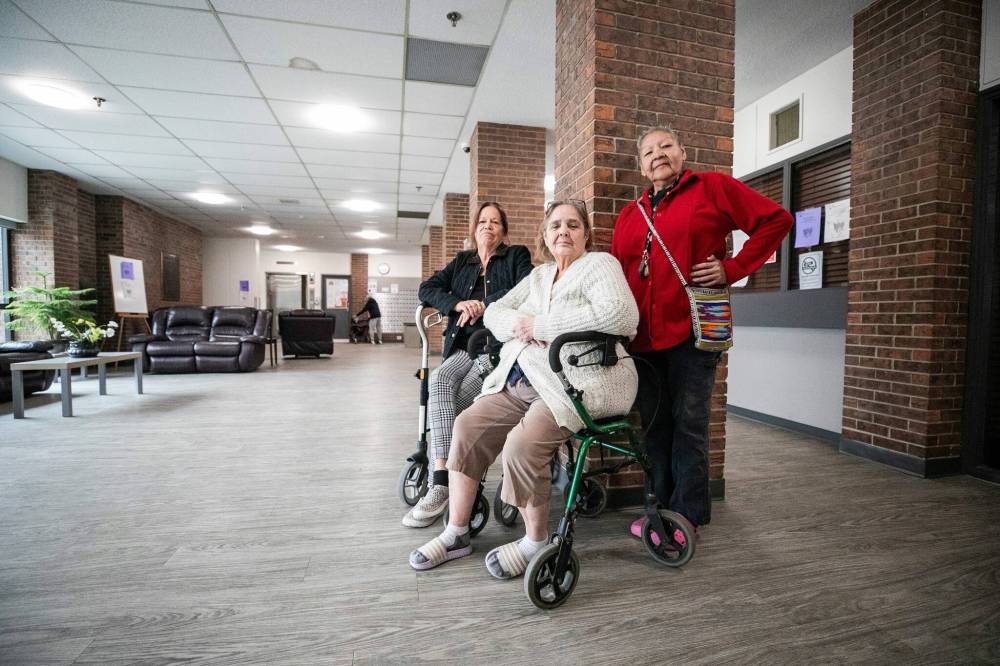
Alison Bailey (left), Agnes Breton, and Frieda Campbell at the Canadian Polish Manor, where residents are fearful of tenants placed there for transitional housing.
If someone is causing trouble, they need evidence to take to the Residential Tenancies Branch in order to evict them.
Heinrichs said that Manitoba Justice is investigating concerns at Canadian Polish Manor. Justice Minister Matt Wiebe’s press secretary Ben Leahy confirmed Wednesday that the department’s public safety unit is investigating. Housing, Addictions and Homelessness Minister Bernadette Smith was not made available for an interview Wednesday.
carol.sanders@freepress.mb.ca
Carol Sanders
Legislature reporter
Carol Sanders is a reporter at the Free Press legislature bureau. The former general assignment reporter and copy editor joined the paper in 1997. Read more about Carol.
Every piece of reporting Carol produces is reviewed by an editing team before it is posted online or published in print — part of the Free Press‘s tradition, since 1872, of producing reliable independent journalism. Read more about Free Press’s history and mandate, and learn how our newsroom operates.
Our newsroom depends on a growing audience of readers to power our journalism. If you are not a paid reader, please consider becoming a subscriber.
Our newsroom depends on its audience of readers to power our journalism. Thank you for your support.
Carol Sanders
Legislature reporter
Carol Sanders is a reporter at the Free Press legislature bureau. The former general assignment reporter and copy editor joined the paper in 1997. Read more about Carol.
Every piece of reporting Carol produces is reviewed by an editing team before it is posted online or published in print — part of the Free Press‘s tradition, since 1872, of producing reliable independent journalism. Read more about Free Press’s history and mandate, and learn how our newsroom operates.
Our newsroom depends on a growing audience of readers to power our journalism. If you are not a paid reader, please consider becoming a subscriber.
Our newsroom depends on its audience of readers to power our journalism. Thank you for your support.
Related Articles
Manitoba Housing resident worries homeless strategy could worsen situation in building


Advertisement Advertise With Us
Advertisement Advertise With Us