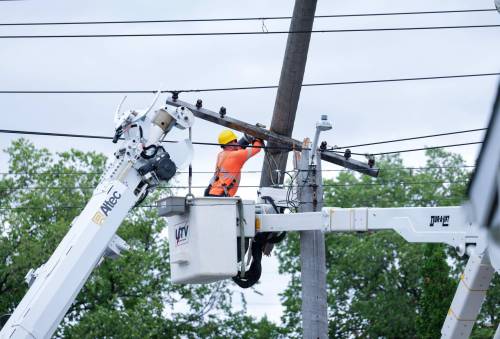
Innocuous critter or varmint to vanquish? Debating best approach to Richardson’s ground squirrel long a Prairie predicament
Read this article for free:
or
Already have an account? Log in here »
To continue reading, please subscribe:

Digital Subscription
One year of digital access for only $205*
- Enjoy unlimited reading on winnipegfreepress.com
- Read the E-Edition, our digital replica newspaper
- Access News Break, our award-winning app
- Play interactive puzzles
*First annual payment billed as $205.00 + GST for one year. This annual subscription will automatically renew at $233.00 + GST every 52 weeks (10% off the regular annual price of $259.35). Offer available to new and qualified returning subscribers only. Cancel any time.
To continue reading, please subscribe:
Add Free Press access to your Brandon Sun subscription for only an additional
$1 for the first 4 weeks*
- Enjoy unlimited reading on winnipegfreepress.com
- Read the E-Edition, our digital replica newspaper
- Access News Break, our award-winning app
- Play interactive puzzles
*Your next Brandon Sun subscription payment will increase by $1.00 and you will be charged $17.95 plus GST for four weeks. After four weeks, your payment will increase to $24.95 plus GST every four weeks.
Read unlimited articles for free today:
or
Already have an account? Log in here »
A peculiar debate brewed in the pages of Saskatchewan’s newspapers in 2001.
It did not concern post-9/11 security or squabbles over federal gun and environmental policies, though it did evoke other perennial Canadian political tensions.
It had to do with gophers.
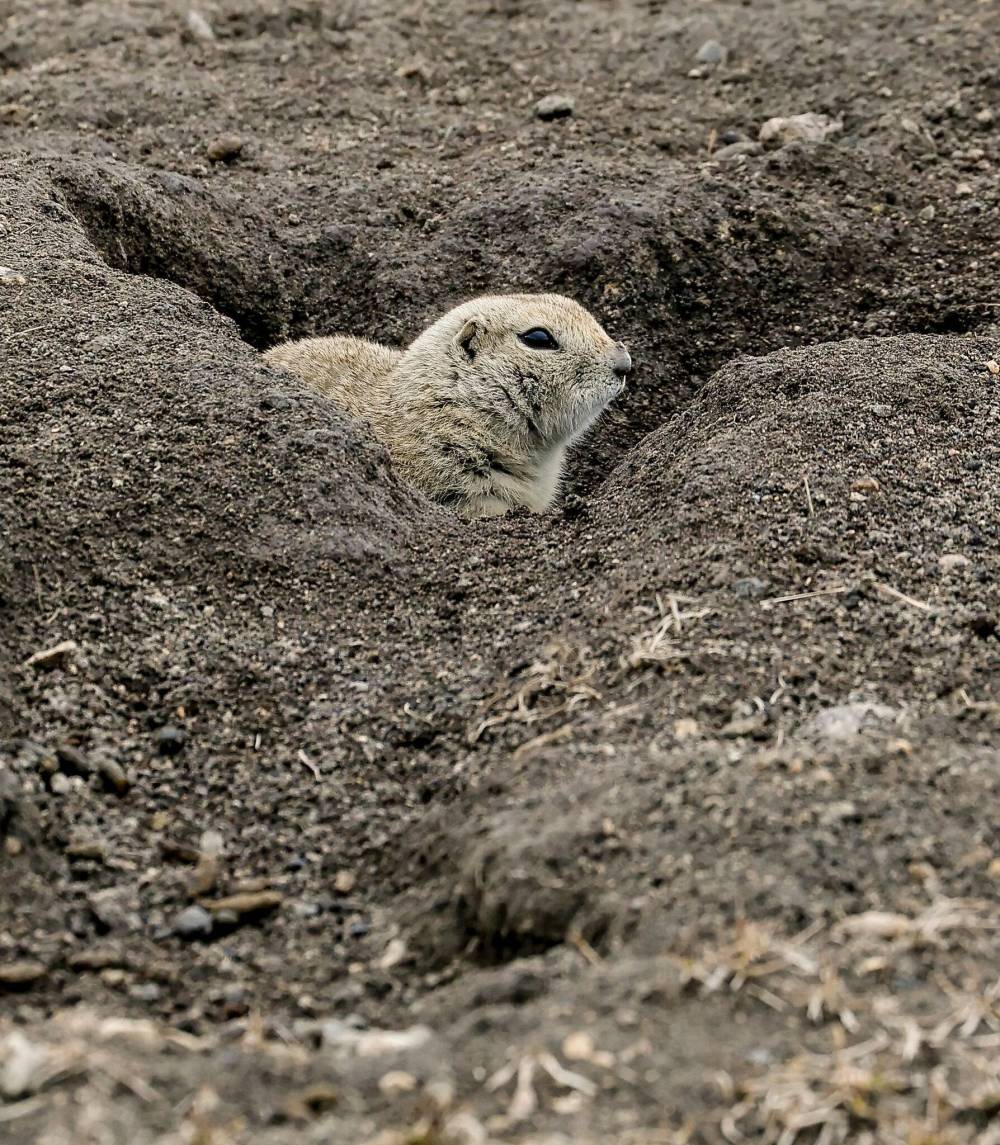
Saskatchewan’s NDP government was choosing an animal to symbolize the province, and the suggestion of a gopher was driving some squirrelly.
“I’ll bet my Winchester .22 that the NDP government had a hand in naming the gopher as the official representative of the animal kingdom for our Great Plains environment,” wrote one self-identified Westerner in a letter to the Western Producer.
The author must have been confident in the wager, since a .22 — a miniature-bore rifle — is a classic tool for rooting out the entrenched, pestilent threat to the Prairie economy. The letter went on to connect gophers to the left-leaning provincial government, a popular object of ire for its perceived lack of support for farmers.
In her 2003 delightful short cultural history, Why Shoot the Gopher? Reading the Politics of a Prairie Icon, Alison Calder illustrates how potent those associations are. If Ottawa bans or restricts rodent poisons like strychnine, suddenly headlines in Prairie newspapers ask, “What would happen if gophers took over the government?”
“A highly contested regional icon.”
Through Calder’s telling, the gopher is “a highly contested regional icon.”
The confrontations it invites between environmentalists and farmers — “big-city fatcat(s) and… gun-waving hicks” — represent both Canada’s urban-rural split and East-West tensions.
And yet it’s a federal Liberal government that farmers can thank for new access to strychnine this spring. The aim is to combat a pestilence of gophers — technically the Richardson’s ground squirrel — that reportedly have hit crops hard and injured livestock.
In March, Agriculture Minister Heath MacDonald and Health Minister Marjorie Michel announced Ottawa was reversing the ban on strychnine, the classic rodent poison used through the 19th century and until the late 20th century that is now heavily restricted in favour of less-deadly rodenticides.
With the announcement, producers will have access to two per cent liquid strychnine until November 2027. The neurotoxin causes rapid convulsions and then death, usually within a few hours, but is also seen as the highest risk to non-targeted wildlife.
“(Ground squirrels) have become a serious pest threatening a variety of crops,” the government said in a news release. “The Prairies have been experiencing abnormally dry conditions, which affects the sustainability and quality of farmlands and allowed the population of these gophers to increase significantly.”
“A serious pest threatening a variety of crops.”
Prior to Ottawa’s announcement, Alberta Agriculture Minister R.J. Sigurdson suggested “the annual risk to hay and native pastures exceeds $800 million,” though there’s little accessible data on how much damage ground squirrels — separate from other agricultural villains like grasshoppers, cutworms and voles — actually cause in Canada.
However, Saskatchewan farmer Jeremy Welter put it this way in a Canadian Press report: “I suspect maybe if the Bible had been written in Saskatchewan, it wouldn’t have been locusts. It would have been gophers… I think (lifting the ban) is one of those things that is long overdue.”
It’s not just country folk with an itch to reduce this Prairie icon’s numbers.
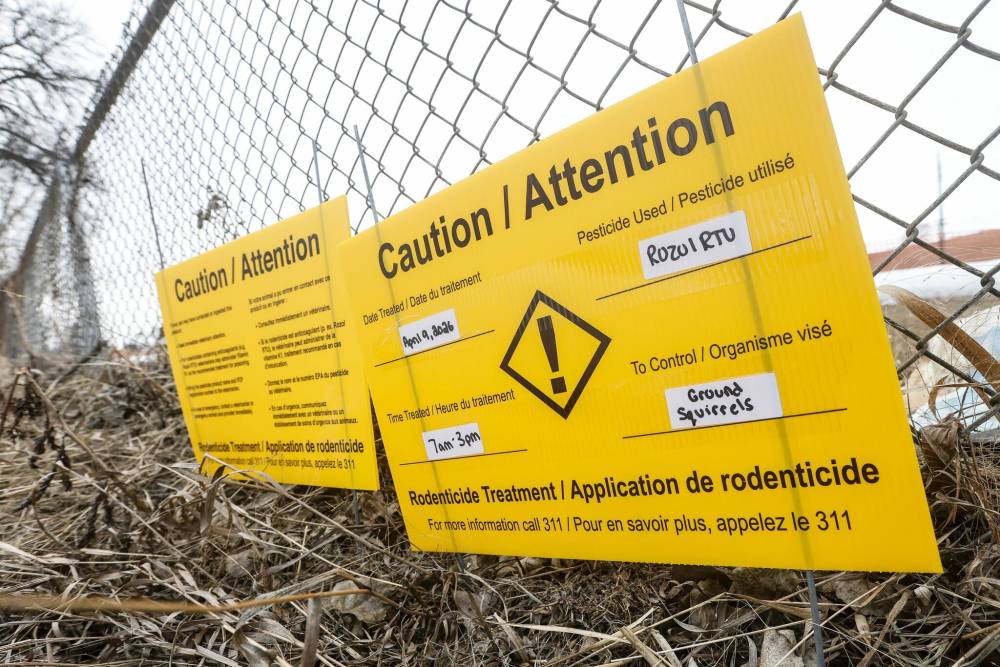
In April, the Manitoba government approved the City of Winnipeg’s request to use rodenticides in nine city parks to control rising populations of Richardson’s ground squirrels.
The city is employing less-controversial forms of rodenticide than strychnine. One is Rozal, an anticoagulant bait that causes internal bleeding; the other is RoCon, a foam asphyxiant that causes suffocation in burrows.
“The treatments we chose are used in most major Canadian cities. They pose limited risk to other animals and people,” the city said in a news release.
The city said it would immediately remove carcasses, post signage 24 hours before and after deploying rodenticide and check sites to ensure non-targeted creatures aren’t among the dead.
Animal welfare groups aren’t having it.
The Winnipeg Humane Society, Animal Justice and Winnipeg biologist James Hare have filed an appeal against the permit, arguing the methods risk harming other wildlife and pets, and inflict a slow, agonizing death on the beleaguered burrower.
Hare, the world’s leading authority on Richardson’s ground squirrels, says he doesn’t identify with “really extreme” animal rights activists on ground squirrel control. But on this issue, the ordinarily jovial University of Manitoba biologist is deadly serious.
“I don’t think there’s any excuse in the city not to live-trap, transport them and have a veterinarian humanely euthanize them,” he says. “Once this s—- gets in the environment, it’s out there and it’s going to cause deaths, and not just among gophers… predators pick up carcasses and cart them off. They die their slow death elsewhere.”
“Gophers are the stupid heroes of springtime. They sight right up the barrel… as if to say, ‘Go ahead, blow my guts into crow food,’” writes poet Rick Hillis in Captain Gopher.
“I don’t think there’s any excuse in the city not to live-trap, transport them and have a veterinarian humanely euthanize them.”
Calder’s work, Why Shoot the Gopher?, layers such hardline rhetoric dating from the 1870s, when the Dominion Lands Act accelerated the settlement of the Prairies for agriculture, to roughly the present day.
From lobbying farmers on Parliament Hill to rodent poison advertisements, gophers have been cast as “evil,” “plundering,” a biblical scourge threatening not just the livelihood of farmers, but the very economic life of the West itself.
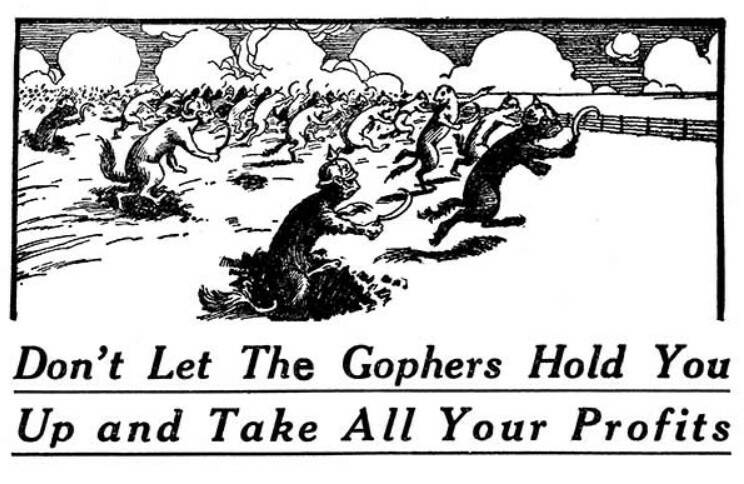
The ways in which ground squirrels damage agricultural life are well-documented: they feed on young plants, seeds, grasses and legumes, while their tunnels can damage soil structure and create hazards for machinery and livestock.
Despite these nuisances, a more sentimental image of the gopher has emerged as the Prairies have urbanized.
As Calder documents, the gopher has become a cute roadside and city-park critter, a lovable hero used to decorate brochures like those of the City of Winnipeg’s Assiniboine Park Zoo or serve as a mascot for teams like the CFL’s Saskatchewan Roughriders.
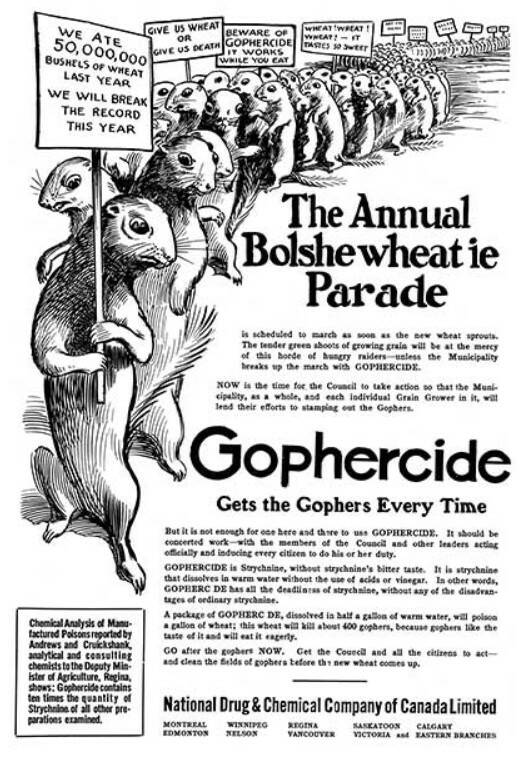
This is a long way off from the early 1920s, when gophers were demonized as “Bolshewheaties” — a greedy Prairie proletariat coming for farmers’ grain, an allusion to Soviet Russia’s People’s Commissariat for Food during the Russian Civil War.
Western Municipal News After the Russian Revolution, gophers were portrayed as ‘Bolshewheaties’ in this 1920 ad for gopher poison.
Later, the anti-American comic Gopher Freedom — published in Saskatoon in 1973 in response to the Vietnam War and the world oil crisis — turned this symbolism on its head, treating gophers as figures of political resistance against outside predators. In it, plucky Canadian gophers fend off an invading U.S. army hungry for Canada’s oil and fresh water — and they celebrate their triumph over the Americans by kissing each other goodnight after a big bonfire.
Such rosy imagery likely fell flat for rural Prairie readers, and probably would today, too.
“In cities, people can more easily be conservationists: because city dwellers don’t have to use the land in the same way that farmers do,” Calder writes.
In other words, it’s easy to keep your conscience clean if you’ve never had to dirty your hands working the land.
In Hare, the Richardson’s ground squirrel has a whiskery champion.
He’s contributed to innovative, catchily titled research articles about the contagious nature of prairie dogs’ jump-yips (“Catch the wave…”), false alarm signals among Richardson’s ground squirrels (“The Squirrel that cried wolf…”), the effects of climate change on male ground squirrel virility (“Shooting blanks…”) and beyond.
When he talks and writes about Richardson’s ground squirrels, it’s easy to detect not just a sharp sense of humour, but a natural affinity for the remarkably adaptive, oft-misunderstood, little subterranean architects and survivors of Canada’s climate extremes.
MIKE DEAL / FREE PRESS James Hare, a world-renowned Richardson’s ground squirrel expert, opposes the city’s poison campaign. 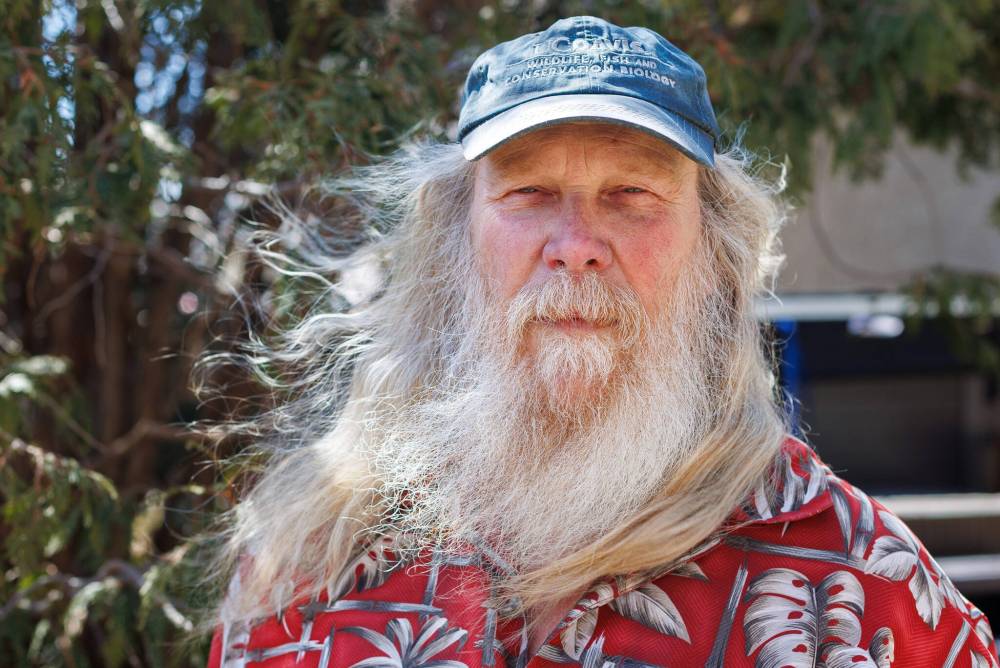
After recommending Calder’s essay, he emphasizes all the good ground squirrels bring to the Prairies — from aerating soil, dispersing seeds, controlling certain pests and weeds like Smoothe Brome to increasing plant diversity and other long-term benefits that can be hard to appreciate when all a farmer sees is the immediate pain these critters are causing.
“They have been the scapegoat forever, right?” Hare says.
Nevertheless, he resists the view the “urban” approach to gophers and wildlife is more enlightened.
“(Rural communities) are working the land… and they have to do what’s right to make ends meet. Generally speaking, they are good stewards of the land,” he says. “I do understand that in some contexts we do have to practise (gopher) control… (and) the old-school method is probably, on balance and all things considered, the best.”
He’s referring to techniques that don’t rely on poison, such as traps and shooting — and which are encouraged by initiatives like the gopher eradication program operated by the Rural Municipality of Stanley in southern Manitoba.
“(Rural communities) are working the land… and they have to do what’s right to make ends meet.”
Running from spring until Sept. 1, the program offers a $1 bounty for every gopher or mole tail turned in and is open to youth under age 18. It’s one of only a few programs of its kind left on the Prairies.
In general, Hare would prefer to see gopher-control season shortened.
“Control efforts after roughly July 1 each year are futile, and even detrimental in that all adult Richardson’s ground squirrels are safely hibernating by then, so control efforts only kill young-of-the-year, depriving predators that would otherwise keep ground squirrel populations in check,” he says.
Ironically, he adds, this can hurt predators, reducing their numbers, and in turn lead to explosive population growth of ground squirrels and pests in the future. Trying to disrupt nature’s rhythms can sometimes intensify their tempo.
Yet, on the whole, he sees programs like the RM of Stanley’s as more humane and ecologically sensitive than what’s in store for Winnipeg’s parks.
“In the hands of a decent marksperson, (squirrels) die very quickly. You’re also not causing that collateral damage to other species. In fact, in many ways, you’re helping scavengers,” he says.
A trophy decorated with rifle shells sits on Luc Lahaie’s desk.
“It’s a little internal, little fun thing,” says the chief administrative officer for the RM of Stanley. “We’re an open book. We don’t shy away from what’s reality here.”
SUPPLIED The Gopher trophy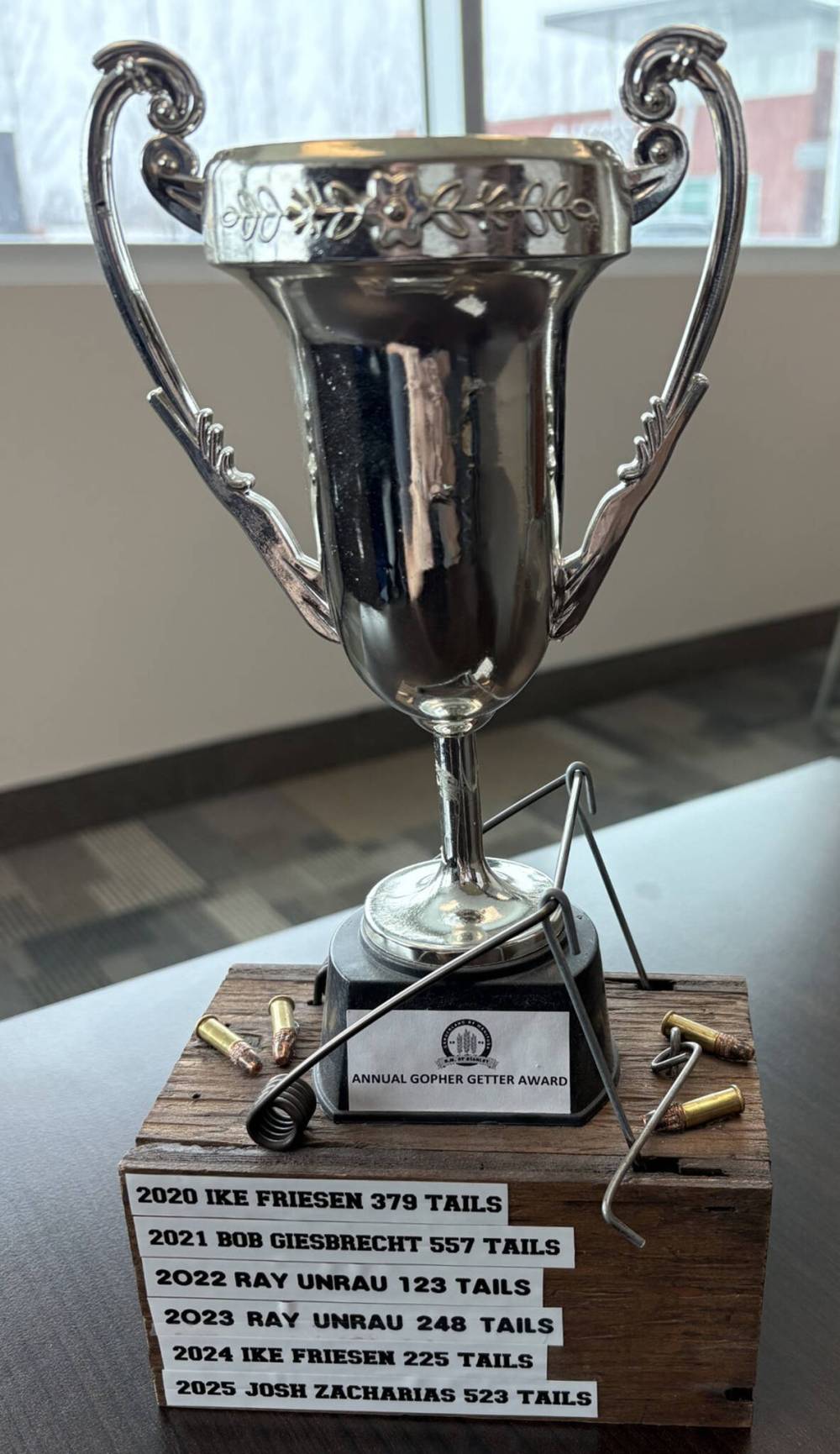
During the pandemic, Stanley’s council members started promoting the gopher program more actively. Families come to the municipal office with gopher tails, often by the garbage bag, which are counted on the spot. The kids are given a buck per tail, while the council member whose ward amassed the most tails gets their name on the trophy and bragging rights.
“During the COVID shutdown in 2020, that’s when council said, ‘Let’s make it a fun thing for our kids to do… to encourage the kids to go outside and be with nature and take care of this problem at the same time,’” Lahaie says. “The councillors get to have face-to-face interaction with the kids. So it’s an introduction to local government for these kids.”
“It’s definitely a good pastime for them to get out and do something practical, rather than sitting inside, doing nothing.”
Brothers Kyle and Cohen Klassen both participate in the program.
“They can lay the traps. And within a couple of hours, they can often have gophers trapped already, so they check them fairly regularly… (the gophers) get crushed pretty quick, so it’s very humane,” says their father Gerald. “It’s definitely a good pastime for them to get out and do something practical, rather than sitting inside, doing nothing.”
Cohen, 14, who’s a wheelchair user, enjoys the challenge. In the winter, he plays para hockey for Team Manitoba. Spring offers the young athlete other ways to stay active, like gopher hunting.
“He has a very strong upper body and is able to pull himself up onto things,” Gerald says. Cohen mounts and dismounts from his ATV, checking and setting the traps, on his own.
JOHN WOODS / FREE PRESS Brothers Kyle (left) and Cohen, with their dad Gerald, are participants in the gopher bounty program.
“It’s great to see him get attached to something and enjoy it… I’ve never heard him complain about his disability and he finds a way,” Gerald says. “The (boys) put (the money earned) into an account to gain interest… they haven’t blown it yet.”
Gerald recalls participating in the program as a kid in the late 1990s, when he also earned a dollar per tail — “you would think, with inflation, it should be more,” he jokes. In the late 1980s, tails brought in 25 cents, which was sometimes topped up by the landowner.
While Stanley’s gopher bounty program was started in 1985, it may seem like a throwback to a more formative Prairie era when similar programs proliferated across Saskatchewan, Alberta and Manitoba.
As portrayed and mythologized in films and books like Wolf Willow, Don’t Shoot the Teacher and Who Has Seen the Wind, hunting the “submarines in the wheatfields” — as they were referred to in an First World War era anti-gopher campaign — was once a venerable childhood tradition.
According to Winnipeg biologist and historian Gordon Goldsborough, about 100,000 gopher tails were handed in by Manitoba children during four days of effort in 1917, while in 1919, Manitoba’s boys’ and girls’ clubs snagged nearly 500,000 gopher tails. In 1921, one dogged sportsman set the record for the number of gophers shot in a day: 385.
JOHN WOODS / FREE PRESS
Despite its periods of excess — which, ironically, could intensify devastating insect infestations — the pastime was considered a civic duty. During the 1930s, when severe drought spread across the Prairies and food security was an urgency, it became a critical side hustle.
While in some areas the bounty was a half-penny per gopher tail, the RM of Shoal Lake paid one cent in 1933, while the RM of Glenwood offered the tidy reward of five cents. This extra income could go a long way during the Great Depression.
As the scale of modern farming has ballooned and chemical rodenticides have become more efficient, manual control has diminished, and with them gopher bounty programs.
Today, rodenticides are the dominant method of control. Firmly estimating the number of creatures they kill is almost impossible, partially because so many squirrels die underground, but Hare suggests it’s likely in the millions.
JOHN WOODS / FREE PRESS The RM program yields about 2,500 gophers a year.

Meanwhile, the RM of Stanley’s gopher bounty program yields about 2,500 tails a year, Lahaie says.
Apart from its economic benefits, Lahaie also frames the program as a modest counterweight to urban and modern woes.
“Kids who hunt and fish don’t mug little old ladies. That’s why we promote hunting and fishing as a great deterrent (and) to get kids into the outdoors and away from the screens,” he says.
Hare is fond of quoting a scene from the 1977 Canadian comedy-drama, Don’t Shoot the Teacher, set during the Great Depression.
“It’s a classic Prairie film. The school inspector comes by and goes, ‘That’s not a gopher, that’s a Richardson ground squirrel!’’’ Hare says theatricality. “I just love it.”
While “gopher” has become part of the everyday vernacular, they are not Richardson’s ground squirrels.
“Kids who hunt and fish don’t mug little old ladies.”
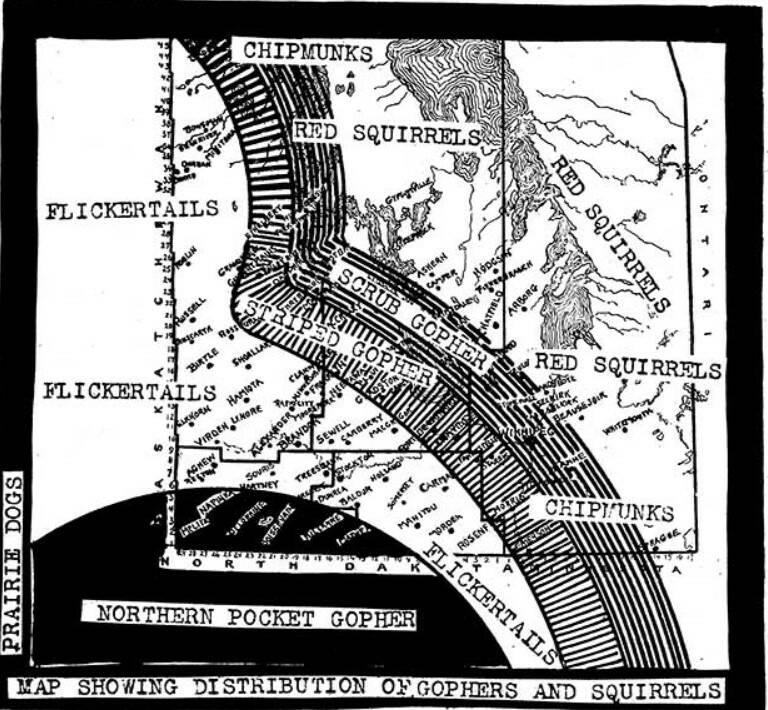
True gophers — members of the taxonomic family Geomyidae — are rodents that predominantly stay underground and look a lot like beavers, to which they’re more closely related than ground squirrels. Richardson’s ground squirrels (Urocitellus richardsonii) are members of the Sciuridae family.
Hare has loose theories about why this accidental naming occurred, but just like calling the koala a “bear,” it’s become stuck in everyday lingo.
Hare will refer to the ground squirrels as gophers colloquially and in the field to make himself understood to farmers, but the confusion grinds his gears a little bit, as they speak to greater misperceptions.
For Hare, it’s not just Prairie wildlife that’s often misunderstood, but also the rural communities that live alongside them.
“At times, people living in the urban setting forget what it is to really live off the land. (Farmers) are making decisions based on their understanding… it’s their living, you know?” he says.
JOHN WOODS / FREE PRESS Cohen Klassen and his brother Kyle work the gopher traps.
Many Manitoba hunters are highly informed about conservation practices. Government wildlife managers consult with both biologists and hunting associations when setting quotas, seasons and control measures, and there’s often an overlap between conservationists and hunters.
“To me, that’s the sweet spot, really,” Hare says. “You have some reverence for the life you’re taking to sustain your own… Hunting is far more in accord with nature than the industrial food processing we have.”
The academic and the practical, the environmental and the economic — these opposing forces can often create tension throughout the Prairie economy, suggests Colin Penner, a director with Keystone Agricultural Producers.
As an instructor at the University of Manitoba’s school of agriculture and a grain farmer, he says he does his best to balance the relevant priorities.
“Right from the time you put your seed in the ground, or turn out that calf on pasture, there’s something trying to negatively impact it,” he says.
“We need to think about future generations.”
“We want our crops to succeed. We want our livestock to succeed. And so it’s about how do we remove hindrances, whether it’s too much water or too many gophers, and do it economically?”
Nevertheless, when it comes to ground squirrels, he agrees with Hare that it’s more humane and ecological to engage in ground squirrel control earlier in the season, before mating occurs and juveniles are emerging from their burrows.
“We need to think about future generations, and how we are impacting the land and ecosystems around us,” he says. “So, how do we navigate all three of these different pillars that sometimes seem at odds with each other?”
Penner’s sensitivity to multiple viewpoints on gophers recalls the end of Calder’s essay.
After quoting Robert Kroetsch’s poem Seed Catalogue — “How do you build a prairie town?… the gopher was the model” — she suggests the contradictory image of the gopher embodies many of the dominant tensions in the Prairies, over heritage, identity and politics.
“Reading the gopher, then, means reading geography, politics, history and culture, and understanding that like the Prairie itself the gopher can mean many things simultaneously,” she writes.
JOHN WOODS / FREE PRESS Cohen Klassen and his brother Kyle work the gopher traps.
“Controversy over the gopher is in important ways symptomatic of the ever-present debates within the region over power as manifested in land ownership and the control of prairie space.”
As the Prairies continue to undergo a period of political polarization — with separatist referendums on the horizon and heated debates about trade and economic diversification, while a bird of prey watches intently from south of the border — these debates aren’t going anywhere.
We can’t bury our heads in the burrows, but maybe Richardson’s ground squirrel has something to teach us through all this.
winnipegfreepress.com/conradsweatman

Conrad Sweatman is an arts reporter and feature writer. Before joining the Free Press full-time in 2024, he worked in the U.K. and Canadian cultural sectors and freelanced for outlets including The Walrus, VICE and Prairie Fire. Read more about Conrad.
Our newsroom depends on a growing audience of readers to power our journalism. If you are not a paid reader, please consider becoming a subscriber.
Our newsroom depends on its audience of readers to power our journalism. Thank you for your support.