

City’s election history suggests Gillingham won’t have to break a sweat on way to second term

Advertisement
Read this article for free:
or
Already have an account? Log in here »
To continue reading, please subscribe:

Digital Subscription
One year of digital access for only $205*
- Enjoy unlimited reading on winnipegfreepress.com
- Read the E-Edition, our digital replica newspaper
- Access News Break, our award-winning app
- Play interactive puzzles
*First annual payment billed as $205.00 + GST for one year. This annual subscription will automatically renew at $233.00 + GST every 52 weeks (10% off the regular annual price of $259.35). Offer available to new and qualified returning subscribers only. Cancel any time.
To continue reading, please subscribe:
Add Free Press access to your Brandon Sun subscription for only an additional
$1 for the first 4 weeks*
- Enjoy unlimited reading on winnipegfreepress.com
- Read the E-Edition, our digital replica newspaper
- Access News Break, our award-winning app
- Play interactive puzzles
*Your next Brandon Sun subscription payment will increase by $1.00 and you will be charged $17.95 plus GST for four weeks. After four weeks, your payment will increase to $24.95 plus GST every four weeks.
Read unlimited articles for free today:
or
Already have an account? Log in here »
Is it over before it’s even really begun?
Last week, Mayor Scott Gillingham surprised no one when he officially registered as a candidate for the mayoral election in the fall. Not to completely disregard the importance of the democratic process, but history in this city has shown us that Gillingham is almost certainly headed to re-election.
The last time an incumbent Winnipeg mayor lost an election was 1956, when then-MLA Stephen Juba defeated George Sharpe. Juba went on to become one of Winnipeg’s longest-serving mayors; Sharpe was best known for using his two years in office to rid Winnipeg of its streetcars, a decision that public-transit supporters rue to this day.
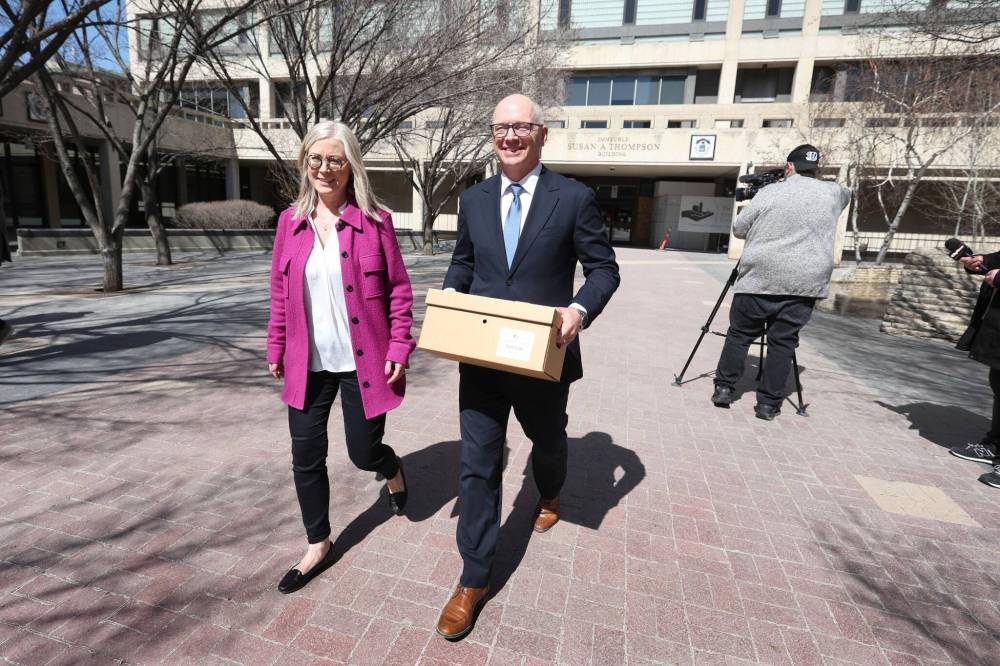
RUTH BONNEVILLE / FREE PRESS
Scott Gillingham, with his wife Marla, leaves City Hall on Friday with a box of documents after officially registering for the civic election in October.
How powerful is incumbency in this town? Although Juba beat Sharpe by only 1,900 votes, over the next 20 years in office, Juba never received less than 70 per cent of the popular vote.
That incumbent dominance continued for the mayors who followed Juba. The most hotly contested mayoral elections were, in general, those that did not involve an incumbent: Susan Thompson in 1992 (39 per cent support); Glen Murray in 1998 (50 per cent support); Sam Katz in 2004 (42 per cent support); Brian Bowman (47 per cent support); and Scott Gillingham in 2022 (27 per cent support).
The inevitability of Gillingham’s re-election should not prevent us from asking whether he deserves a second term. After looking at the broad strokes of his first three years in office, the answer is, yes.
When Gillingham moved into the mayor’s office in 2022, he inherited a city that had been — like all major urban centres across the world — ravaged by COVID-19.
There is an argument here that few if any Winnipeg mayors have, in their very first term, faced such an array of existential challenges. And while he cannot declare victory over any one of those challenges, Gillingham can certainly point to some positive achievements.
Among the highlights the mayor self-identified was movement on the completion of the interminable North End sewage treatment plant, the redevelopment of Portage Place and the reopening of Portage and Main to pedestrians.
It is the last of those accomplishments that demonstrates the positives that Gillingham brings to the mayor’s office.
City hall had tied itself in knots over reopening Portage and Main, with former mayor Brian Bowman essentially abandoning an issue he had campaigned on when seeking his own re-election. A hastily imposed 2018 plebiscite that turned a thumb’s-down to the project further tied the city’s hands.
Gillingham applied a sensible and practical lens to the issue. When it was learned the cost of repairs to the underground concourse — which would require tearing apart the intersection at street level and cause four or five years of miserable traffic issues — had risen to uncomfortable heights in the neighbourhood of $73 million, he built support on council for the removal of the barriers and a return to pedestrian crossings.
Some Winnipeggers likely still disagree with his decision. But a year on, the reopened intersection is a lightning rod for selfies, not grievances about traffic.
The mayor did not highlight the decision that he and council made to raise property taxes by 5.95 per cent this year, but there is an argument that this was, again, a sign of strong leadership. The city needed the money and past, politically expedient property tax freezes did way more long-term harm than good.
Those two decisions reveal a mayor committed to the right decisions, not the expedient decisions. In fact, there really is only one politically expedient mark on Gillingham’s first-term resumé: the odd and vague campaign for bail law reform.
Last year, when concerns about allegedly lax bail laws reached a fevered pitch, Gillingham began issuing bulletins about particularly egregious cases where it appeared the justice system was catching and then releasing dangerous, repeat offenders.
The problem was — and remains — that Gillingham didn’t have any tangible ideas on how to reform bail. He only sought to amplify the growing public concern that dangerous criminals were being indiscriminately released into the community to inflict more harm.
There’s a problem with that narrative: notwithstanding anecdotal incidents, the available data shows it’s tougher to get bail now than ever before and that our jails are overflowing with people who have not been convicted of a crime.

Gillingham is a politician and it is admittedly opportunistic to criticize him for engaging in politics. The people we elect to public office understand they need to occasionally echo, perhaps even pander to, the issues that people are concerned about. Even when those “issues” are not a fair reflection of reality.
The analysis of Gillingham’s first term is not an slam-dunk argument for re-election. It is an acknowledgement he has a case to make in seeking a second term.
You will be able to see just how strong a case when we start logging in challengers for the mayoralty. I could be wrong, but the smart money says that few if, any, serious contenders step forward.
Which is why, barring some weird and unforeseen development, we’re going to have four more years of Gillingham. Which, all in all, might not be the worst outcome.
dan.lett@freepress.mb.ca
Dan Lett is a columnist for the Free Press, providing opinion and commentary on politics in Winnipeg and beyond. Born and raised in Toronto, Dan joined the Free Press in 1986. Read more about Dan.
Dan’s columns are built on facts and reactions, but offer his personal views through arguments and analysis. The Free Press’ editing team reviews Dan’s columns before they are posted online or published in print — part of the our tradition, since 1872, of producing reliable independent journalism. Read more about Free Press’s history and mandate, and learn how our newsroom operates.
Our newsroom depends on a growing audience of readers to power our journalism. If you are not a paid reader, please consider becoming a subscriber.
Our newsroom depends on its audience of readers to power our journalism. Thank you for your support.
Dan Lett is a columnist for the Free Press, providing opinion and commentary on politics in Winnipeg and beyond. Born and raised in Toronto, Dan joined the Free Press in 1986. Read more about Dan.
Dan’s columns are built on facts and reactions, but offer his personal views through arguments and analysis. The Free Press’ editing team reviews Dan’s columns before they are posted online or published in print — part of the our tradition, since 1872, of producing reliable independent journalism. Read more about Free Press’s history and mandate, and learn how our newsroom operates.
Our newsroom depends on a growing audience of readers to power our journalism. If you are not a paid reader, please consider becoming a subscriber.
Our newsroom depends on its audience of readers to power our journalism. Thank you for your support.
Related Articles
Gillingham lists first-term mayoral accomplishments on way to register for Round 2

Advertisement Advertise With Us
Advertisement Advertise With Us