

New flex unit product of shift in police thinking

Advertisement
Read this article for free:
or
Already have an account? Log in here »
To continue reading, please subscribe:

Digital Subscription
One year of digital access for only $205*
- Enjoy unlimited reading on winnipegfreepress.com
- Read the E-Edition, our digital replica newspaper
- Access News Break, our award-winning app
- Play interactive puzzles
*First annual payment billed as $205.00 + GST for one year. This annual subscription will automatically renew at $233.00 + GST every 52 weeks (10% off the regular annual price of $259.35). Offer available to new and qualified returning subscribers only. Cancel any time.
To continue reading, please subscribe:
Add Free Press access to your Brandon Sun subscription for only an additional
$1 for the first 4 weeks*
- Enjoy unlimited reading on winnipegfreepress.com
- Read the E-Edition, our digital replica newspaper
- Access News Break, our award-winning app
- Play interactive puzzles
*Your next Brandon Sun subscription payment will increase by $1.00 and you will be charged $17.95 plus GST for four weeks. After four weeks, your payment will increase to $24.95 plus GST every four weeks.
Read unlimited articles for free today:
or
Already have an account? Log in here »
If you’ve ever called police for a non-emergency in Winnipeg and waited — and waited — for an officer to show up, you already understand the problem the Winnipeg Police Service is trying to fix.
It’s not that police don’t care. It’s that they’re stretched thin.
So the creation of a new 32-officer “flex unit” — announced last week — looks like one of those rare things in public policy: a practical, low-drama improvement that could actually make a difference.
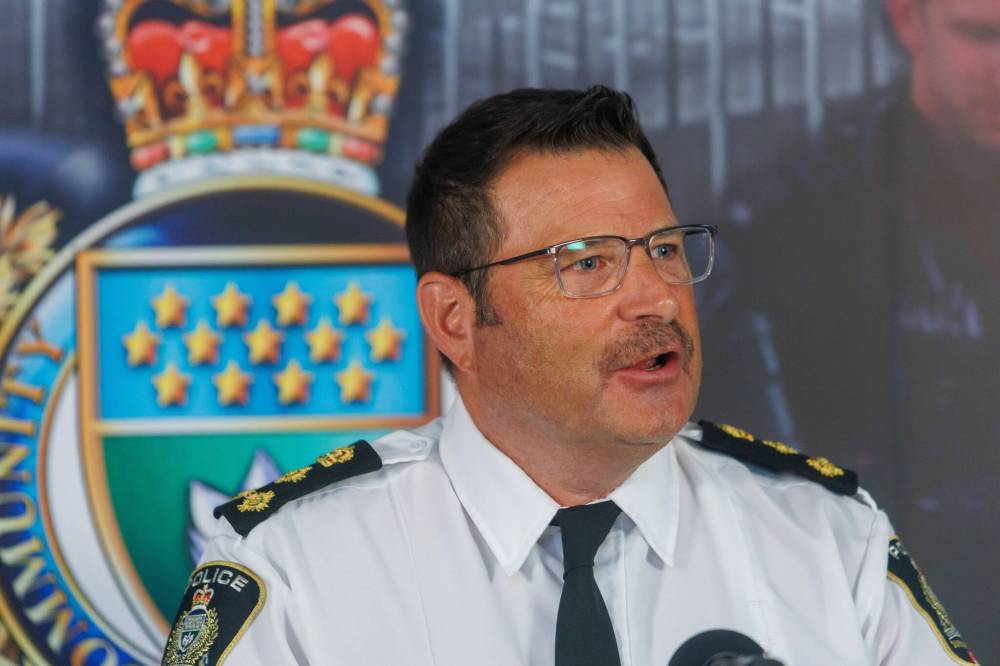
WPS Chief Gene Bowers announces the new Rapid Response Unit in April. (Mike Deal / Free Press files)
And in a city where policing debates often swing between “spend more” and “spend less,” this is something else entirely: spend smarter.
The concept is straightforward. Instead of constantly pulling officers away from specialized units — guns and gangs, community support, and others — whenever there’s a major event or a spike in calls, the flex team will handle those demands as its primary job.
When it’s not tied up with a marathon, a rally or a protest, it can be deployed wherever pressures are building, based on real-time data and community need.
That matters more than it might seem.
Until now, Winnipeg police have essentially been robbing Peter to pay Paul. A protest downtown? Pull officers from another unit. A parade? Same thing. A sudden surge in calls in a neighbourhood? Shift resources again. Every time that happens, something else gets delayed or diminished.
Police Chief Gene Bowers put it plainly: it wasn’t an efficient use of resources.
Policing isn’t just about how many officers you have. It’s about how you use them. And Winnipeg hasn’t exactly been swimming in extra capacity.
Even though the total number of officers has increased somewhat in recent years, it hasn’t kept pace with population growth. The result is a slow but steady erosion in police presence relative to the size of the city.
In 2013, Winnipeg had about 204 officers per 100,000 people. By 2024, that number dropped to 165.
That’s not a small change. That’s a significant decline over more than a decade.
Now layer on top of that the reality of modern policing: more demonstrations, more large-scale public events, more complicated cases, and close to 800,000 calls for service a year — well over 2,000 a day, on average.
Something has to give.
Too often, what gives is response time — especially for lower-priority calls. Those are the calls that may not involve immediate danger but still matter deeply to the people making them: property crimes, disturbances, ongoing neighbourhood issues.
When those calls get pushed down the priority list for hours — or longer — public confidence erodes. People feel ignored, frustration builds and small problems have a way of becoming bigger ones.
That’s where the flex unit could have a real impact.
By creating a dedicated team to absorb the predictable disruptions — protests, parades, rallies — the service frees up front-line officers to do the job they’re supposed to be doing: responding to calls in a timely way. And when call volumes spike, the flex team becomes a pressure valve, helping to prevent the system from backing up.
It’s not glamorous. But it’s smart.
It’s also happening at a time when the broader crime picture in Winnipeg is, cautiously, improving. Violent crime has been trending downward and overall crime has eased somewhat in recent years.
That’s good news. It takes some pressure off the system.
Still, violent crime in Winnipeg may be declining, but it remains at historically high levels.
Which makes the timing of this initiative important.
When demand is still high but no longer spiking upward, it creates a window to rethink how resources are deployed. The flex unit is exactly that kind of adjustment — not a reactive scramble, but a proactive recalibration.
And importantly, it’s being done without adding new officers.
That will inevitably raise some eyebrows. Can you really create a 32-officer unit without leaving gaps elsewhere?
Bowers insists the answer is yes and even suggests the old way of doing things was already creating those gaps by constantly redeploying officers on the fly.
Of course, the proof will be in the results. If response times improve — particularly for those long-neglected lower-priority calls — the flex unit will quickly prove its worth. If it doesn’t, then it’s just another internal reshuffle with a new name.

But on paper, at least, this looks like the kind of change policing experts have been calling for: more flexibility and more data-driven deployment.
Winnipeg doesn’t have the luxury of ignoring efficiency. With fewer officers per capita and ongoing demands on the system, every decision about resource allocation matters.
The flex unit won’t fix everything. It won’t eliminate delays or erase the underlying pressures on the system. But it does suggest a shift in thinking — away from reactive decision-making and toward a more structured, flexible approach.
In a service that fields thousands of calls a day, that kind of shift matters.
tom.brodbeck@freepress.mb.ca
Tom Brodbeck is an award-winning author and columnist with over 30 years experience in print media. He joined the Free Press in 2019. Born and raised in Montreal, Tom graduated from the University of Manitoba in 1993 with a Bachelor of Arts degree in economics and commerce. Read more about Tom.
Tom provides commentary and analysis on political and related issues at the municipal, provincial and federal level. His columns are built on research and coverage of local events. The Free Press’s editing team reviews Tom’s columns before they are posted online or published in print – part of the Free Press’s tradition, since 1872, of producing reliable independent journalism. Read more about Free Press’s history and mandate, and learn how our newsroom operates.
Our newsroom depends on a growing audience of readers to power our journalism. If you are not a paid reader, please consider becoming a subscriber.
Our newsroom depends on its audience of readers to power our journalism. Thank you for your support.
Tom Brodbeck is an award-winning author and columnist with over 30 years experience in print media. He joined the Free Press in 2019. Born and raised in Montreal, Tom graduated from the University of Manitoba in 1993 with a Bachelor of Arts degree in economics and commerce. Read more about Tom.
Tom provides commentary and analysis on political and related issues at the municipal, provincial and federal level. His columns are built on research and coverage of local events. The Free Press’s editing team reviews Tom’s columns before they are posted online or published in print – part of the Free Press’s tradition, since 1872, of producing reliable independent journalism. Read more about Free Press’s history and mandate, and learn how our newsroom operates.
Our newsroom depends on a growing audience of readers to power our journalism. If you are not a paid reader, please consider becoming a subscriber.
Our newsroom depends on its audience of readers to power our journalism. Thank you for your support.
Related Articles
Police chief announces ‘flex’ unit to staff public events and improve lower-priority response times
Advertisement Advertise With Us
Advertisement Advertise With Us