Canadian company’s winning innovation a giant leap for drinking water on the moon

Advertisement

Advertise with us

MONTREAL - On the moon, access to drinking water could mean the difference between short visits and a permanent human presence, and a Canadian company's award-winning invention has made colonizing Earth's natural satellite more within reach.

Read this article for free:


or

Already have an account? Log in here »

To continue reading, please subscribe:

Subscribe and receive a limited-edition Free Press branded hat or tote.

Digital Subscription

One year of digital access for only $205*

  • Enjoy unlimited reading on winnipegfreepress.com
  • Read the E-Edition, our digital replica newspaper
  • Access News Break, our award-winning app
  • Play interactive puzzles

*First annual payment billed as $205.00 + GST for one year. This annual subscription will automatically renew at $233.00 + GST every 52 weeks (10% off the regular annual price of $259.35). Offer available to new and qualified returning subscribers only. Cancel any time.

To continue reading, please subscribe:

Add Free Press access to your Brandon Sun subscription for only an additional

$1 for the first 4 weeks*

  • Enjoy unlimited reading on winnipegfreepress.com
  • Read the E-Edition, our digital replica newspaper
  • Access News Break, our award-winning app
  • Play interactive puzzles
Start now

*Your next Brandon Sun subscription payment will increase by $1.00 and you will be charged $17.95 plus GST for four weeks. After four weeks, your payment will increase to $24.95 plus GST every four weeks.

MONTREAL – On the moon, access to drinking water could mean the difference between short visits and a permanent human presence, and a Canadian company’s award-winning invention has made colonizing Earth’s natural satellite more within reach.

“There’s no shortage of challenges to purifying water in space,” Daniel Sax, CEO of Canadian Strategic Missions Corporation, said in a recent interview. ”We were able to develop a system designed to operate in the moon’s extreme conditions.”

His company’s invention — called LunaPure — won a competition in April run by the Canadian Space Agency, which had invited companies across the country to design technologies capable of extracting and purifying water on the moon.
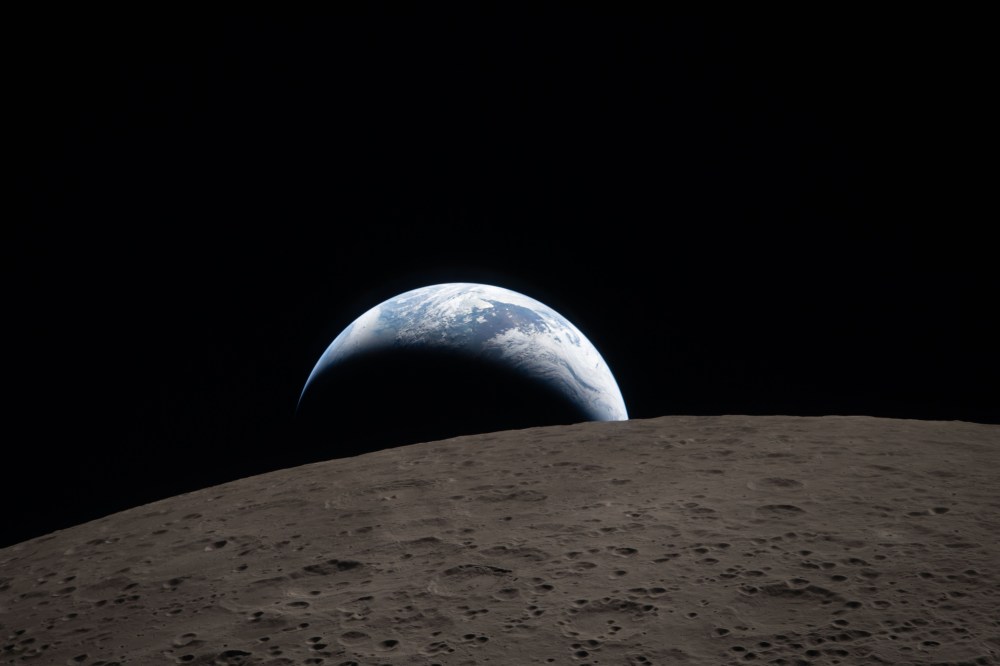
Earthset captured through the Orion spacecraft window at 6:41 p.m. EDT, April 6, 2026, during the Artemis II crew’s flyby of the Moon, is shown in this handout photo. THE CANADIAN PRESS/Handout - NASA (Mandatory Credit)

Every kilogram sent into space carries extraordinary cost, and the stakes are high: a viable solution for accessible drinking water could drastically cut the need for resupply missions — and help turn the idea of long-term lunar living into reality.

And the real-world application for LunaPure is becoming increasingly realistic. NASA’s Artemis program, developed in partnership with Canada’s space agency, aims to land a crew on the moon’s surface in 2028 and to eventually start construction of a lunar base that could support astronauts for weeks or even months at a time. The Artemis II mission saw four crew — including Canadian Jeremy Hansen — return to Earth April 10 after a 10-day trip around the moon.

The goal of the Canadian Space Agency’s Aqualunar Challenge was to identify a technology that was technically feasible, innovative and had long-term potential for future moon missions. Jury member, Marc Guilbert, who holds a PhD in theoretical physics and now works as an entrepreneur, said Sax’s proposal could realistically be adapted and be commercialized in the near future.

“We evaluated around 45 submissions,” Guilbert said in a recent interview. “Even in something as extreme as water extraction on the moon, there were multiple fundamentally different ways to tackle the problem.”

The winning proposal — Sax describes his prototype as no larger than a “box of books” — earned the competition’s grand prize of $400,000. It works by using heat from solar energy to melt ice and trigger a chemical process that removes contaminants, producing clean water.

Dr. Tara Hayden, a lunar geoscientist at Western University who worked with the Canadian Space Agency through the Artemis II and Artemis III programs, says technologies like LunaPure could also be used for producing rocket fuel.

Moving from ice to rocket fuel ”works by extracting hydrogen and oxygen from water through electrolysis,” said Hayden, who is a post-doctoral associate at Western’s department of earth sciences. Electrolysis is a process that uses electricity to ”split” water; the gases can then be compressed into liquid form and used as rocket propellant, she explained.

But accessing water on the moon is far from being straightforward — water is so scarce its presence is counted in parts per million. “It is not like Earth, you cannot assume easy access to water.”

Scientific understanding of lunar water has shifted significantly in recent years. With samples taken during Apollo moon missions, “we thought the moon was bone dry,” said Hayden. But Hayden says her research shows that water is ”present in multiple reservoirs — we now believe there is around 600 billion kilograms of water in the form of ice (on the moon).”

Hayden says current missions are focused on ice trapped in permanently shadowed regions — deep craters where sunlight never reaches. These areas, among the coldest on the moon, have acted as “cold traps” over billions of years, allowing water to accumulate and remain frozen.

Upcoming Artemis missions aim to locate these deposits remotely, then eventually to collect samples from them. “We don’t know exactly where the ice is,” Hayden said.

Even once located, extracting lunar ice presents major engineering challenges. That complexity, said Sax, is exactly what technologies like the Aqualunar-winning system aim to address. He said the technology was designed under strict constraints, including limits on mass, power, and self-sufficiency — all critical considerations for space missions.

“Everything in space is mass and power limited,” he said. “It costs millions (of dollars) per kilogram to launch materials, so the system has to be extremely efficient.”

Purification adds another layer of difficulty. “You are dealing with contaminants and highly variable composition,” Sax said. While the LunaPure system has achieved high levels of purification in testing, he added that it would still need further refinement before being used for human consumption or fuel production.

“We’re getting significantly closer,” Hayden said. “Now, we just need to test (the technologies) specifically in the lunar environment to see if it would be sustainable for helping our long-term cohabitation there.” Trials are expected to unfold over the next few years.

Deploying such technology on the moon will likely require international collaboration, said Sax.

”If we are lucky and play our cards right, our technology could be part of future lunar missions,” he said, adding the system could one day become “one of the processes … humans are using to purify water on the moon for the next 100 years.”

Beyond enabling human life on the moon, Hayden said, the technology could also have applications on Earth. “We could use it to locate and access water that isn’t easily available, particularly in regions facing scarcity,” she said.

This report by The Canadian Press was first published May, 6 2026.

Report Error Submit a Tip

More Stories

Late philanthropist, family fill Harvest’s Empty Bowls with record-setting $5-M donation

Morgan Modjeski 3 minute read Preview

Late philanthropist, family fill Harvest’s Empty Bowls with record-setting $5-M donation

Morgan Modjeski 3 minute read Updated: Yesterday at 11:54 PM CDT

It was a record-breaking night for Harvest Manitoba made possible by a genuine Winnipeg hero and his family.

The organization’s annual Empty Bowls Celebrity Auction Dinner on Thursday raised $6.5 million to support Manitobans facing hunger and food insecurity.

And it was a $5-million legacy donation from late city philanthropist Doug Harvey and his family that will see the event go down in the history books as the largest gala fundraising total ever recorded in Manitoba.

“There was literally nothing that lit my dad up more than contributing himself, but even more so, inspiring others to give,” his daughter Lauren Harvey said Friday.

Read
Updated: Yesterday at 11:54 PM CDT

Nature doesn’t waste its time

Russell Wangersky 7 minute read Preview

Nature doesn’t waste its time

Russell Wangersky 7 minute read 2:01 AM CDT

Sixteen months in and the black burn from a forest fire somehow transitions from the foreground to the background. I’m not sure if it actually softens, if it really changes, or if is just that your eyes, now used to the background, start seeing less of it.

One thing’s for certain: nature doesn’t waste any time taking its opportunities. In the sheltered ground behind where the shed over our Newfoundland root cellar used to be, a forest of sorrel has arisen, its dark-green leaves with their distinctive double horns at their base crowding in tight amongst each other.

It’s no surprise: sorrel is new beginnings, often the first plant I see recultivating abandoned gardens or disturbed ground and I’m happy to have it around always. Its distinctive lemony bite is a fine addition to salads, though we’re not likely to choose it from that particular root cellar patch. Not with the way the asphalt roof shingles burned right around there. I shovelled up the heavy pats of congealed black tar last spring, right after the fire, bringing them up from inside the cellar in big plastic buckets to send to safe disposal. But there’s probably plenty of tar still in the ground and out of sight — hardly an appetizing thought.

From other areas, maybe we will eventually sample sorrel: it depends on how close they were to the house or shed or anything else that burned. And so very much burned. The province has said gardens are safe from contamination by fire-retardant chemicals as nothing has shown up in tests. But we know what way the wind was blowing — what burned, and where, is always part of the equation. It’s a strange calculation to make: I’m just glad our house wasn’t heated with fuel oil, was too old to contain asbestos, and didn’t have indoor plumbing for decades.

Read
2:01 AM CDT

Letters, Oct. 10

6 minute read 2:01 AM CDT

Investing in adult vaccines

Last week, provincial and territorial health ministers held an emergency meeting on the looming expiration of federal health funding and the financial pressures facing health systems across the country.

As they gather again in Winnipeg later this month, there is a critical piece missing from the conversation — prevention.

Canada has a strong public-health tradition, but its gains cannot be taken for granted. In 2021, Canada reported zero measles cases. By 2025, more than 5,400 cases had been reported, costing Canada its measles elimination status and Manitoba saw this firsthand.

Puppies, stocks — ‘zoomies’ abound

Andrew Froese 4 minute read 2:01 AM CDT

This spring, I adopted a three-month-old rescued German Shepherd mix. To say she is easily excitable is an understatement.

It is not really her fault. A puppy’s frontal cortex, the part of the brain that helps with decision-making and impulse control, is still developing. When an older dog, or a human, gets tired, we generally understand we should rest. Puppies have not quite figured that out. They often interpret tiredness as a signal something is wrong, which makes them more alert, more reactive and harder to settle.

That creates a feedback loop. The puppy gets tired, which makes her frantic, which makes her more tired, which makes her even more frantic. Eventually, this becomes what people call the “zoomies”: frantic sprinting, biting, jumping and general chaos.

From the outside, it looks like the puppy has too much energy. In reality, the opposite is true. The zoomies are not a sign of excess energy. They are a sign the puppy is overtired and does not know it yet.

A Rocky day on the mayoral campaign trail for Kevin Klein

Malak Abas 12 minute read Preview

A Rocky day on the mayoral campaign trail for Kevin Klein

Malak Abas 12 minute read Yesterday at 12:00 PM CDT

Kevin Klein acknowledges it’s hard to foresee what he’ll wake up to each morning in the final weeks of a mayoral campaign.

But the seasoned politician, who has served as both a city councillor and a provincial cabinet minister, couldn’t have predicted the events — what he describes as “drama” — that unfolded last Sunday.

Fellow mayoral candidate Mike Vogiatzakis accused Klein’s campaign team of offering him a job to drop out of the race, while a guest writer’s column in the Winnipeg Sun that questioned the deaths of Indigenous children at residential schools, just days after the National Day for Truth and Reconciliation, sparked condemnation from a prominent Indigenous organization. (Klein is the CEO of the Klein Group, the company that owns the Sun. He has maintained he is not involved in its operations while running for mayor.)

The Free Press had already been scheduled to join Klein on the campaign trail Monday, intending to document a day in the life of the front-running candidate to unseat incumbent Scott Gillingham, before the controversies hit.

Read
Yesterday at 12:00 PM CDT

Manitoba worker dead after fall from roof

Matthew Frank 3 minute read Thursday, Oct. 8, 2026

The province is investigating after a worker died on the job after falling off a roof last month.

The worker, who was employed by Winnipeg-based Pristine Roofing & Siding, was critically injured on Sept. 22 after falling from a roof during a residential re-roofing project in the Rural Municipality of St. Andrews, a provincial spokesperson said in an email.

The man later died.

The investigation is ongoing, and no other information will be provided, the spokesperson said Thursday.