

Venezuela tells UN court that mineral-rich part of Guyana was fraudulently taken in colonial era
Advertisement
Read this article for free:
or
Already have an account? Log in here »
To continue reading, please subscribe:
Digital Subscription
One year of digital access for only $1.44 a week*
- Enjoy unlimited reading on winnipegfreepress.com
- Read the E-Edition, our digital replica newspaper
- Access News Break, our award-winning app
- Play interactive puzzles
*Billed as $5.77 plus GST every four weeks. After 52 weeks, price increases to the regular rate of $19.95 plus GST every four weeks. Offer available to new and qualified returning subscribers only. Cancel any time.
To continue reading, please subscribe:
Add Free Press access to your Brandon Sun subscription for only an additional
$1 for the first 4 weeks*
- Enjoy unlimited reading on winnipegfreepress.com
- Read the E-Edition, our digital replica newspaper
- Access News Break, our award-winning app
- Play interactive puzzles
*Your next Brandon Sun subscription payment will increase by $1.00 and you will be charged $17.95 plus GST for four weeks. After four weeks, your payment will increase to $24.95 plus GST every four weeks.
Read unlimited articles for free today:
or
Already have an account? Log in here »
THE HAGUE, Netherlands (AP) — Venezuela insisted Wednesday that a disputed mineral-rich region of Guyana was fraudulently taken in a 19th-century example of colonialism, arguing that a 1966 agreement and not the United Nations’ highest court should finalize ownership of the territory.
The International Court of Justice is holding a week of hearings between the South American neighbors who both lay claim to the Essequibo region, which is rich in gold, diamonds, timber and other natural resources and is located close to massive offshore oil deposits.
An 1899 decision by arbitrators from Britain, Russia and the United States drew the border along the Essequibo River largely in favor of Guyana. The U.S. represented Venezuela in part because the Venezuelan government had broken off diplomatic relations with Britain. Venezuela contends that the Americans and Europeans conspired to cheat the country out of its rightfully owned land.
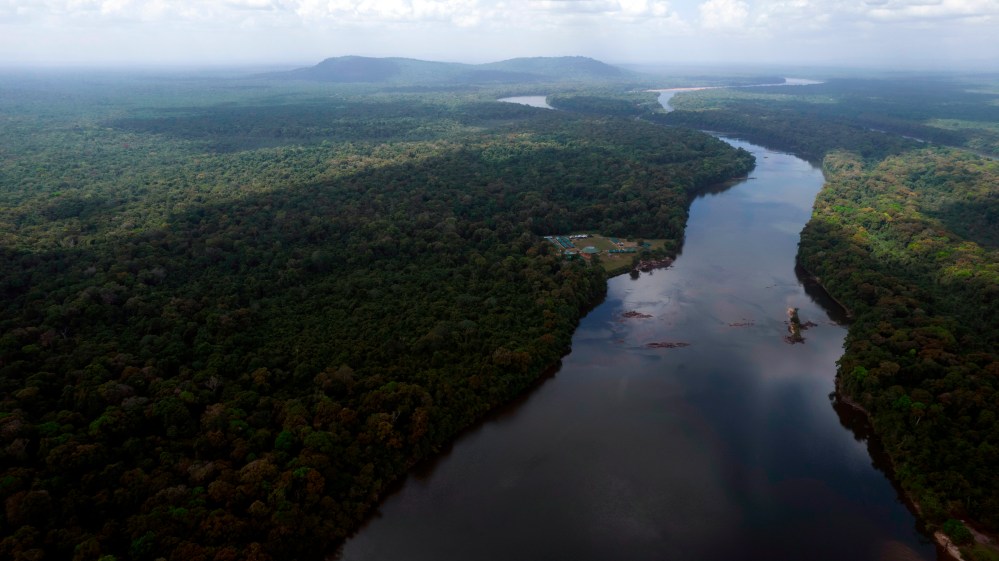
Venezuela has considered Essequibo as its own since the Spanish colonial period when the jungle-draped region was within its boundaries. The country argues a 1966 agreement sealed in Geneva to resolve the dispute effectively nullified the 19th-century arbitration.
“Guyana presents itself as the true, legitimate heir to British and Dutch territories, but the reality is that it is the beneficiary of colonial dispossession, formalized through fraudulent arbitration. The Geneva Agreement seeks to correct this century-old injustice,” Venezuela’s representative, Samuel Reinaldo Moncada Acosta, told the world court.
He said that Venezuela rejects the court’s jurisdiction that was “erroneously imposed” in a 2020 decision and said the 1966 agreement “establishes a framework” for a negotiated resolution.
As hearings opened Monday, Guyana’s foreign minister, Hugh Hilton Todd, told the panel of international judges that the dispute “has been a blight on our existence as a sovereign state from the very beginning.” He said that 70% of Guyana’s territory is at stake.
The court, based in The Hague, is likely to take months to issue a final and legally binding ruling in the case.
___
This story has been corrected to show that the first name of Guyana’s foreign minister is Hugh, not High.