

New Brunswick should move faster on Health Canada guidelines for clean water: doctor
Advertisement
Read this article for free:
or
Already have an account? Log in here »
To continue reading, please subscribe:

Digital Subscription
One year of digital access for only $205*
- Enjoy unlimited reading on winnipegfreepress.com
- Read the E-Edition, our digital replica newspaper
- Access News Break, our award-winning app
- Play interactive puzzles
*First annual payment billed as $205.00 + GST for one year. This annual subscription will automatically renew at $233.00 + GST every 52 weeks (10% off the regular annual price of $259.35). Offer available to new and qualified returning subscribers only. Cancel any time.
To continue reading, please subscribe:
Add Free Press access to your Brandon Sun subscription for only an additional
$1 for the first 4 weeks*
- Enjoy unlimited reading on winnipegfreepress.com
- Read the E-Edition, our digital replica newspaper
- Access News Break, our award-winning app
- Play interactive puzzles
*Your next Brandon Sun subscription payment will increase by $1.00 and you will be charged $17.95 plus GST for four weeks. After four weeks, your payment will increase to $24.95 plus GST every four weeks.
Read unlimited articles for free today:
or
Already have an account? Log in here »
FREDERICTON – New Brunswick’s government should adapt its clean water regulations more quickly to Health Canada guidelines, a physician with an environmental advocacy group told legislators Thursday during a morning hearing.
The government should put into law a process to eliminate the lag between federal guidance and on-the-ground application by the province, Dr. Chris Arsenault told a committee considering changes to the Clean Water Act.
“It just happens in an ad hoc fashion right now. We’re recommending that it happens in a formalized way,” Arsenault, a representative of the local chapter of the Canadian Association of Physicians for the Environment, told reporters after the meeting.

He cited the example of Health Canada issuing recommendations several years ago on preventing chemical contamination of drinking water.
Health Canada in 2018 and 2019 established drinking water guidelines for various forever chemicals — known as PFAS — which are man-made chemicals that don’t break down easily and can pose health risks.
“Nothing really happened provincially at that time,” Arsenault said. New Brunswick, he said, only in February started monitoring for so-called forever chemicals after an updated set of PFAS guidelines were released by Health Canada in 2024.
At that time, high concentrations of forever chemicals were found in the water supply of a northern New Brunswick town. Arsenault said it will never be known how long the chemicals were in Charlo’s water supply because the province wasn’t monitoring for the dangerous chemicals before then.
New Brunswick’s Environment Department said in a statement to The Canadian Press that testing has so far indicated PFAS levels in the rest of the province are typically below Health Canada’s interim objective PFAS levels established in 2024.
Jennifer MacNeil, an Environment Department spokesperson, confirmed the province’s drinking water regulations were updated to align with Health Canada earlier this year.
“Health Canada’s drinking water guidelines are recommendations, and provinces are responsible for deciding how to implement them based on the local regulatory framework and review processes,” MacNeil wrote.
She also noted New Brunswick’s new drinking water quality portal featuring data collected by local governments. MacNeil said the portal is part of the Liberal government’s aim to increase public confidence in their drinking water.
Arsenault said public health guidelines are continually evolving based on scientific evidence, so it’s important to stay up to date.
“Any time Health Canada updates their guidelines, it’s because they’ve demonstrated with a reasonable amount of scientific certainty some kind of causal link between a toxin exposure at a certain level and a negative health consequence for human beings,” Arsenault said.
“And so if we’re not updating … we’re potentially essentially ignoring undue exposures and their health consequences.”
Megan Mitton, a Green Party member on the committee, said the government’s water-protection mechanisms are inadequate because officials don’t quickly adopt the newest science.
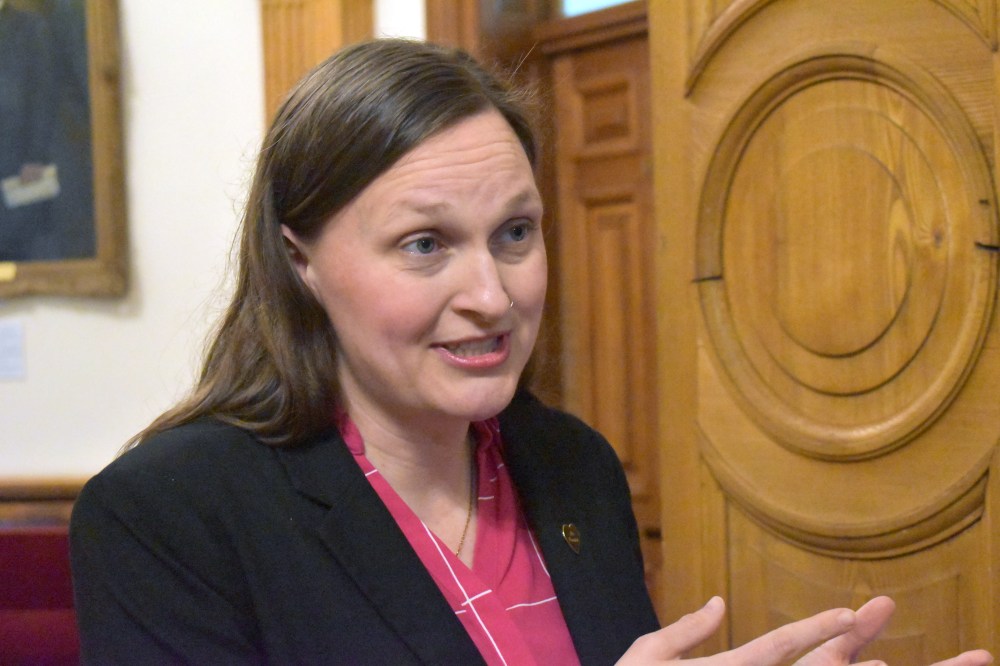
“We need to have a process — perhaps it needs to automatically happen. Or, there needs to be a short time limit to allow for the adoption,” Mitton said in an interview.
The committee also heard from representatives of the Conservation Council of New Brunswick and Chief Hugh Akagi of the Peskotomuhkati First Nation.
Marieka Chaplin, freshwater director at the conservation council, said the government should provide financial support for PFAS testing to private homeowners with wells.

“I’ve learned that it costs $1,000 if you’re on a private well to test annually for PFAS, for forever chemicals. I could imagine a very small percentage of the population could afford that,” Chaplin said.
In a presentation to the committee, Chief Akagi said the government needs to treat First Nations communities as partners. Too often, he said, it feels as though the government is checking off boxes on a list instead of truly dialoguing with Indigenous Peoples.
“With co-governance, we have to make it real. It’s not real,” he said following the hearing.
Earlier this week, the climate change and environmental stewardship committee heard from a lawyer urging the government to enshrine the right to clean water in legislation.
This report by The Canadian Press was first published May 7, 2026.