Novel’s narrative built on memory’s fallible foundation

Advertisement
Read this article for free:
or
Already have an account? Log in here »
To continue reading, please subscribe:
Digital Subscription
One year of digital access for only $1.44 a week*
- Enjoy unlimited reading on winnipegfreepress.com
- Read the E-Edition, our digital replica newspaper
- Access News Break, our award-winning app
- Play interactive puzzles
*Billed as $5.77 plus GST every four weeks. After 52 weeks, price increases to the regular rate of $19.95 plus GST every four weeks. Offer available to new and qualified returning subscribers only. Cancel any time.
To continue reading, please subscribe:
Add Free Press access to your Brandon Sun subscription for only an additional
$1 for the first 4 weeks*
- Enjoy unlimited reading on winnipegfreepress.com
- Read the E-Edition, our digital replica newspaper
- Access News Break, our award-winning app
- Play interactive puzzles
*Your next Brandon Sun subscription payment will increase by $1.00 and you will be charged $17.95 plus GST for four weeks. After four weeks, your payment will increase to $24.95 plus GST every four weeks.
Read unlimited articles for free today:
or
Already have an account? Log in here »
We like to think we remember things exactly as they happened, exactly as they were. But memories can be slippery. They can be fragmented. Can they ever really be relied upon?
Winnipeg author M.C. Joudrey wrestles with these ideas in his latest novel, Marmalade Parade (Guernica Editions), which came out earlier this month and will be launched Saturday at McNally Robinson Grant Park.
The initial seeds for the book were planted when Joudrey, 49, began watching family members struggle with memory loss, dementia and Alzheimer’s.

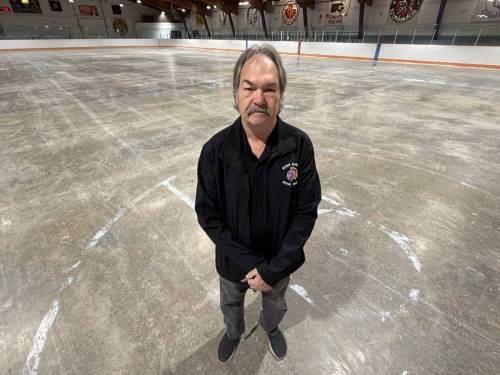
Anders Homenick photo
M.C. Joudrey’s Marmalade Parade was inspired by his relatives’ struggles with memory loss.
“And the really baffling nature of those diseases is how somebody who’s known you for 50 years suddenly doesn’t know you at all, or has no recollection of decades and decades of history,” he says.
But even if one doesn’t suffer from a medical condition that attacks memory, our memories are not as infallible as we like to believe, especially when it comes to shared experiences, because other people have memories, too.
“There’s a number of scenarios that play out in the novel that express exactly that,” he says. “Arguments happen, and people are so confident about their points of argument — you know, you said this, and then that other person says, no, I didn’t. So who’s right?”
Marmalade Parade does not follow a traditional linear narrative. In the first section, our unnamed first-person narrator arrives at a remote house owned by a man suffering from illness affecting his memory, and both men need to puzzle out why they have been brought together.
The second section is an estate auction, lives recounted in objects. The last section, Paperwork, is a clinical corporate conversation closing out the case.
The estate-sale auction gets readers thinking about the relationship to their own belongings, how much identity — and memory — we derive from them.
“I wanted to explore the idea of: do we actually own anything, or are we just holding it for the next generation? The things that we own, do we leave any imprints upon them? Is there anything that we can learn from the person that lived with those belongings?” he says.
Joudrey, as it happens, is an avid collector himself, which adds a meta layer to the auction section.
“It is a constant conversation in the house,” he says with a laugh. “I have some rare butterflies, a big record collection, the list goes on and on. The ephemera, oh, the ephemera is almost staggering. Do I just begin to sell it now? Or am I just going to keep enjoying these things? Because I do enjoy them. That is, I think, the power of nostalgia.”

M.C. Joudrey’s latest novel is Marmalade Parade.
Nostalgia, obviously, plays a big role in a novel about memory. In the book, the protagonist recounts his earliest memory, in which he is given a toy truck by his father, and the truck is red.

“And the antagonist says, ‘Well, how do you know it was red?’ And he goes, ‘Because I remember that it was red.’ And the antagonist says, ‘Yeah, but you have a picture of it? Do you still own it? Do you have any proof that it’s red at all? It’s your oldest memory. How do you know it’s not green?’” Joudrey says.
“I think about this a lot. I have these memories, and I rely on them as the foundation of who I am. We rely on the most unreliable things to become who we are.”
And even our most treasured, foundational memories are distorted by the smudged lens through which we view them.
“There’s some tragicomedy in there,” Joudrey says. “Nostalgia is steeped in this custard-coloured celluloid memory, and it is beautiful and glittering and completely unreliable.”
winnipegfreepress.com/jenzoratti
Jen Zoratti is a columnist and feature writer working in the Arts & Life department, as well as the author of the weekly newsletter NEXT. A National Newspaper Award finalist for arts and entertainment writing, Jen is a graduate of the Creative Communications program at RRC Polytech and was a music writer before joining the Free Press in 2013. Read more about Jen.
Every piece of reporting Jen produces is reviewed by an editing team before it is posted online or published in print – part of the Free Press‘s tradition, since 1872, of producing reliable independent journalism. Read more about Free Press’s history and mandate, and learn how our newsroom operates.
Our newsroom depends on a growing audience of readers to power our journalism. If you are not a paid reader, please consider becoming a subscriber.
Our newsroom depends on its audience of readers to power our journalism. Thank you for your support.
Book launch
Marmalade Parade by M.C. Joudrey
Hosted by George Toles
● McNally Robinson Booksellers Grant Park
● Saturday, 7 p.m.
● Free
Jen Zoratti is a columnist and feature writer working in the Arts & Life department, as well as the author of the weekly newsletter NEXT. A National Newspaper Award finalist for arts and entertainment writing, Jen is a graduate of the Creative Communications program at RRC Polytech and was a music writer before joining the Free Press in 2013. Read more about Jen.
Every piece of reporting Jen produces is reviewed by an editing team before it is posted online or published in print – part of the Free Press‘s tradition, since 1872, of producing reliable independent journalism. Read more about Free Press’s history and mandate, and learn how our newsroom operates.
Our newsroom depends on a growing audience of readers to power our journalism. If you are not a paid reader, please consider becoming a subscriber.
Our newsroom depends on its audience of readers to power our journalism. Thank you for your support.
Advertisement Advertise With Us
Advertisement Advertise With Us