Cocktail of pills, caffeine and fire retardant put B.C. chinook salmon at risk: study

Advertisement

Advertise with us

British Columbia researchers found more than 200 contaminants in water and chinook salmon tissue samples collected from five sites in the Lower Fraser River estuary including everything from cocaine and antidepressants to caffeine and flame retardants.

Read this article for free:


or

Already have an account? Log in here »

To continue reading, please subscribe:

Subscribe and receive a limited-edition Free Press branded hat or tote.

Digital Subscription

One year of digital access for only $205*

  • Enjoy unlimited reading on winnipegfreepress.com
  • Read the E-Edition, our digital replica newspaper
  • Access News Break, our award-winning app
  • Play interactive puzzles

*First annual payment billed as $205.00 + GST for one year. This annual subscription will automatically renew at $233.00 + GST every 52 weeks (10% off the regular annual price of $259.35). Offer available to new and qualified returning subscribers only. Cancel any time.

To continue reading, please subscribe:

Add Free Press access to your Brandon Sun subscription for only an additional

$1 for the first 4 weeks*

  • Enjoy unlimited reading on winnipegfreepress.com
  • Read the E-Edition, our digital replica newspaper
  • Access News Break, our award-winning app
  • Play interactive puzzles
Start now

*Your next Brandon Sun subscription payment will increase by $1.00 and you will be charged $17.95 plus GST for four weeks. After four weeks, your payment will increase to $24.95 plus GST every four weeks.

British Columbia researchers found more than 200 contaminants in water and chinook salmon tissue samples collected from five sites in the Lower Fraser River estuary including everything from cocaine and antidepressants to caffeine and flame retardants.

They say some of the “cocktail” that the juvenile fish are swimming in presents a possible risk to the young fish themselves and is concerning for the endangered whales that eat them.

The study, to be published in Environmental Toxicology and Chemistry, is believed to be the largest screening of its kind in the Lower Fraser River and was done by researchers from the Fisheries Department, Simon Fraser University, the Raincoast Conservation Foundation and Environment and Climate Change Canada. 
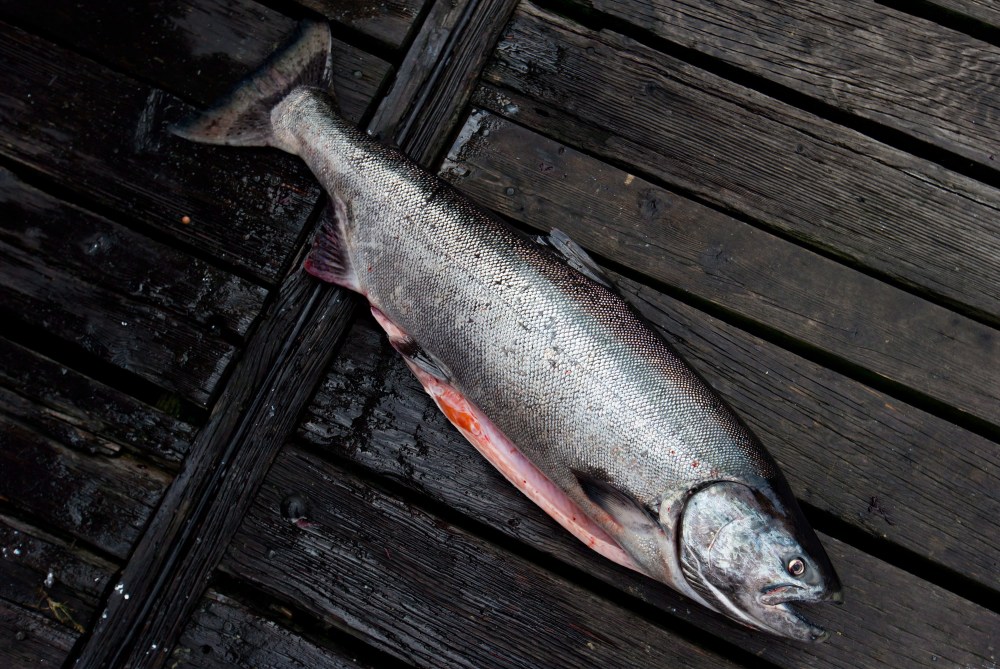
A 24-pound chinook salmon is seen on the dock after a guided fishing tour operated by Bonnie Lee Charters in Vancouver, B.C., on Saturday August 18, 2012. THE CANADIAN PRESS/Darryl Dyck

Senior author Tanya Brown said of the contaminants found, 16 were deemed “priority contaminants,” meaning the amounts were high enough that they “had potential for adverse effects” on aquatic life.

Another 23 were labelled as being worth monitoring.

“Of those 16 priority contaminants, 15 were ones that were detected in water, and those are largely dominated by pharmaceuticals, like caffeine and antidepressants, blood pressure medication were detected, (as well as) metformin, which is used for diabetes,” she said.

Brown said the next step is to study what effect the contamination is having on the salmon’s health.

Decades of declines mean more than 85 per cent of chinook populations are now classified as either endangered or threatened.

She said the next studies will look at measurements such as tissue-level changes, cellular changes and metabolism changes in the fish.

Brown said the thresholds the study used to determine whether something could pose a risk to the fish come from research where chemicals were tested individually, not in the kind of “cocktail” that was found in the river.

“We really don’t have a grasp on the additive effects of this complex mixture that fish are essentially swimming in,” she said.

“I think there’s a potential for it to be much more concerning than what we can actually propose it may be.” 

Brown said the Fraser River is fast-flowing and if contamination is found there, it’s possible it could be more concentrated in creeks and other bodies of water that don’t move as quickly.

She said along with being worried about the salmon, researchers were concerned about the implications for endangered whales that rely on them for food.

“We know that the Fraser River chinook populations account for up to 90 per cent of southern resident killer whales’ diet during summer months. So, they play a really significant role,” she said.

At last count, there were only 74 southern resident killer whales in existence.

This report by The Canadian Press was first published May 21, 2026.

Report Error Submit a Tip

More Stories

Winnipeg, police and downtown crime

Editorial 4 minute read Preview

Winnipeg, police and downtown crime

Editorial 4 minute read 2:01 AM CDT

A safer downtown is not much use if people are still afraid to walk there.

That is the uncomfortable message from Winnipeg’s latest police citizen survey, and one city council should take seriously.

Downtown crime has fallen this year, according to the most recent police statistics. Violent crime is down even more. But for most Winnipeggers, the downtown still feels like a place to avoid, particularly after dark.

Only 44 per cent of survey respondents said they feel very or reasonably safe walking alone downtown during the day. At night, that number plunges to just eight per cent. Among women, it is an appalling three per cent, compared with 14 per cent of men.

Read
2:01 AM CDT

Two drivers suffer minor injuries in Highway 8 crash

1 minute read Yesterday at 12:30 PM CDT

Two men sustained minor, but not life-threatening injuries after a crash on Highway 8 at Whytewold Road in the RM of St. Andrews Monday afternoon.

At 3:45 p.m. Selkirk RCMP responded to the two-vehicle collision, which happened after a vehicle travelling south on Highway 8 collided with a westbound vehicle that was crossing the highway from Whytewold Road.

The driver of the southbound vehicle, a 26-year-old man, and the driver of the westbound vehicle, a 24-year-old man, both from the RM of Gimli, were involved. The 24-year-old was ticketed for proceeding before safe to do so.

Nothing wrong with planting trees, but it won’t get province very far on path to net zero

Dan Lett 5 minute read Preview

Nothing wrong with planting trees, but it won’t get province very far on path to net zero

Dan Lett 5 minute read Monday, Sep. 14, 2026

Manitoba’s new plan to achieve net zero carbon emissions by 2050 is a lot of things. It’s detailed. It’s certainly comprehensive in scope. But when it is all said and done, it is still very much a work in progress.

Read
Monday, Sep. 14, 2026

Defenceman Morrissey focused on season ahead

Ken Wiebe 8 minute read Preview

Defenceman Morrissey focused on season ahead

Ken Wiebe 8 minute read Monday, Sep. 14, 2026

Josh Morrissey insists that a trade request from the franchise goalie doesn’t change his desire to be a lifelong Winnipeg Jet.

The top-pairing defenceman and alternate captain reinforced that view on Monday morning when speaking to a group of reporters prior to the Winnipeg Jets Golf Classic at St. Charles Country Club.

“At the end of the day, I love being here and I love being a Jet. That’s how I’ve always felt,” said Morrissey, who spoke for just over nine minutes on a variety of topics. “That doesn’t change because of somebody else’s decision. Nothing is finalized, so who knows, he could be back. My position doesn’t change.”

Morrissey has two years left on a contract that pays him US$6.25 million and he’s only eligible to sign an extension on July 1, but the future of the franchise pillar will be a topic of discussion as the Jets work to sort through the situation with franchise goaltender Connor Hellebuyck, which remains unresolved.

Read
Monday, Sep. 14, 2026

Wind and batteries the best bet

James Wilt 5 minute read Preview

Wind and batteries the best bet

James Wilt 5 minute read 2:01 AM CDT

For years, Manitoba Hydro has claimed that we can’t rely on wind turbines during multi-day or even multi-week cold snaps. Although turbines can be equipped with cold-weather packages to operate down to –30 C, as at the St. Leon and St. Joseph wind farms, Hydro routinely warns of the possibility of a lengthy winter wind drought at the same time as electricity use peaks due to high heating demand.

This concern is largely why Hydro is pushing to build a 750 MW fossil gas-fired power plant in Brandon, rather than building more wind farms.

But new analysis by Alexander Hogeveen Rutter, a former energy modeller for Manitoba Hydro, shows that wind-generation reliability well exceeds assumptions and that, if combined with battery energy storage, it could meet even the most bullish load growth forecasts. (These findings were presented to the Public Utilities Board on Aug. 31, and the full report can be found on Climate Action Team Manitoba’s website.)

Hydro’s low estimate of wind generation stems from its erroneous assumption that all new wind farms will be built in the same locations as Manitoba’s two existing wind farms (St. Leon and St. Joseph). Because these two wind farms are only 100 kilometres apart, they have highly correlated wind speeds; when wind conditions are low at one site, they likely are at the other as well. This is not how new wind farms will be built in Manitoba. Instead, they will be located in different areas and use much taller turbines with higher generation potential than the existing wind farms.

Read
2:01 AM CDT

BRANDON — A 29-year-old man has been sentenced to 18 years in prison for sexually abusing and impregnating a 14-year-old girl in 2024.

“Sexual abuse of a child is inherently a grave violation of the child’s bodily integrity, dignity, and security, and in this case, the consequences were compounded by the victim’s pregnancy and the need to undergo a termination,” Brandon provincial court Judge Patrick Sullivan said on Tuesday.

The accused had pleaded guilty to two counts of sexual interference and two counts of breaching a court order banning him from contacting anyone under 18.

A publication ban prohibits the publication of information that could identify the 14-year-old, who is from a western Manitoba First Nation, and two other minors with whom he communicated.