

Municipalities seek revival of cross-border river basin project
Advertisement
Read this article for free:
or
Already have an account? Log in here »
To continue reading, please subscribe:
Digital Subscription
One year of digital access for only $75*
- Enjoy unlimited reading on winnipegfreepress.com
- Read the E-Edition, our digital replica newspaper
- Access News Break, our award-winning app
- Play interactive puzzles
*Billed as $5.77 plus GST every four weeks. After 52 weeks, price increases to the regular rate of $19.95 plus GST every four weeks. Offer available to new and qualified returning subscribers only. Cancel any time.
Monthly Digital Subscription
$4.99/week*
- Enjoy unlimited reading on winnipegfreepress.com
- Read the E-Edition, our digital replica newspaper
- Access News Break, our award-winning app
- Play interactive puzzles
*Billed as $19.95 plus GST every four weeks. Cancel any time.
To continue reading, please subscribe:
Add Free Press access to your Brandon Sun subscription for only an additional
$1 for the first 4 weeks*
- Enjoy unlimited reading on winnipegfreepress.com
- Read the E-Edition, our digital replica newspaper
- Access News Break, our award-winning app
- Play interactive puzzles
*Your next Brandon Sun subscription payment will increase by $1.00 and you will be charged $17.95 plus GST for four weeks. After four weeks, your payment will increase to $24.95 plus GST every four weeks.
Read unlimited articles for free today:
or
Already have an account? Log in here »
BRANDON — Officials from municipalities in the Assiniboine River Basin want the provincial government to pay for the return of an organization that helped prevent flooding and improved watersheds.
The City of Brandon, the Rural Municipality of Sifton and about a dozen other municipalities say the Assiniboine River Basin Initiative should be revived as early as next year.
The NDP cut funding after being elected in 2023, leading to the disbandment of the trans-boundary initiative, which had representatives from Manitoba, Saskatchewan and North Dakota.
Alex Lambert / The Brandon Sun
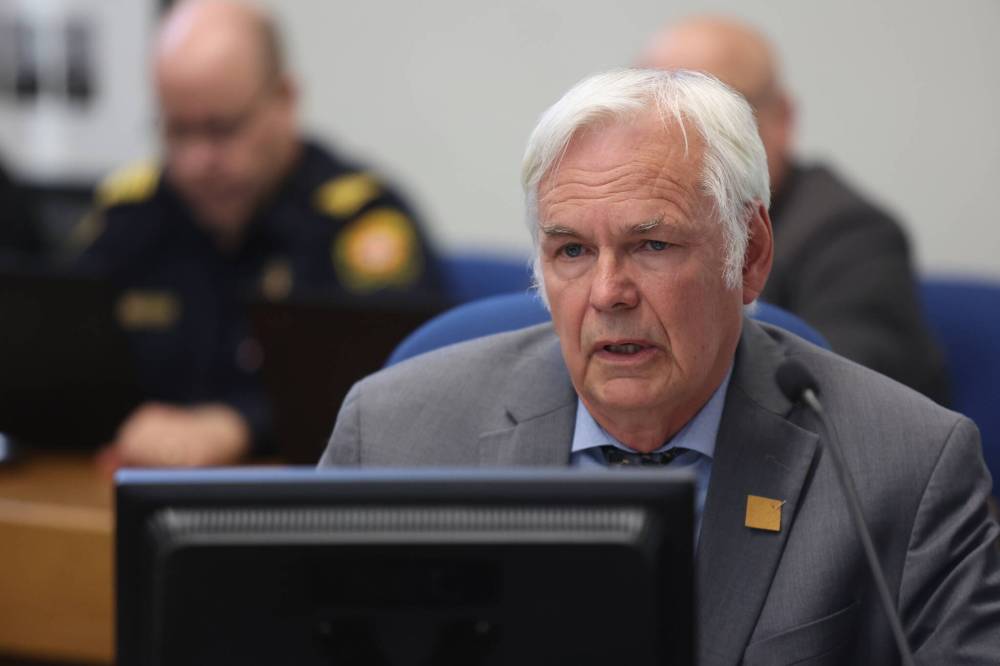
Brandon Coun. Barry Cullen: cross-border relationships are important.
Ward 3 Brandon Coun. Barry Cullen speaks about the Assiniboine River Basin at Tuesday evening’s council meeting. (Alex Lambert/The Brandon Sun)
The initiative, which was created following floods in 2011 and 2014, brought together as many as 51 organizations, including municipalities and watershed groups, from the three jurisdictions.
“We need to have more communication with the grassroots delegates,” Sifton Coun. Scott Phillips said Thursday.
“As long as the people are talking, we can work together, so at least we know what’s coming,” he said.
The basin covers about 420,000 square kilometres and is home to 1.5 million people.
The Assiniboine River Basin stretches from west of Regina along the Qu’Appelle River and south of Minot, N.D., along the Souris River, collecting from smaller rivers and creeks. Eastward, the basin reaches to the Red River in Winnipeg.
The RM of Sifton is sponsoring a resolution to the Association of Manitoba Municipalities for it to lobby the province to restore funding in 2027. It must pass at the association’s regional and fall meetings.
The province had contributed $50,000 to the initiative in the final year before it was cut, a report from the City of Brandon says.
Saskatchewan and North Dakota stopped funding the initiative after Manitoba backed out.
Phillips said the initiative helped build relationships across borders and get officials in Saskatchewan, for example, to understand issues in Manitoba.
For example, water that used to take weeks to flow from Saskatchewan into Manitoba can take days or even hours owing to changes in culvert sizes, Phillips said, adding drainage laws in Saskatchewan are not as stringent as in Manitoba.
“We need to work together on improving laws and regulations.”
Having more regular planned conversations with officials can affect decision making or warn people downstream about potential problems.
Proposals, such as a joint dam project, could also be discussed at the group’s meetings, he said.
The resolution, in part, says the board “can focus on replanting of trees and natural habitats,” along with other needs, including water retention, agricultural and industrial needs, aquatic life, recreation and sustainability.
Brandon Coun. Barry Cullen, who was on the group’s board before it was disbanded following a meeting in 2024, said the initiative and relationships that come with it are “more important now than it ever was.”
Cullen cited faster-moving water, along with higher levels of uncertainty related to the Trump government in the U.S., as reasons for its importance.
Water can be a source of conflict between jurisdictions, he said.
“I think the most important thing about the organization was (that) you have a relationship with cross-border people,” Cullen said.
The initiative had struggled to create concrete results and had difficulty meeting its mandate, Cullen said, adding that a restored board would be more vital.
Cullen said it would “be very difficult to re-establish” the initiative now, as there must be buy-in from Saskatchewan, North Dakota and smaller organizations.
Brandon Mayor Jeff Fawcett said he was “disappointed” when the funding stopped, as relationships with Saskatchewan and North Dakota representatives had improved under the initiative.
“We all have our own concerns about that, so it’s best to look at those things together,” Fawcett said.

“In the grand scheme of provincial budgets, that’s not a great big amount, and I think that that relationship is healthy to have.”
Premier Wab Kinew said the province will keep tabs on resolutions raised by the AMM.
“We actually provide a lot of resources to the Westman region and work closely with municipalities to ensure that we’re there to respond if we do see flooding,” Kinew said Thursday when asked about reinstating the board and how municipalities are expected to deal with flooding.
Last week, regarding flooding in the Parkland, Kinew said the province will work with municipalities and other provinces about longstanding issues related to floodwaters from Saskatchewan.
— Brandon Sun