

Winds strip soil, seed, fertilizer — add stress

Advertisement
Read this article for free:
or
Already have an account? Log in here »
To continue reading, please subscribe:

Digital Subscription
One year of digital access for only $205*
- Enjoy unlimited reading on winnipegfreepress.com
- Read the E-Edition, our digital replica newspaper
- Access News Break, our award-winning app
- Play interactive puzzles
*First annual payment billed as $205.00 + GST for one year. This annual subscription will automatically renew at $233.00 + GST every 52 weeks (10% off the regular annual price of $259.35). Offer available to new and qualified returning subscribers only. Cancel any time.
To continue reading, please subscribe:
Add Free Press access to your Brandon Sun subscription for only an additional
$1 for the first 4 weeks*
- Enjoy unlimited reading on winnipegfreepress.com
- Read the E-Edition, our digital replica newspaper
- Access News Break, our award-winning app
- Play interactive puzzles
*Your next Brandon Sun subscription payment will increase by $1.00 and you will be charged $17.95 plus GST for four weeks. After four weeks, your payment will increase to $24.95 plus GST every four weeks.
Read unlimited articles for free today:
or
Already have an account? Log in here »
On the days those big, gusty winds swept across the Prairies earlier this month, I was driving to Alberta and pulling a camper.
Springtime wind events are nothing new for this region, but what was unusual about this one was its force and how widely it extended through Saskatchewan and Manitoba.
We changed our route to travel north and avoid the gusts that toppled semi-trailers near Regina, but we were still driving into headwinds of up to 80 km/h past fields where the seeders were stopped in their tracks, with the soil around them moving instead.
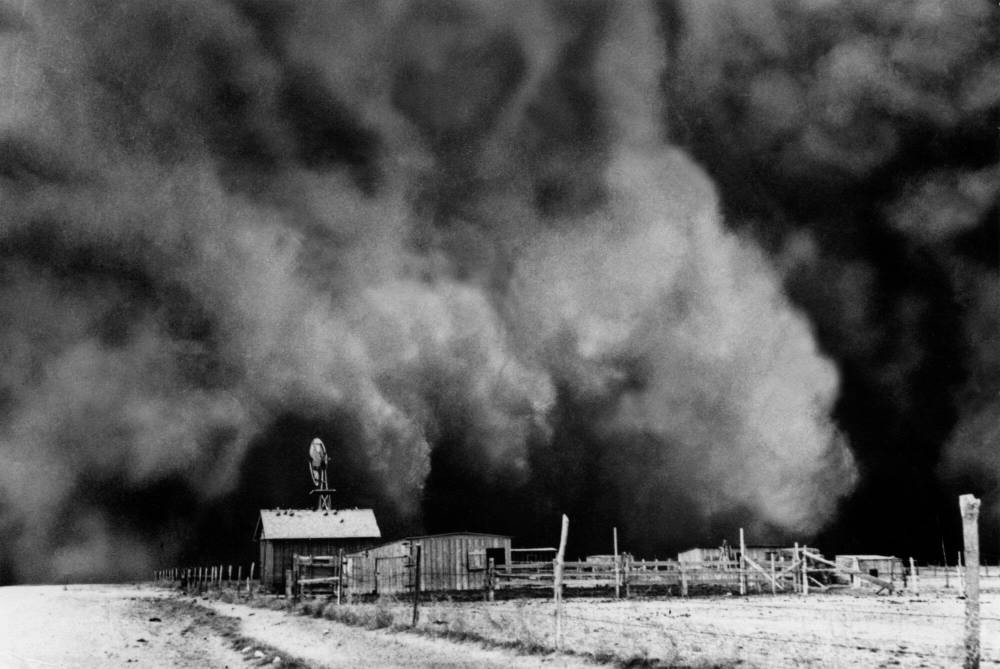
The aftermath was fully visible as we made our way home this week.
Nearly every town we passed through featured business and road signs that were twisted, toppled or snapped right off. Roofs were ripped from buildings and a few grain bins were lying on their sides.
Less visible was the setback those winds caused for the farmers still trying to seed their crops.
Wind erosion is less of a problem than it was back in the days when farmers routinely left fields unplanted for a growing season to control weeds with deep tillage, and because they believed summerfallow conserved moisture. All that exposed soil set the stage for the infamous “Dirty Thirties,” when the dunes of soil drifting across vast swaths of land nearly turned Western Canada into a Sahara.
Nowadays, farmers rarely summerfallow. They rely less on tillage and more on herbicides to control weeds. They’ve discovered they can conserve moisture and improve soil health by minimizing disturbance and keeping their land covered with growing plants or the residue from the previous crop.
However, planting the crop every spring still requires some form of tillage. Some farmers seed directly into last year’s stubble, placing the fertilizer near the seed at the same time, which keeps disturbance to a minimum. Others continue to work the soil before and during seeding, either because of the crops they are planting or the conditions they are seeding into — or sometimes just because that’s the way they’ve always done it.
If the wind picks up during that three- to four-week period between when the ground is planted and the crop is established, it is highly vulnerable to erosion — as anyone who looked outside last week could see.
Farmers typically go over their fields with herbicides before seeding to kill any emerging weeds so the crop gets a head-start before the next flush of competition. That type of operation is sidelined if it is windy.
Small-seeded crops such as canola will blow right out of the ground in high winds. There were photos circulating this week of sprouted wheat laid bare after the wind blew away the soil that covered it.
Extension advisers say there is little chance those plants will recover, suggesting farmers will need to go back and reseed affected areas.
All that “blow dirt” now plugging ditches will create drainage problems after a heavy rain. As well, researchers testing drifted soil after past wind events have found it can contain concentrated amounts of fertilizer amidst the fine particles of soil.
It’s not easily replaced on the fields that lost it. Fertilizer prices were already high and have risen upwards of 40 per cent this spring due to the war in the Middle East cutting global supply chains.

Even if the farmer is equipped to get out there and move drifted soil back into place, there is no way of knowing where best to place it without extensive soil testing. And those sifted particles lack the structure that soil needs to retain moisture and hold nutrients for the growing plants.
Seeding was already running behind because of the extraordinarily cold temperatures and May snowstorms keeping farmers out of their fields. Crop yields start to ratchet down for every day seeding is delayed past about the middle of May.
Lost time is calculably lost money.
It’s no wonder the radio stations across the West are filled with ads reminding farmers of how they can access stress counselling if they feel overwhelmed.
Laura Rance-Unger is editor emeritus for Glacier FarmMedia. She can be reached at lrance@farmmedia.com
Laura Rance is editorial director at Farm Business Communications.
Our newsroom depends on a growing audience of readers to power our journalism. If you are not a paid reader, please consider becoming a subscriber.
Our newsroom depends on its audience of readers to power our journalism. Thank you for your support.
Laura Rance is editorial director at Farm Business Communications.
Our newsroom depends on a growing audience of readers to power our journalism. If you are not a paid reader, please consider becoming a subscriber.
Our newsroom depends on its audience of readers to power our journalism. Thank you for your support.
Advertisement Advertise With Us
Advertisement Advertise With Us