

After protests outside synagogues, New York makes it a crime to block entry to a house of worship
Advertisement
Read this article for free:
or
Already have an account? Log in here »
To continue reading, please subscribe:
Digital Subscription
One year of digital access for only $1.44 a week*
- Enjoy unlimited reading on winnipegfreepress.com
- Read the E-Edition, our digital replica newspaper
- Access News Break, our award-winning app
- Play interactive puzzles
*Billed as $5.77 plus GST every four weeks. After 52 weeks, price increases to the regular rate of $19.95 plus GST every four weeks. Offer available to new and qualified returning subscribers only. Cancel any time.
To continue reading, please subscribe:
Add Free Press access to your Brandon Sun subscription for only an additional
$1 for the first 4 weeks*
- Enjoy unlimited reading on winnipegfreepress.com
- Read the E-Edition, our digital replica newspaper
- Access News Break, our award-winning app
- Play interactive puzzles
*Your next Brandon Sun subscription payment will increase by $1.00 and you will be charged $17.95 plus GST for four weeks. After four weeks, your payment will increase to $24.95 plus GST every four weeks.
Read unlimited articles for free today:
or
Already have an account? Log in here »
NEW YORK (AP) — Blocking someone from entering a house of worship, or acting in a way that makes worshippers entering the building fear for their safety, is now a crime in New York under a law approved after a series of raucous demonstrations outside synagogues.
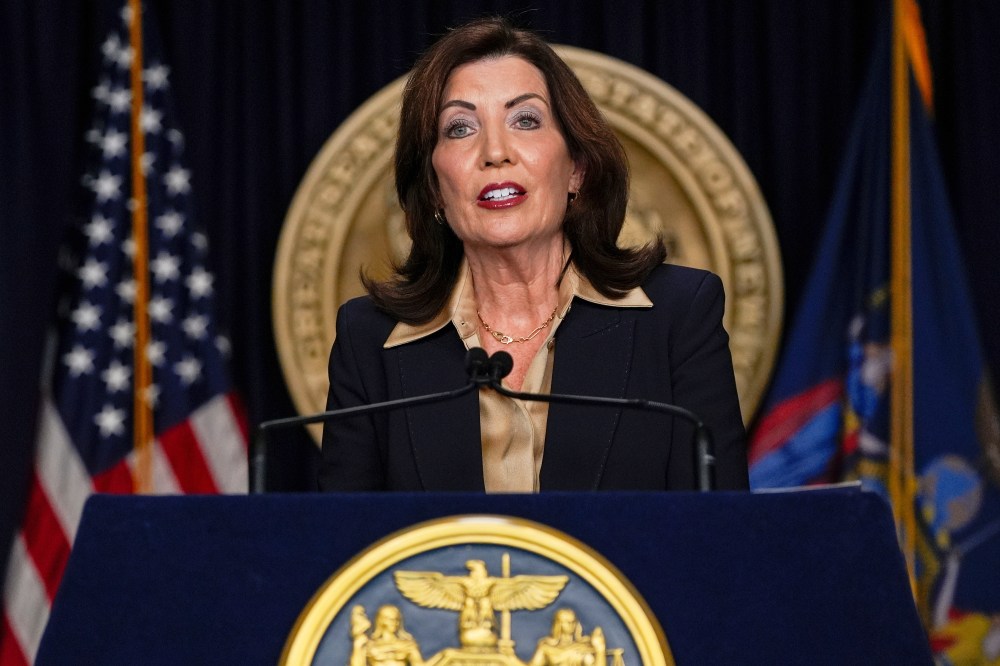
The law, signed Tuesday by Gov. Kathy Hochul, also expressly allows police to establish 50-foot security perimeters outside houses of worship where protests are not allowed.
“Every New Yorker should be able to enter their house of worship and practice their religion without fear,” Hochul, a Democrat, said in a statement.
Critics worry that the buffer zones could be used to quell nonviolent demonstrations or criminalize free speech.
“This law risks chilling activism at a time when the voices of New Yorkers are more needed than ever, which will be a gift to the Trump administration,” said Donna Lieberman, executive director of the New York Civil Liberties Union. “This effort to trade away New Yorkers’ rights was needless and reflects the worst kind of governance.”
The governor signed the law after a series of protests outside synagogues hosting real estate events promoting emigration to Israel and the Israeli-occupied West Bank.
Pro-Palestinian groups have argued that the events are part of a yearslong campaign to drive Arabs out of Israel and the land it controls. They also maintain that the events facilitate the growth of illegal Jewish settlements in occupied territories.
Some Jewish leaders, though, have called the demonstrations antisemitic.
During one protest outside a synagogue in Queens, activists chanted pro-Hamas remarks. Other demonstrations have devolved into clashes between pro-Israel and pro-Palestinian groups.

The new law creates a misdemeanor criminal charge for people who interfere with access to houses of worship.
The idea of a protest buffer zone has been under consideration for months, raising questions about how government can balance free speech protections and the right to worship in legislation that could pass legal muster. The U.S. Supreme Court in 2014 struck down a 35-foot protest-free zone outside abortion clinics in Massachusetts, declaring it unconstitutional.
The law signed by Hochul would apply statewide and would apply to any house of worship, including mosques, which have also been targeted by protests over the years.
New York City Mayor Zohran Mamdani has also signed a separate, local law requiring the New York Police Department to disclose plans on how it handles protests outside houses of worship and rules on how it could use security perimeters.
Mamdani vetoed a similar measure that would have applied to protests outside schools over concerns that its definition of an educational facility was too broad.
The Free Press acknowledges the financial support it receives from members of the city’s faith community, which makes our coverage of religion possible.