Humanoids dance and thread needles as Japanese robotics developers look to outdo Chinese

Advertisement

Advertise with us

TOKYO (AP) — Mechanical hands dexterous enough to thread a needle, childlike dancing robots and adult-sized ones to help with deliveries were on display Thursday as the Humanoids Summit Tokyo opened.

Read this article for free:


By clicking the button above, an account will be created and you will begin to receive some of our recommended newsletters. You may opt out of any newsletter by visiting your Email and Communication Preferences page or by clicking "unsubscribe" at the bottom of any email.

or

Already have an account? Log in here »

To continue reading, please subscribe:

Digital Subscription

One year of digital access for only $1.44 a week*

  • Enjoy unlimited reading on winnipegfreepress.com
  • Read the E-Edition, our digital replica newspaper
  • Access News Break, our award-winning app
  • Play interactive puzzles

*Billed as $5.77 plus GST every four weeks. After 52 weeks, price increases to the regular rate of $19.95 plus GST every four weeks. Offer available to new and qualified returning subscribers only. Cancel any time.

To continue reading, please subscribe:

Add Free Press access to your Brandon Sun subscription for only an additional

$1 for the first 4 weeks*

  • Enjoy unlimited reading on winnipegfreepress.com
  • Read the E-Edition, our digital replica newspaper
  • Access News Break, our award-winning app
  • Play interactive puzzles
Start now

*Your next Brandon Sun subscription payment will increase by $1.00 and you will be charged $17.95 plus GST for four weeks. After four weeks, your payment will increase to $24.95 plus GST every four weeks.

TOKYO (AP) — Mechanical hands dexterous enough to thread a needle, childlike dancing robots and adult-sized ones to help with deliveries were on display Thursday as the Humanoids Summit Tokyo opened.

Among the dozens of companies taking part, including well-known players like Boston Dynamics and Toyota Motor Corp., the big stars now were clearly the Chinese.

Chinese newcomers, like Booster Robotics and LimX Dynamics, took the technology initially developed in Japan and the U.S. and fine-tuned it, often for cheaper mass production. It’s a repeat of what happened in other Japanese industries, from consumer electronics to cellphones and electric vehicles. In humanoids, Japan was initially ahead but then failed to produce major commercial solutions.
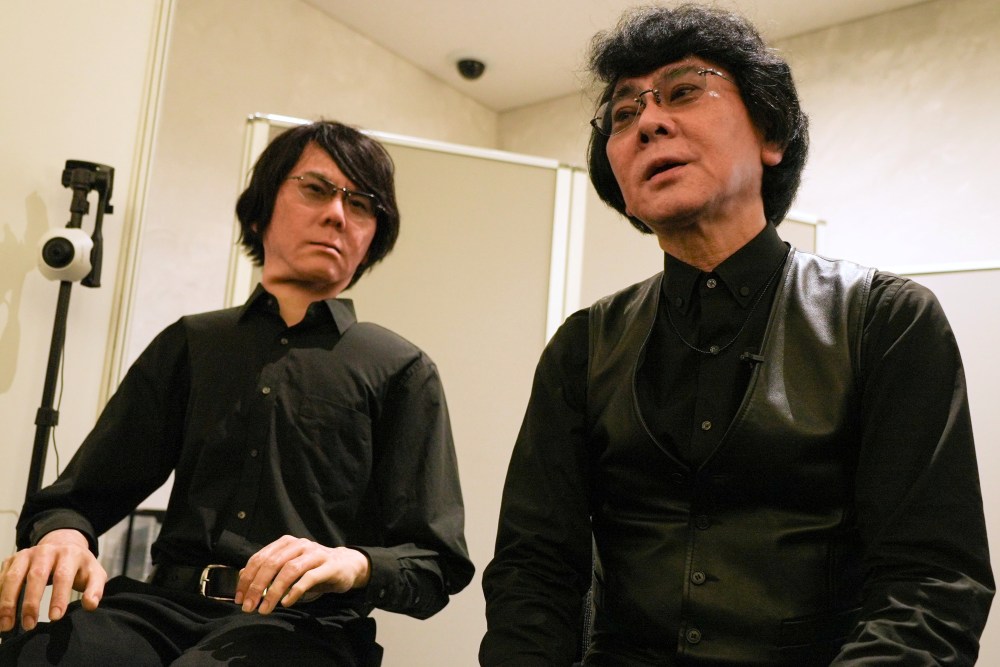
Professor Hiroshi Ishiguro, right, of Osaka University talks to android robot Geminoid at the Humanoids Summit 2026 in Tokyo, Thursday, May 28, 2026. (AP Photo/Ayaka McGill)

Tim Hornyak, author of “Loving the Machine: The Art and Science of Japanese Robots,” who was at the event, categorized it as the so-called “Galapagos syndrome,” referring to how innovative Japanese products evolve in isolation and end up not translating for the international market.

“I really hope that Japan can come up with a Ford Model T-version of humanoid roots. But I think China has already stolen their lunch. It’s a bit too little too late,” he said.

The dancing and wiggling Mini Pi Plus robot from High Torque of China, for instance, still can’t help at an auto plant or do your dishes. But it’s cute. And it doesn’t come with an eye-popping price tag, starting at $5,500.

Chinese robots are dominating

One telling example of Chinese robotics use in Japan was GMO, a Tokyo-based AI and robotics company working on a humanoid with camera eyes that will help with Japan Airlines cargo and other chores at an airport.

The key is to have the robot do the work in the same way as people so they would be interchangeable, an initiative meant to tackle the labor shortage problem that is increasingly serious in Japan.

The inner robotics workings were all courtesy of Unitree, a Chinese outfit, which is also working on a four-legged dog-like “stellar explorer.”

Experts say Japan, with its finesse in manufacturing, proved a good breeding ground for robotics development. The sociological backdrop of a public receptive to robotics also helped.

A recent Pew global survey showed that people in Japan are highly aware of AI but are less anxious about it, at about 28%, than people in the U.S. at 50%.

Japanese automaker Honda Motor Co., a leader in robotics with its walking humanoid Asimo, first shown in 2000, was demonstrating a motorized four-fingered robotic hand that could screw on and off tiny bolts, or thread a needle.

It didn’t seem to bother Keisuke Tsuta, assistant chief engineer, that similar mechanical hands were on display galore near his booth, many of them from Chinese makers.

Japanese robotics show their prowess

The technology Honda had developed is more durable and powerful than rival offerings, and the Japanese have historically shown they can excel at quality mass production, according to Tsuta.

The looming threat of a Chinese robotics domination didn’t seem to phase Osaka University Professor Hiroshi Ishiguro, who has worked on humanoids for decades, including one that’s his clone.

“What’s significant is that Japan has a culture that’s receptive to robotics. If we’re going to really start using robots in society, Japan is the ideal place,” he said, stressing that Japanese don’t discriminate against robots.

His robotic counterpart, dressed all in black like the professor, did as good a job, if not better, of answering a key existentialist question on the meaning of robots.

“I think robots will coexist with people. Robots are the mirror of human beings,” the robot replied in a slightly monotonous but human-like voice.

Earlier, the professor had answered a similar question, but a bit differently.

“No one is interested in me. All everyone cares about is my robot,” he said, sitting next to his twin-like humanoid.

“As long as people identify with what I have produced, I am a success,” he added. ___

Yuri Kageyama is on Threads: https://www.threads.com/@yurikageyama

Report Error Submit a Tip

More Stories

Author Emily St. John Mandel’s Exit Party a story of hope in dark times

Ben Sigurdson 6 minute read Preview

Author Emily St. John Mandel’s Exit Party a story of hope in dark times

Ben Sigurdson 6 minute read 4:00 AM CDT

If Emily St. John Mandel’s new novel Exit Party is in any way prophetic, Americans should be worried.

The B.C.-born, New York-based author’s bestselling fourth novel, 2014’s Station Eleven, chronicled a performing troupe in a post-pandemic world. The novel experienced a second wave of popularity when the COVID-19 pandemic took hold, and when HBO’s Station Eleven miniseries premièred in late 2021.

Mandel launches Exit Party, her seventh novel, at McNally Robinson Booksellers’ Grant Park location tonight, where she’ll be joined in conversation by Winnipeg novelist Joan Thomas.

Published in September by HarperCollins, Exit Party sees Mandel once again working in the near future, in this case in a novel that features two timelines — one (dubbed the A-side in the novel) where the U.S. has fractured into a number of small countries following a civil war, and another (the B-side) where a singular, autocratic surveillance state has tightened its grip over its citizens.

Read
4:00 AM CDT

Letters, Oct. 17

7 minute read 2:01 AM CDT

Province must also retain docsRe: Ottawa offers $6M to hire 90 new doctors (Oct. 15)

The federal government’s $6 million commitment to help Manitoba recruit up to 90 additional family doctors by 2028–29 is welcome news, but it should not be mistaken for a solution to the province’s persistent physician shortage.

The question is not simply how many doctors Manitoba can recruit, but how many it can retain —and whether patients will actually have better access to care as a result.

Expanding the practice-ready assessment program for internationally trained physicians is a sensible step. These doctors bring valuable skills and experience, and a more efficient licensing pathway can help address staffing shortages, particularly in rural, northern and Indigenous communities. However, recruitment alone cannot compensate for a health-care system that struggles to retain the physicians it already has.

A Life's Story: Musician made great contributions, advocated for fellow artists

Conrad Sweatman 7 minute read Preview

A Life's Story: Musician made great contributions, advocated for fellow artists

Conrad Sweatman 7 minute read 6:00 AM CDT

When a University of Manitoba dean came to inform Victor Davies that he was booted from pre-med in the late 1950s, it was — to permit a cliché — music to his ears.

“In his mind, what he heard was much more encouraging. He heard, ‘Follow your own dream. Listen to your own melody. Speak with your own voice,’” says Davies’s daughter, Heather.

Davies, who died at 87 from pancreatic cancer and PLS in late September, was nevertheless about to take a major gamble, one that would eventually earn him an honorary doctorate from the University of Manitoba and a nomination to the Order of Canada.

Few careers are as uncertain as music, and at a time when the composition departments were saying au revoir to tonality, embracing the heavily dissonant styles of France and Germany, Davies was about to go against the grain. He would soon find a new home across the border in Bloomington, Ind., where for four years he studied at Indiana University Jacobs School of Music.

Read
6:00 AM CDT

Federal data on Winnipeg's number of homeless people inaccurate, advocates say

Scott Billeck 5 minute read Preview

Federal data on Winnipeg's number of homeless people inaccurate, advocates say

Scott Billeck 5 minute read Updated: Yesterday at 1:02 PM CDT

The head of End Homelessness Winnipeg says she has no confidence in data about the city’s homeless population due to problems with the federal system that tracks those numbers.

Read
Updated: Yesterday at 1:02 PM CDT

Disgraced ex-dean landed job at German university after fleeing Winnipeg

Maggie Macintosh 8 minute read Preview

Disgraced ex-dean landed job at German university after fleeing Winnipeg

Maggie Macintosh 8 minute read Yesterday at 3:07 PM CDT

Before he was arrested in a posh Paris suburb, the disgraced dean of Manitoba’s only law school — who fled the country following a 2020 expense scandal — kept a low profile at a German university.

Read
Yesterday at 3:07 PM CDT

Double-down on fun pursuits to sidestep bets

Maureen Scurfield 4 minute read Yesterday at 2:00 AM CDT

DEAR MISS LONELYHEARTS: I get a big kick out of my new mother-in-law who enjoys going out with her girlfriends to “gamble away the family fortune.”

She’s taken me out with these older ladies on the weekends and has even given me some “fun money” to blow. We often share the winnings — if there are any. That’s the part that really sets my husband’s teeth on edge.

We’re so newly married I still tell my man everything, but I am learning. This week he said he doesn’t want me training with his mom and her crazy gambling buddies.

My husband really should take a look in the mirror before criticizing others, as he himself loves betting on the horses. I don’t complain about his betting. The truth is I find him and his whole family a lot more interesting than my own relations, who are too strait-laced, religious and boring for my liking.