

Teens, social media and doctors’ advice
Advertisement
Read this article for free:
or
Already have an account? Log in here »
To continue reading, please subscribe:

Digital Subscription
One year of digital access for only $205*
- Enjoy unlimited reading on winnipegfreepress.com
- Read the E-Edition, our digital replica newspaper
- Access News Break, our award-winning app
- Play interactive puzzles
*First annual payment billed as $205.00 + GST for one year. This annual subscription will automatically renew at $233.00 + GST every 52 weeks (10% off the regular annual price of $259.35). Offer available to new and qualified returning subscribers only. Cancel any time.
To continue reading, please subscribe:
Add Free Press access to your Brandon Sun subscription for only an additional
$1 for the first 4 weeks*
- Enjoy unlimited reading on winnipegfreepress.com
- Read the E-Edition, our digital replica newspaper
- Access News Break, our award-winning app
- Play interactive puzzles
*Your next Brandon Sun subscription payment will increase by $1.00 and you will be charged $17.95 plus GST for four weeks. After four weeks, your payment will increase to $24.95 plus GST every four weeks.
Read unlimited articles for free today:
or
Already have an account? Log in here »
It seems fair to state that we are on the path to someday viewing social media exposure as the source of mass social harm in the same way we now view leaded gasoline fumes and lead-painted toys.
A survey by Doctors Manitoba of its members — 242 of whom completed it — found overwhelming support for a ban on social media and artificial-intelligence chatbots for people age 16 and under. The survey found 7.5 per cent of respondents are against a ban. Two per cent were unsure.
“The findings are quite clear,” Dr. Alon Altman, president of Doctors Manitoba, said Monday. “Doctors believe social media, screen time and chatbots are among the top risks to children’s health and well-being, ranking higher than even smoking, drinking, injuries and sedentary lifestyles.”
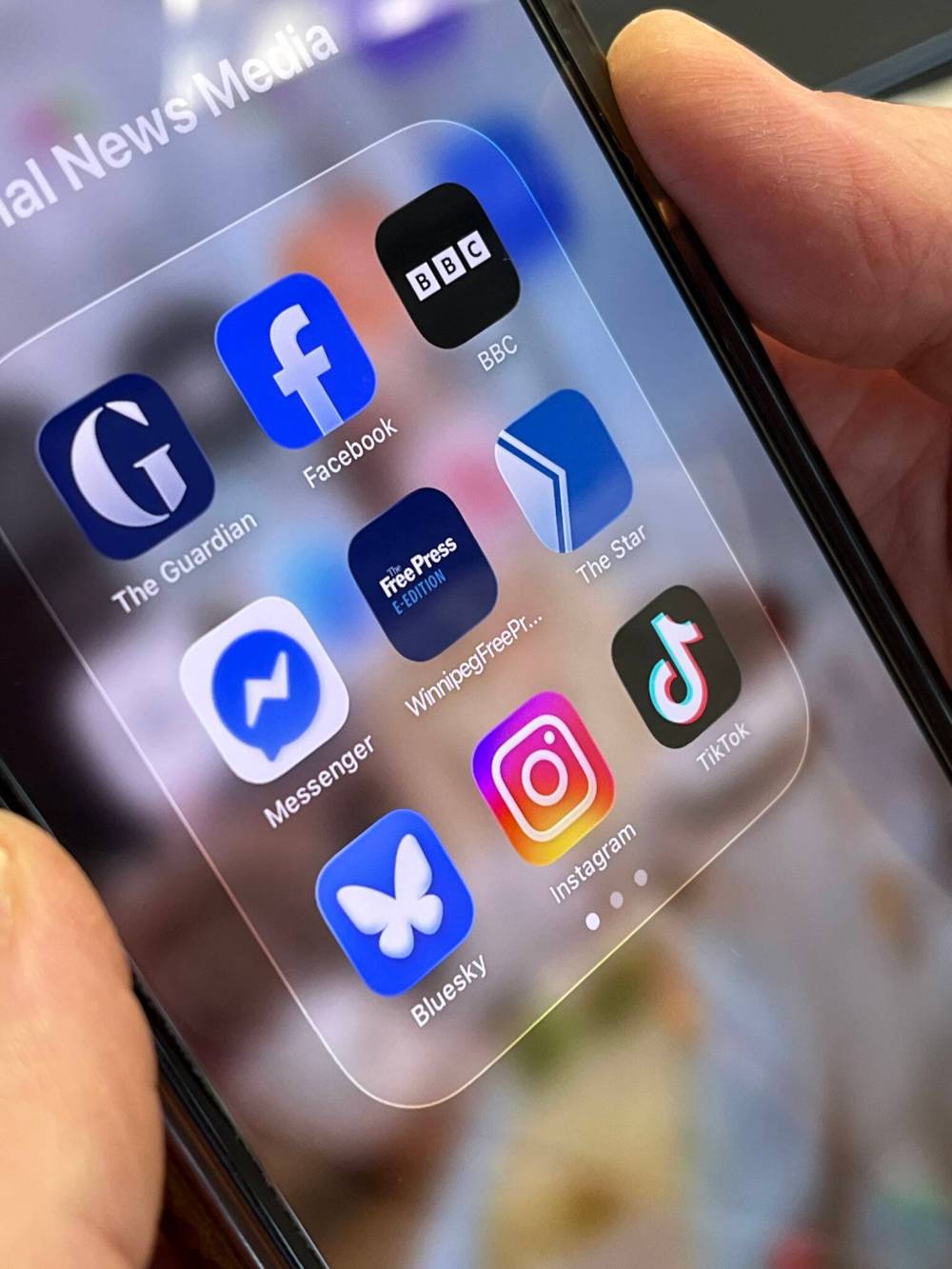
File
Social media apps on a smartphone.
That’s quite a claim, but one not without merit. The Mayo Clinic, in an online summary of the effect of social media on teens, lists sleep disruption, the formation of unrealistic views “about other people’s lives or bodies,” and exposure to predators and cyberbullying as among the risks.
“In a study focusing on 12- to 15-year-olds in the United States, spending three hours a day using social media was linked to a higher risk of mental health concerns,” the clinic states.
The issue is one Doctors Manitoba has pondered before, but the survey itself was provoked by Premier Wab Kinew’s intentions to institute such a social media ban on teens.
It’s a plan rife with concerns and complications. Such a ban would include, for one, co-operation with a tech industry which has, so far, shown little interest. It also brings up the spectre of age verification, which is either so lax as to be laughable (“Click here if you are 18 or over”) or so invasive as to be a huge individual security risk (“Provide our website with your photo ID”).
It may seem too small a problem to be worth bothering with. There are many financial, institutional, and social crises to manage in the world without government making a big deal out of how much time teens spend on Snapchat or Instagram.
However, it’s important to take the long view. We have witnessed, via the dissemination of misinformation on social media and the rise of AI-generated fakes and nonsense, that adults are also susceptible to the negative side of the internet.
Allowing young people to be fully immersed in that world risks priming them for a life of being easy targets for online malefactors.
Is instituting a ban strictly necessary? Manitoba doctors seem to be answering that with resounding “yes.” So, what the reasons are not to?
Arguments against doing it are, essentially, that it will be difficult to do, and the benefits are hard to determine right now, as any upside won’t be clear until the teens who grow up under the new paradigm become adults.

But are those good reasons to maintain the status quo? Does it not just let Big Tech off the hook for its products yet again? After all, internet providers have been arguing for years that they should continue to be absolved of responsibility for anything they carry into our homes or phones, because they are simply a utility like a water supply pipe.
But if they’re doing damage, do they continue to get a bye?
Banning social media for teens may seem silly, or an overcorrection, or even a waste of time and resources.
But it might also be akin to removing asbestos from buildings or lead from paint and gasoline — a move made to prevent further damage to new generations after we’ve learned of the potential harms.
Better to be safe than sorry. Especially with young, developing minds.