

Brandon police roll out body cams
Advertisement
Read this article for free:
or
Already have an account? Log in here »
To continue reading, please subscribe:

Digital Subscription
One year of digital access for only $205*
- Enjoy unlimited reading on winnipegfreepress.com
- Read the E-Edition, our digital replica newspaper
- Access News Break, our award-winning app
- Play interactive puzzles
*First annual payment billed as $205.00 + GST for one year. This annual subscription will automatically renew at $233.00 + GST every 52 weeks (10% off the regular annual price of $259.35). Offer available to new and qualified returning subscribers only. Cancel any time.
To continue reading, please subscribe:
Add Free Press access to your Brandon Sun subscription for only an additional
$1 for the first 4 weeks*
- Enjoy unlimited reading on winnipegfreepress.com
- Read the E-Edition, our digital replica newspaper
- Access News Break, our award-winning app
- Play interactive puzzles
*Your next Brandon Sun subscription payment will increase by $1.00 and you will be charged $17.95 plus GST for four weeks. After four weeks, your payment will increase to $24.95 plus GST every four weeks.
Read unlimited articles for free today:
or
Already have an account? Log in here »
BRANDON — Officers with body-worn cameras will be expected to turn them on during “any public encounter,” police in this western Manitoba city said Monday.
That includes calls for service, traffic stops and any interaction “where there could potentially be evidentiary value,” Insp. Jason Dupuis said.
Twelve Brandon Police Service members will be assigned their own body-worn camera today. Dupuis said BPS will slowly roll out a total of 65 cameras this year.
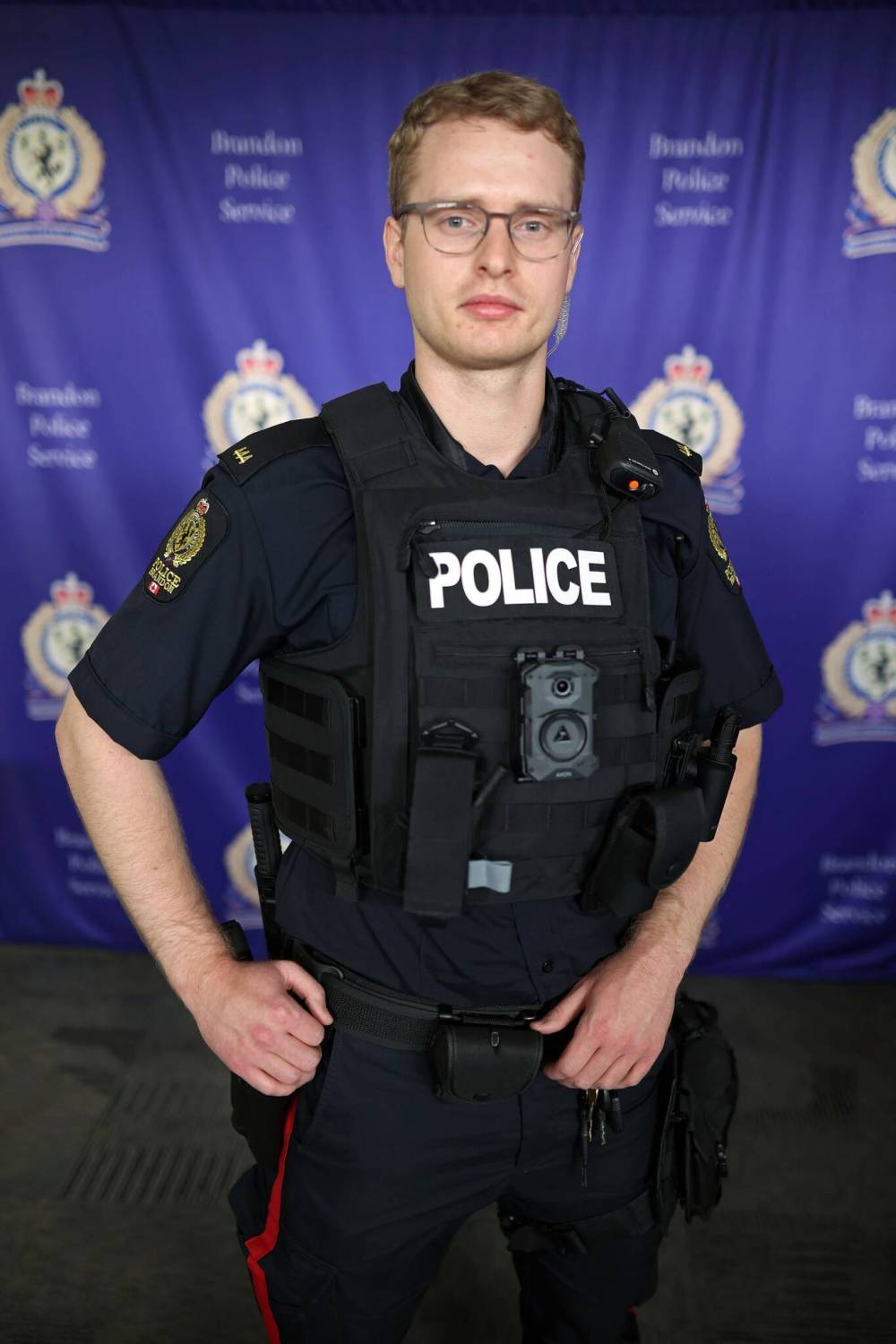
Const. Gary Sheane with the Brandon Police Service wears a body-worn video camera at BPS headquarters on Monday. (Tim Smith/The Brandon Sun)
“I think it’s going to be very positive,” Dupuis said. “Everyone is going to be cognizant of what they’re saying and I think it shows … full transparency on both sides.”
If officers don’t turn on their camera as directed, they will be subject to a disciplinary process, Dupuis said, adding that initially, there will be a grace period.
The service said it would add one sworn officer position and three professional staff positions dedicated to digital evidence management and technological support.
Dupuis said two of the people filling those positions started on Monday — one sergeant and one civilian — and the other two positions will likely be filled in the fall as they start to roll out more cameras.
He said their roles will include training members on how to use body-worn cameras and will involve managing digital evidence, not just from body cams.
“They will be helping with labelling the evidence, ensuring quality control, reviewing the evidence …. and preparing stuff to go into court services,” he said.
While body-worn cameras will not likely de-escalate situations involving people who are intoxicated or under the influence, Dupuis said an average person may change their behaviour if they know they are being recorded.
He said the footage will only be disclosed for court purposes and not to the public or media.
Dupuis said he could not share the project cost but said it came out of the police service budget.
Christopher Schneider, a professor in Brandon University’s department of sociology who published a book on body-worn cameras this year, said the cameras are “only as good as policy.”
That policy should be released to the public so people can have a “baseline expectation of how these cameras are going to work,” including what disciplinary measures are in place if officers don’t turn on their camera when they are supposed to.
“Given they’ve been planning this for quite some time … the question becomes, why did they not just release the policy to all of us?”
He also emphasized that cameras don’t stop or deter bad behaviour but “merely document it,” and the public won’t get to see that documentation.

“Because of strict privacy legislation that’s federal in Canada, body-worn camera footage is typically not released, which means that Brandonites can expect never to see body-worn camera footage,” he said.
“Is that consistent with transparency? I would argue not.”
He said body-worn cameras do have evidentiary value, specifically in situations involving intoxicated drivers, as police can capture the entire interaction from the moment they step out of their cruiser.
As of early December 2025, all Manitoba RCMP officers were equipped with body-worn cameras. In January, the Manitoba First Nations Police Service announced it has a full deployment and use of Axon body-worn cameras throughout all 12 of its detachments.
— Brandon Sun
Related Articles
Winnipeg police to launch body camera program next week
Advertisement Advertise With Us
Advertisement Advertise With Us
History
Updated on Tuesday, June 2, 2026 7:25 AM CDT: Adds photo