Radio scans find no alien tech from the latest interstellar comet

Advertisement

Advertise with us

CAPE CANAVERAL, Fla. (AP) — The group leading the charge in the search for extraterrestrial life has given the all clear: An interstellar comet looks to be completely natural and free of any alien tech.

Read this article for free:


or

Already have an account? Log in here »

To continue reading, please subscribe:

Subscribe and receive a limited-edition Free Press branded hat or tote.

Digital Subscription

One year of digital access for only $205*

  • Enjoy unlimited reading on winnipegfreepress.com
  • Read the E-Edition, our digital replica newspaper
  • Access News Break, our award-winning app
  • Play interactive puzzles

*First annual payment billed as $205.00 + GST for one year. This annual subscription will automatically renew at $233.00 + GST every 52 weeks (10% off the regular annual price of $259.35). Offer available to new and qualified returning subscribers only. Cancel any time.

To continue reading, please subscribe:

Add Free Press access to your Brandon Sun subscription for only an additional

$1 for the first 4 weeks*

  • Enjoy unlimited reading on winnipegfreepress.com
  • Read the E-Edition, our digital replica newspaper
  • Access News Break, our award-winning app
  • Play interactive puzzles
Start now

*Your next Brandon Sun subscription payment will increase by $1.00 and you will be charged $17.95 plus GST for four weeks. After four weeks, your payment will increase to $24.95 plus GST every four weeks.

CAPE CANAVERAL, Fla. (AP) — The group leading the charge in the search for extraterrestrial life has given the all clear: An interstellar comet looks to be completely natural and free of any alien tech.

The SETI Institute said Wednesday that extensive radio scans by its telescope in Northern California found no signs of otherworldly technology from our solar system’s latest interstellar visitor.

The object labeled 3I/Atlas was discovered last summer sweeping through our neck of the cosmic woods. Scientists quickly identified it as a comet that migrated from another star, although a few insisted without evidence it might be associated with intelligent life.

FILE - This image provided by NASA shows the interstellar comet 3I/Atlas captured by the Hubble Space Telescope on Nov. 30, 2025. (NASA, ESA, STScI, D. Jewitt (UCLA), M.-T. Hui (Shanghai Astronomical Observatory), J. DePasquale (STScI) via AP, File)

It’s only the third known object from a faraway star — all deemed of natural origin — to venture into the sun’s turf.

Several NASA spacecraft observed the celestial iceball as it swung past Mars last October, venturing within 19 million miles (30 million kilometers) of the red planet. The closest it ever got to Earth was in December at a whopping 167 million miles (269 million kilometers) away.

SETI said it conducted more than seven hours of observations in July soon after the comet was discovered, searching through a wide range of radio signals. The team identified nearly 74 million narrow-band radio signals.

After accounting for human interference or signals matching the object’s movement, only slightly more than 200 signals remained, all of which “traced back to technology on the surface of the Earth or our own Earth-orbiting satellites,” according to SETI.

Results were published in the Astronomical Journal.

This diagram provided by NASA/JPL-Caltech shows the trajectory of interstellar comet 3I/ATLAS as it passes through the solar system. (NASA/JPL-Caltech via AP)

These results “show how realistic it is to detect a signal with the technology we have today,” co-author Valeria Garcia Lopez of Furman University said a statement. “That is why it is important to keep searching for technosignatures, even from objects we might not expect to have signals.”

SETI’s Sofia Sheikh, the lead author, and her team pointed out that NASA’s Voyager spacecraft will one day become extraterrestrial objects in neighboring star systems. Launched in the 1970s, the twin probes are the most distant spacecraft from Earth, drifting in the space between stars.

“Voyager and similar probes will eventually become interstellar objects in other stellar systems. We thus know that no extrapolation is needed for the idea of interstellar technological objects, as we have a proof by existence,” they wrote.

Almost 1 billion miles away now (1.3 billion kilometers) as it makes its way back to interstellar space — never to return — the comet is estimated to be within 1,444 feet (440 meters) and 3.5 miles (5.6 kilometers) in size. Scientists suspect it could be as old as 11 billion years, twice as old as the sun.

___
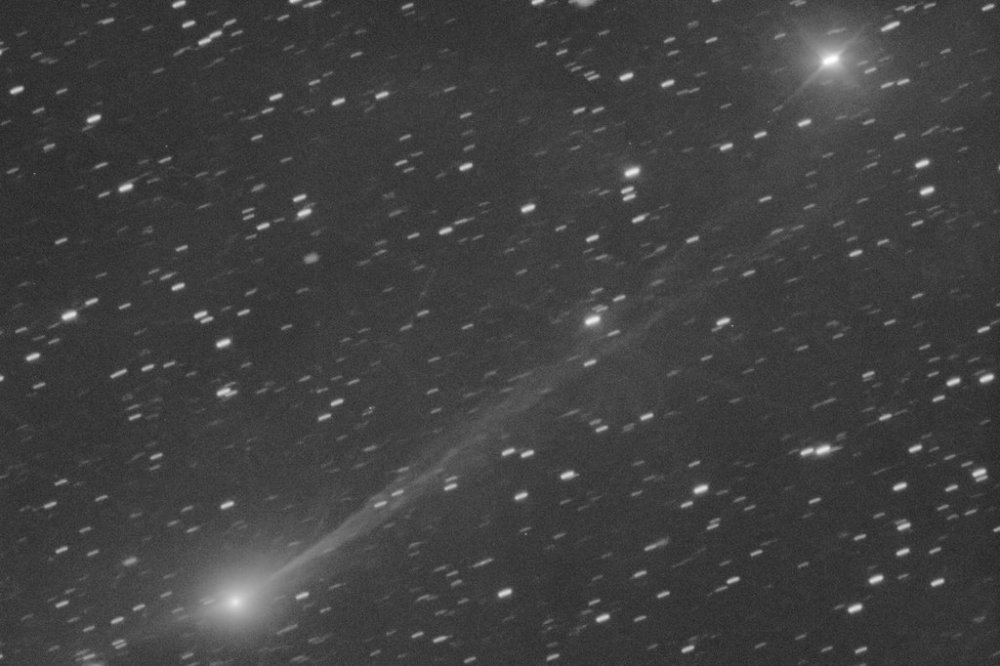
This photo provided by Gianluca Masi shows the interstellar comet 3I/Atlas as it streaks through space, 190 million miles from Earth, on Wednesday, Nov. 19, 2025. The image was taken from Manciano, Italy. (Gianluca Masi via AP)

The Associated Press Health and Science Department receives support from the Howard Hughes Medical Institute’s Department of Science Education and the Robert Wood Johnson Foundation. The AP is solely responsible for all content.

This image provided by NASA/European Space Agency shows an image captured by Hubble of the interstellar comet 3I/ATLAS on July 21, 2025, when the comet was 277 million miles from Earth. (NASA/European Space Agency via AP)
Report Error Submit a Tip

More Stories

MPI leadership not fooling anyone by forcing PUB’s hand

Dan Lett 5 minute read Preview

MPI leadership not fooling anyone by forcing PUB’s hand

Dan Lett 5 minute read Yesterday at 1:33 PM CDT

It is not a question you will hear raised at Public Utilities Board hearings into Autopac rates, but you can bet it’s the one on most people’s minds.

When will the NDP government step in and repair leadership at Manitoba Public Insurance? For the third year in a row, MPI has limped into PUB hearings like a badly damaged vehicle that should have been written off years ago.

This week, the Crown corporation’s chief actuary admitted the 2.38-per-cent increase requested for the 2027-28 fiscal year was too low, in part because of the impact of last summer’s multiple hailstorms and the premiums MPI pays for re-insurance that protects the public insurer from surges in claims costs.

Chief actuary Cara Low said the rate application was not updated because of “uncertainty.” That is sort of like a firefighter complaining about not being able to do the job because there was too much smoke and flame.

Read
Yesterday at 1:33 PM CDT

Secondary scoring steps up as Jets ride 4-1-1 record into Chicago

Mike McIntyre 5 minute read Preview

Secondary scoring steps up as Jets ride 4-1-1 record into Chicago

Mike McIntyre 5 minute read Yesterday at 6:36 PM CDT

CHICAGO — It’s the type of unselfish, team-first play that can go a long way.

With the Winnipeg Jets holding a 5-2 lead over the Minnesota Wild late in the third period Tuesday night, forward Cole Koepke threw himself in front of a blistering slapshot off the stick of Daemon Hunt.

The result was painfully predictable — the puck was deflected far away from Jets goaltender Stuart Skinner, Koepke was briefly in agony as he hobbled to the bench and the crowd inside Canada Life Centre roared in approval.

“Fine. A little sore. But it’s all good,” Koepke said Wednesday following the team’s optional practice ahead of flying to the Windy City where they’ll face the Chicago Blackhawks on Thursday night.

Read
Yesterday at 6:36 PM CDT

White-supremacist highway sign casts pall on Steinbach city council campaign

Matthew Frank 4 minute read Preview

White-supremacist highway sign casts pall on Steinbach city council campaign

Matthew Frank 4 minute read Tuesday, Oct. 13, 2026

The RCMP is investigating a white-nationalist sign near Steinbach with racist messaging and alleged links to a known Canadian far-right group.

Read
Tuesday, Oct. 13, 2026

A man is dead and a woman is in hospital after a vehicle rollover on Highway 44 and Floodway Drive early Sunday.

Selkirk RCMP attended the scene at 12:31 a.m. in the Rural Municipality of St. Clements. The vehicle was found in a field northwest of the intersection.

The passenger, an 18-year-old woman from West St. Paul, was sent to hospital with non-life-threatening injuries.

The driver, a 24-year-old man from Beausejour, was sent to hospital but has since died.

Jets-linked biometrical hockey skills platform launches

Gabrielle Piché 5 minute read Preview

Jets-linked biometrical hockey skills platform launches

Gabrielle Piché 5 minute read Yesterday at 7:52 PM CDT

High-performance hockey players may soon choose more paperwork.

Rather, they’ll choose reports — detailed documents breaking down the skills they need to improve upon. True North Sports and Entertainment Ltd., the ownership company behind the Winnipeg Jets, is throwing its weight into a new business producing data-filled analyses.

“This was probably one of the most exciting things I’ve seen in skating in a long time,” said Dave Cameron, head on-ice instructor and program director of Jets Hockey Development.

Cameron, a former WHL and Canadian university forward, has taught young hockey players through Jets programs for a decade.

Read
Yesterday at 7:52 PM CDT

Chief says minister offered money to remove highway checkstop

Kelly-Anne Riess 5 minute read Preview

Chief says minister offered money to remove highway checkstop

Kelly-Anne Riess 5 minute read Yesterday at 5:53 PM CDT

The chief of the Bloodvein River First Nation says a Manitoba cabinet minister offered up to $250,000 for economic development as he was trying to persuade her to remove a highway checkstop that has outraged hunters.

Chief Lisa Young said Ian Bushie, the minister of Indigenous futures, raised the money in a private conversation in September, also telling her the First Nation would receive a letter directing it to move the checkstop because it’s on a provincial highway.

Young said Bushie described the money as support for economic development in the community.

“I really felt like I was being pushed into a corner. I also felt that I was being bribed,” Young said in an interview. “It may not have come off that way. But he even further said, ‘And I’m not bribing you.’ So, I really didn’t know what to say.”

Read
Yesterday at 5:53 PM CDT