
Takeaways from how water pollution in Iowa can deflate summer fun

Advertisement

Advertise with us

MANCHESTER, Iowa (AP) — Iowa is a particularly stark example of the Midwest’s broader struggle with water pollution.

Read this article for free:


or

Already have an account? Log in here »

To continue reading, please subscribe:

Subscribe and receive a limited-edition Free Press branded hat or tote.

Digital Subscription

One year of digital access for only $205*

  • Enjoy unlimited reading on winnipegfreepress.com
  • Read the E-Edition, our digital replica newspaper
  • Access News Break, our award-winning app
  • Play interactive puzzles

*First annual payment billed as $205.00 + GST for one year. This annual subscription will automatically renew at $233.00 + GST every 52 weeks (10% off the regular annual price of $259.35). Offer available to new and qualified returning subscribers only. Cancel any time.

To continue reading, please subscribe:

Add Free Press access to your Brandon Sun subscription for only an additional

$1 for the first 4 weeks*

  • Enjoy unlimited reading on winnipegfreepress.com
  • Read the E-Edition, our digital replica newspaper
  • Access News Break, our award-winning app
  • Play interactive puzzles
Start now

*Your next Brandon Sun subscription payment will increase by $1.00 and you will be charged $17.95 plus GST for four weeks. After four weeks, your payment will increase to $24.95 plus GST every four weeks.

MANCHESTER, Iowa (AP) — Iowa is a particularly stark example of the Midwest’s broader struggle with water pollution.

It’s a leading agricultural state that also has lots of rivers and streams. Runoff from fertilizer and manure on farms contains nitrates and phosphorus that drain into those waters, making Iowa among the leading contributors to an aquatic dead zone in the Gulf of Mexico.

Residents have lived with water pollution for decades. The problem affects not only public health but also people’s ability to enjoy water in the summertime.
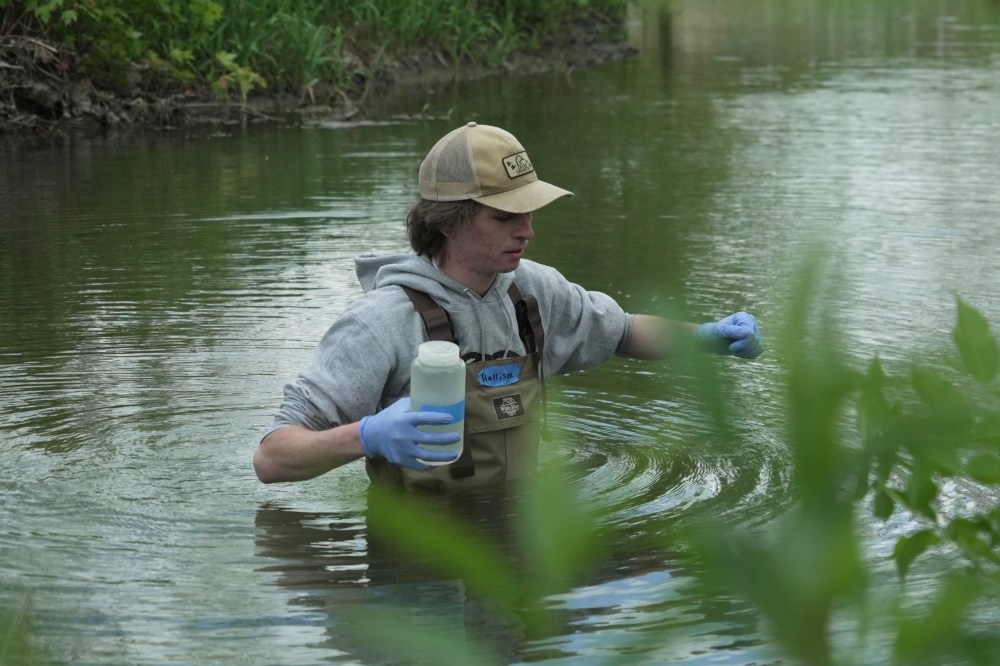
Drake University student Harrison Ziegler holds a bottle as he collects a water sample Wednesday, May 6, 2026, in Des Moines, Iowa. (AP Photo/Brittany Peterson)

Algal blooms can create dangerous conditions at beaches, and soil runoff can make the water just feel gross. Bacteria, sometimes from human sewage, keeps teenagers out of streams. More than half the sections of rivers, streams and lakes the state tracked in 2024 did not meet state standards for swimming, drinking or aquatic life.

Here’s a look at the takeaways from the AP story:

The lost fun of summer

Though landlocked, Iowa’s identity is shaped by waterways including the Missouri and Mississippi Rivers, which form some of its borders. There are beautiful lakeside beaches and excellent trout fishing. Waterways are among its few natural spaces.

On a recent afternoon, Hannah Ray J Childs propelled her kayak into a rapid on the Maquoketa River and dipped her paddle in the water to swing the front of her boat into the air. She loves spending her days performing whitewater kayaking acrobatics that dunk her body in the water — it’s on water like this that she found community.

But she has also gotten sick from the water and now wears nose and ear plugs to minimize risk. Many question why she goes in in the first place.

“People’s first response when I tell them that I like to kayak and be upside down in the river,” Childs said, “is, ‘Ew, that’s disgusting. Why would you do that?’”

She says it is worth it, but the water problems for others have grown too severe for them to feel comfortable.

Mary Swander, a 75-year-old theater director and former state poet laureate, fondly remembers learning to canoe and swim outdoors while growing up near the water. Summer was for splashing around. Winter, ice skating.

“I had a little group of friends and we played hooky once, and we all got our swimsuits and drove over to Lake MacBride and spent the whole day in the lake, in the water, swimming, and we had a whole picnic,” she said.

Swander now avoids the water after bad experiences. One time the water at a state park felt wrong — sticky. Another time a ranger warned her canoeing group not to get their hands — or anything else — in the water.

“I was like, ‘Well, what the hell are we doing out here, then?’” she said.

Why is this happening?

Bacteria plays the biggest role in making streams inaccessible. It comes from cows, deer and other animals, although in some places human sewage is the biggest problem. Experts say heavy rains are a major risk when they wash away manure — something that climate change will intensify — and improving sewage treatment and leaky septic systems is vital.

Nitrates and phosphorus from manure and fertilizer on farms are also at the heart of the problem. Millions of acres of farmland use plastic pipes under fields — a system called tile drainage — to quickly direct water into streams. The nutrients feed algae, leading to lake advisories and threatening drinking water.

Water pollution is an embedded problem

Environmentalists see a state that can’t say no to agriculture.

While Minnesota has mandated vegetation near streams to reduce runoff. Iowa has taken a different approach. It relies on its agriculture and natural resources departments, along with Iowa State University, to develop voluntary strategies that include less fertilizer use, improved crop management and adding wetlands to reduce runoff.

Many farmers are also under pressure. Supply costs have risen sharply in recent years as have fertilizer prices following the war in Iran, according to Aaron Lehman, president of the Iowa Farmers Union, which represents family farms and pushes for sustainable practices.

“There’s a lot less control that farmers have,” Lehman said.

Plus it can take years for farmers to see a return on their investment — if they ever do — when they improve their practices. Demand for federal and state help to do so outstrips supply, according to Rachel Curry, an agriculture educator at the University of Illinois Extension.

It was once explained to her like this: Changing farming practice is like turning a cruise ship — it takes time, but with the right help, it can be done.

___

Associated Press writer M.K. Wildeman in Hartford, Connecticut, contributed.

___

The Associated Press receives support from the Walton Family Foundation for coverage of water and environmental policy. The AP is solely responsible for all content. For all of AP’s environmental coverage, visit https://apnews.com/hub/climate-and-environment


Report Error Submit a Tip

More Stories

Piece of magic history disappears

Kelly-Anne Riess 5 minute read Preview

Piece of magic history disappears

Kelly-Anne Riess 5 minute read Updated: Yesterday at 4:15 PM CDT

A piece of Winnipeg’s magic history has vanished, and internationally renowned escape artist Dean Gunnarson is offering a $500 reward to anyone who can make it reappear.

The plaque marked the birthplace of what has become the world’s largest organization of professional and amateur magicians, the International Brotherhood of Magicians, which was founded in Winnipeg more than a century ago.

Gunnarson said fellow magician and local magic historian Bruce Thompson discovered the disappearance Tuesday while on his way to work.

Thompson returned to inspect the site and found what appeared to be evidence it had been forcibly removed.

Read
Updated: Yesterday at 4:15 PM CDT

Manitoba e-scooter legislation changes set to impose speed limit, age restrictions, sidewalk ban

Matthew Frank 5 minute read Preview

Manitoba e-scooter legislation changes set to impose speed limit, age restrictions, sidewalk ban

Matthew Frank 5 minute read Sunday, Oct. 11, 2026

People riding e-scooters and other personal electric vehicles in Manitoba will have to strap on a helmet, stay off sidewalks and follow new age limits once new provincial rules for the devices take effect next year.

The vehicles, which also include electric skateboards, hoverboards and unicycles, will fall under The Highway Traffic Act starting in 2027, according to the province’s website. E-bikes are excluded from the new rules, according to the province’s frequently-asked-questions page.

All riders must be at least 16 years old and wear properly fitting helmets — that goes for passengers, too, the province said.

The proposed new legislation sets a speed limit of 25 km/h and would prohibit personal electric vehicles from sidewalks unless signs specifically allow sidewalk use. Riders would be using shared paths or roads with speed limits of 50 km/hr or less. They won’t be allowed to operate the vehicles under the influence of alcohol or drugs and they must use hand signals and obey traffic signs.

Read
Sunday, Oct. 11, 2026

Hurricane Simon pounds resorts and vulnerable towns along Mexico’s Pacific coast

Fernando Llano And Martin Silva, The Associated Press 5 minute read Preview

Hurricane Simon pounds resorts and vulnerable towns along Mexico’s Pacific coast

Fernando Llano And Martin Silva, The Associated Press 5 minute read Updated: Yesterday at 2:38 AM CDT

PUERTO VALLARTA, Mexico (AP) — Hurricane Simon pounded Mexico’s Pacific coast as a Category 3 storm on Sunday, its eye remaining just offshore as its most powerful winds and rain slammed people living between the Sierra Madre and the ocean.

The hurricane's center swirled parallel to the coast, closing in on the Puerto Vallarta area, where its most damaging winds and rain were expected to hit around midnight and continue through Monday morning. Its maximum sustained winds weakened late Sunday to 115 mph (185 kph), according to the U.S. National Hurricane Center in Miami, but it was still expected to remain a dangerous hurricane.

That’s not good news for people in and around Puerto Vallarta, a popular tourist destination in the state of Jalisco. Just inland and uphill from the resort areas, many Mexicans live in communities where housing might not stand up to the storm.

By late Sunday, Simon's eye was moving northwest about 45 miles (75 kilometers) south of Cabo Corrientes at about 5 mph (7 kph). A senior hurricane center specialist, Philippe Papin, said this westernmost tip of mainland Mexico is the area most likely to get a direct hit from the system. Cabo Corrientes is at the southern tip of Bahia de Banderas, the wide bay where Puerto Vallarta looks out to the Pacific.

Read
Updated: Yesterday at 2:38 AM CDT

Letters, Oct. 13

7 minute read Preview

Letters, Oct. 13

7 minute read Updated: 8:14 AM CDT

The major assumption Manitoba Hydro undertakes is the weather. Hydro projected a $214 million profit for the 2025-26 fiscal year. On Sept. 29, it reported a $446 million loss. It took on additional debt due to $751 million in operating losses. In addition, Hydro stated the fiscal results for 2025-26 were “significantly influenced by circumstances largely beyond Hydro’s control.”

Read
Updated: 8:14 AM CDT

Puzzles Palace

1 minute read Monday, Jul. 27, 2026

To solve our puzzles, please subscribe with this special offer: |

Riding the Unity Bus to rally support for Canada in Alberta

Melissa Martin 8 minute read Preview

Riding the Unity Bus to rally support for Canada in Alberta

Melissa Martin 8 minute read Updated: Yesterday at 9:57 PM CDT

WAINWRIGHT, Alta. — The Unity Bus arrives right on time, pulling into a parking lot on the edge of this town of about 6,600 people close to the Alberta-Saskatchewan border. As the vehicle slows to a halt, resplendent in its patriotic red-and-white paint, a small group of supporters stand waiting, decked in their own maple leaf garb.

The Unity Bus’s doors open and former Alberta deputy premier Thomas Lukaszuk bounds to the ground. The supporters, volunteers with Lukaszuk’s Forever Canadian campaign, welcome him with applause; he greets them with open arms. He knows many by name, having been to Wainwright four times; some of them fondly call him “the boss.”

“Do you need some stickers?” he asks. “Do you need some swag to give away?”

It’s a chilly Thanksgiving Monday morning on the eastern edge of Alberta. A sharp wind nips at exposed skin and drab grey clouds hang low in the sky. Such weather does not encourage high spirits, but Lukaszuk and these volunteers can’t afford to let theirs falter: in just one week, on Oct. 19, Albertans will vote on a historic question on whether to remain in Canada.

Read
Updated: Yesterday at 9:57 PM CDT


