Pieces with presence
Exhibition offers fresh perspective on history of Indigenous representation in art
Advertisement
Read this article for free:
or
Already have an account? Log in here »
To continue reading, please subscribe:

Digital Subscription
One year of digital access for only $205*
- Enjoy unlimited reading on winnipegfreepress.com
- Read the E-Edition, our digital replica newspaper
- Access News Break, our award-winning app
- Play interactive puzzles
*First annual payment billed as $205.00 + GST for one year. This annual subscription will automatically renew at $233.00 + GST every 52 weeks (10% off the regular annual price of $259.35). Offer available to new and qualified returning subscribers only. Cancel any time.
To continue reading, please subscribe:
Add Free Press access to your Brandon Sun subscription for only an additional
$1 for the first 4 weeks*
- Enjoy unlimited reading on winnipegfreepress.com
- Read the E-Edition, our digital replica newspaper
- Access News Break, our award-winning app
- Play interactive puzzles
*Your next Brandon Sun subscription payment will increase by $1.00 and you will be charged $17.95 plus GST for four weeks. After four weeks, your payment will increase to $24.95 plus GST every four weeks.
Read unlimited articles for free today:
or
Already have an account? Log in here »
A new exhibition at WAG-Qaumajuq invites viewers to grapple with two simultaneous histories of Indigenous presence in art.
Reframed, which opened Wednesday, takes settler art of Indigenous people shaped by colonial perspectives of the time and contrasts it with modern-day contemporary work from Indigenous artists who challenge those perspectives.
Many historical paintings create a vague representation of Indigenous people by homogenizing the culture and erasing historical presence, says Marie-Anne Redhead, assistant curator of Indigenous and contemporary art.
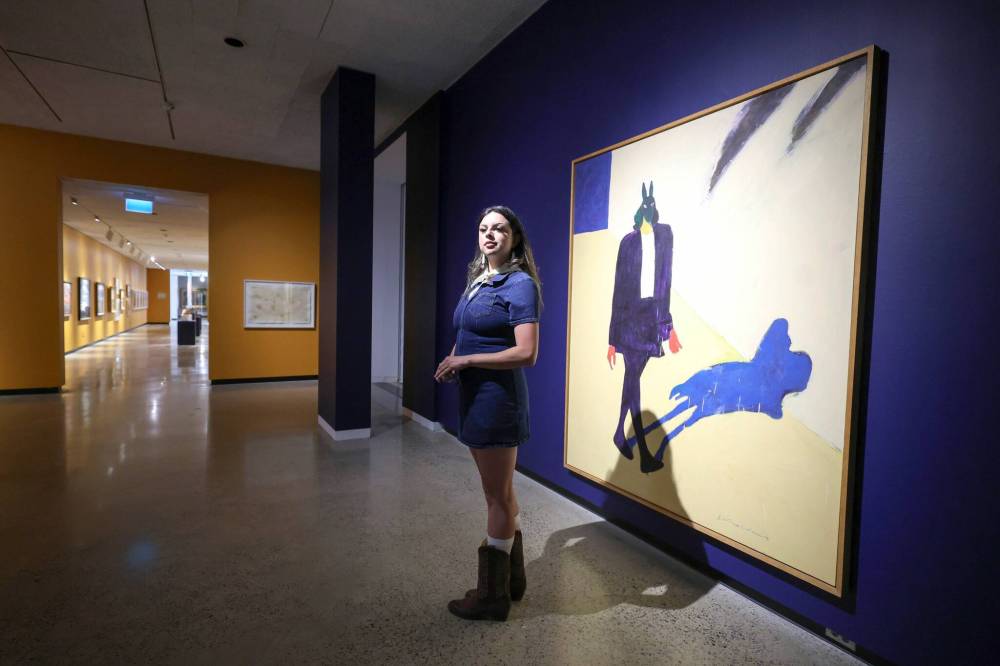
Ruth Bonneville / Free Press
Marie-Anne Redhead, assistant curator of Indigenous and contemporary art at Winnipeg Art Gallery-Qaumajuq says she ‘wanted to highlight Indigenous perspectives on these artworks to really see these people as people,’ with Reframed.
“I wanted to highlight Indigenous perspectives on these artworks to really see these people as people,” she said.
Redhead said the idea came to her in 2021, while working on a project to rename historic Indigenous settler art with racist titles.
Through this process, she realized that less than one per cent of the WAG-Qaumajuq’s collection is by First Nations or Métis artists.
“In our collection (we) actually have more of these ethnographic representations of us rather than artwork by us,” Redhead says.
This is when she decided to expand the scope of the original project and pair the historical paintings with modern work that resists colonial stereotypes and brings forward Indigenous presence.
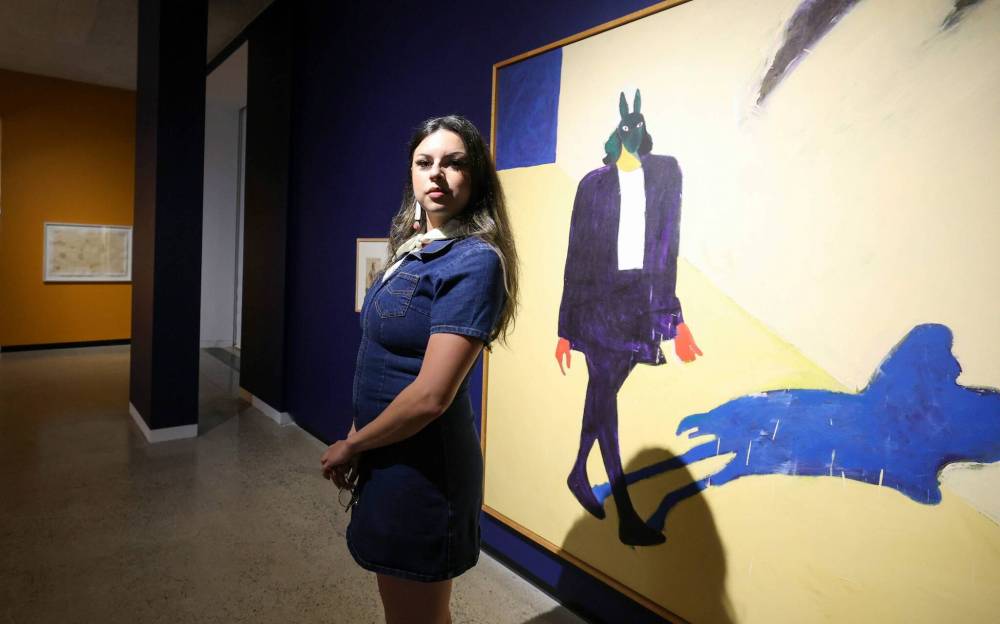
photos by Ruth Bonneville / Free Press
Marie-Anne Redhead, assistant curator of Indigenous and contemporary art at Winnipeg Art Gallery-Qaumajuq, wanted to highlight Indigenous perspectives with Reframed.
“I looked around at what a lot of contemporary First Nations and Métis artists were doing, and I found that a lot of them were already sort of doing the work Reframed was doing, which is to speak against those stereotypes and representations of us,” Redhead says.
One example of her pairings is a painting from Quebec expressionist artist Jean-Paul Riopelle, who is well known for his abstract paintings.
Riopelle’s paintings are usually placed with his contemporaries, who are also white settlers, but by placing his work next to Indigenous artist Rita Letendre, whose work comes from the same artistic movement, Redhead wanted to show that racialized artists have been using these practices for just as long without the same recognition.
“I’m reframing the way that we engage with not only Indigenous art but also art history,” she says.
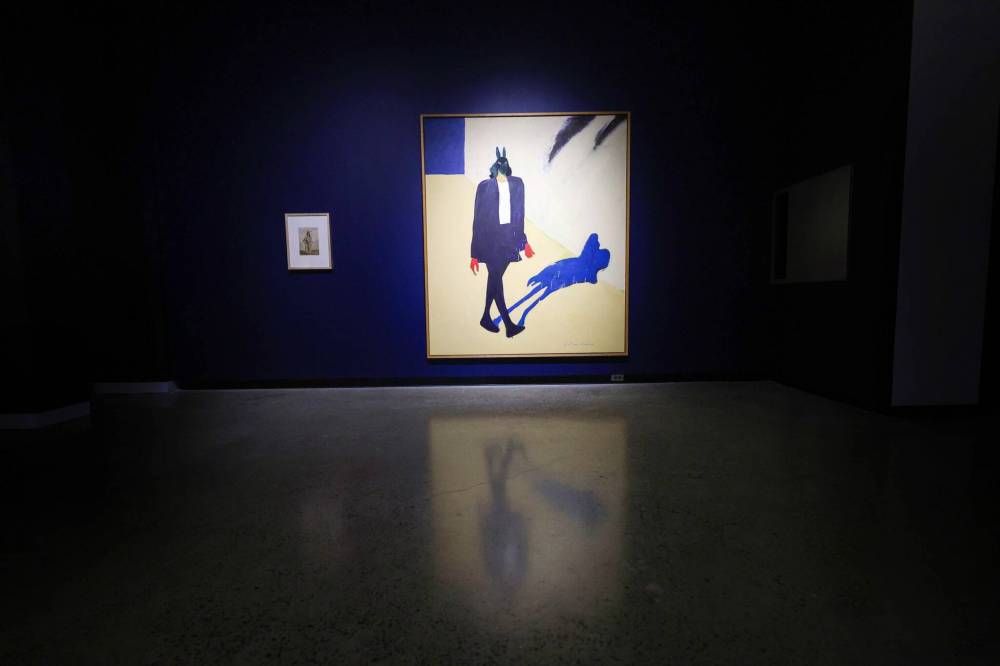
Reframed presents an unsanitized version of Indigenous and settler relations that the curator admits could be hard for some to take in and reckon with.
Ruth Bonneville Free Press
Artwork by American Indigenous artist Fritz Scholder, right, juxtaposed against work by William Armstrong at the Reframed exhibit.
“I think people walking through this exhibit may be dealing with a little bit of discomfort,” she says. “I want people to sit with that discomfort and understand where it might be coming from. I also want people to learn more about the history of Indigenous presence and resistance as well.”
Redhead says representation in places such as the Winnipeg Art Gallery plays a big role in breaking down colonial views, because Indigenous work was never historically considered fine art.
Vi Houssin, one of the emerging artists featured in the exhibition, says beadwork has been the “flagship artistic medium” of the Métis people, but hasn’t been considered high art until the last 10 to 15 years.
“It has been undervalued, it has been sold for ridiculously low amounts of money and it has been treated as ethnographic items rather then works of fine art,” she says.
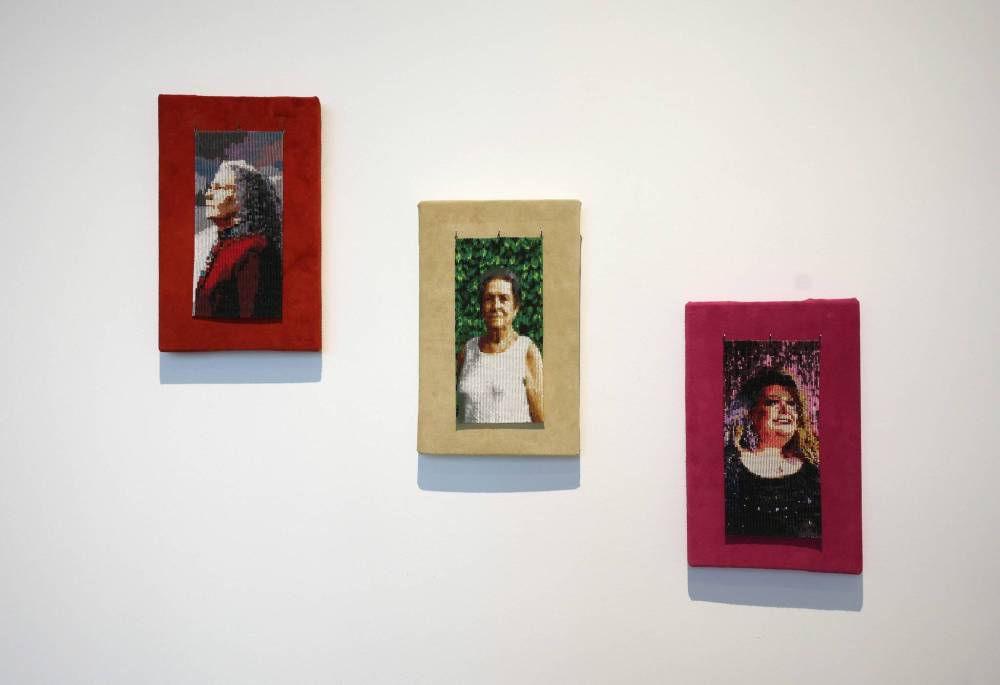
Houssin’s beadwork in the exhibit consists of three separate pieces that depict the most influential women in her life.
Ruth Bonneville / Free Press
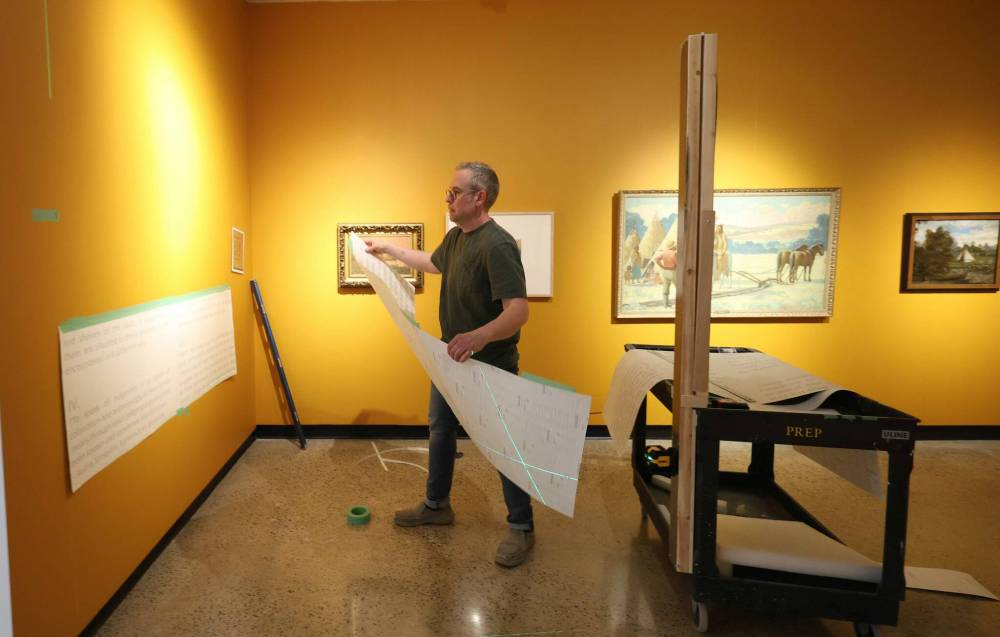
Galleries installation technician Andrew Lodwick places new signage up in the new exhibit.

She says many historical portrayals of Métis people depict them as a patriarchy, when they were a matriarchal society.
“So many of our communities are guided by women and the knowledge of women,” Houssin says.
“I hope people see these portraits and see the love that I poured into them and realize that Indigenous women are valuable, Indigenous women are loved, Indigenous woman are deserving of our reverence.”
Houssin says the beadworks took hundreds of hours to complete and were made between 2023 and 2024. She was recently asked by Redhead to add the pieces to the gallery.
tiago.resko@freepress.mb.ca
Ruth Bonneville / Free Press
Beaded artwork by Red River Métis artist Vi Houssin. From left: Anita (2024, seed beads, nylon thread, silver guardians, hide); Elma, (2023, seed beads, nylon thread, silver guardians, hide); Jennine (2023, seed beads, nylon thread, silver guardians, hide).