

‘Going to be a disaster of a summer’
Late start to season due to cold washed away in storm-powered flash for many Manitoba farmers

Advertisement
Read this article for free:
or
Already have an account? Log in here »
To continue reading, please subscribe:

Digital Subscription
One year of digital access for only $205*
- Enjoy unlimited reading on winnipegfreepress.com
- Read the E-Edition, our digital replica newspaper
- Access News Break, our award-winning app
- Play interactive puzzles
*First annual payment billed as $205.00 + GST for one year. This annual subscription will automatically renew at $233.00 + GST every 52 weeks (10% off the regular annual price of $259.35). Offer available to new and qualified returning subscribers only. Cancel any time.
To continue reading, please subscribe:
Add Free Press access to your Brandon Sun subscription for only an additional
$1 for the first 4 weeks*
- Enjoy unlimited reading on winnipegfreepress.com
- Read the E-Edition, our digital replica newspaper
- Access News Break, our award-winning app
- Play interactive puzzles
*Your next Brandon Sun subscription payment will increase by $1.00 and you will be charged $17.95 plus GST for four weeks. After four weeks, your payment will increase to $24.95 plus GST every four weeks.
Read unlimited articles for free today:
or
Already have an account? Log in here »
Torrential rains eroded Manitoba farms, flooded fields, isolated cattle herds and damaged longstanding rural properties.
The entirety of the damage from this month’s storms is still unknown. Many producers are waiting for water to drain.
The provincial government plans to assess the situation at the end of June by using crop insurance data and talking to producers. From there, it’ll determine whether more support is needed for impacted farmers, the agriculture minister said.
MIKAELA MACKENZIE / FREE PRESS
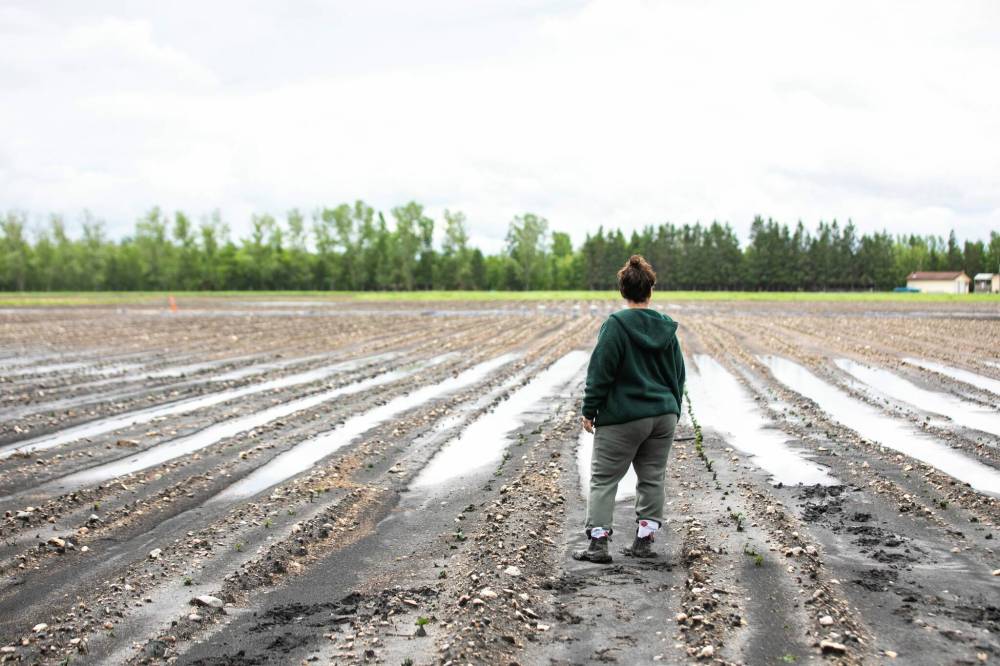
Danielle Boonstra, co-owner of Boonstra Farms, surveys a waterlogged strawberry field (with new seedlings) at the company’s berry picking site near Stonewall on Thursday.
Meanwhile, the Manitoba Agricultural Services Corp. — which oversees crop insurance — has received an average 314 calls daily over the first three days this week.
Ryan Hofford expects he’s lost a quarter of his crops north of Swan River. His 1,500 acres weren’t hit “as bad” as neighbours — roughly six inches (152 millimetres) fell between Saturday and Sunday, Hofford said.
Nearby, roads have been washed out. Hofford has seen pictures from fellow farmers, including those in Minitonas, which is just east.
“It’s almost unbelievable that the water can move that much soil,” he said. “I don’t know if … parts of those fields will ever be productive again. Certainly not for a lot of years.
“This experience is very difficult for those guys.”
Hofford thinks he’ll be able to seed his full plot next year. But for this summer, some of his canola is a literal wash.
He finished seeding just before the rains came. Canola farmers were generally late this year due to a cold May.
The smaller the plant, the more vulnerable it is to heavy rain, said Lindsey Brooks, an agronomy specialist with the Manitoba Canola Growers. “We really don’t know (total crop loss) until that water moves off of the field.”
Hail and wind also disturbed crops throughout the province. Some farmers had soil blown into their ditches during heavy May winds — now, in some cases, water isn’t draining from fields “as quickly as we’d like,” Brooks said.
“Every region of the province has been affected by the weather so far this year,” added Jake Ayre, vice-president of Keystone Agricultural Producers.
Some rural municipalities declared states of emergencies this week because of overland flooding, power outages and overwhelmed sewer systems.
Parts of Stonewall recorded a jaw-dropping 255 mm of rain on Tuesday and early Wednesday.
SUPPLIED
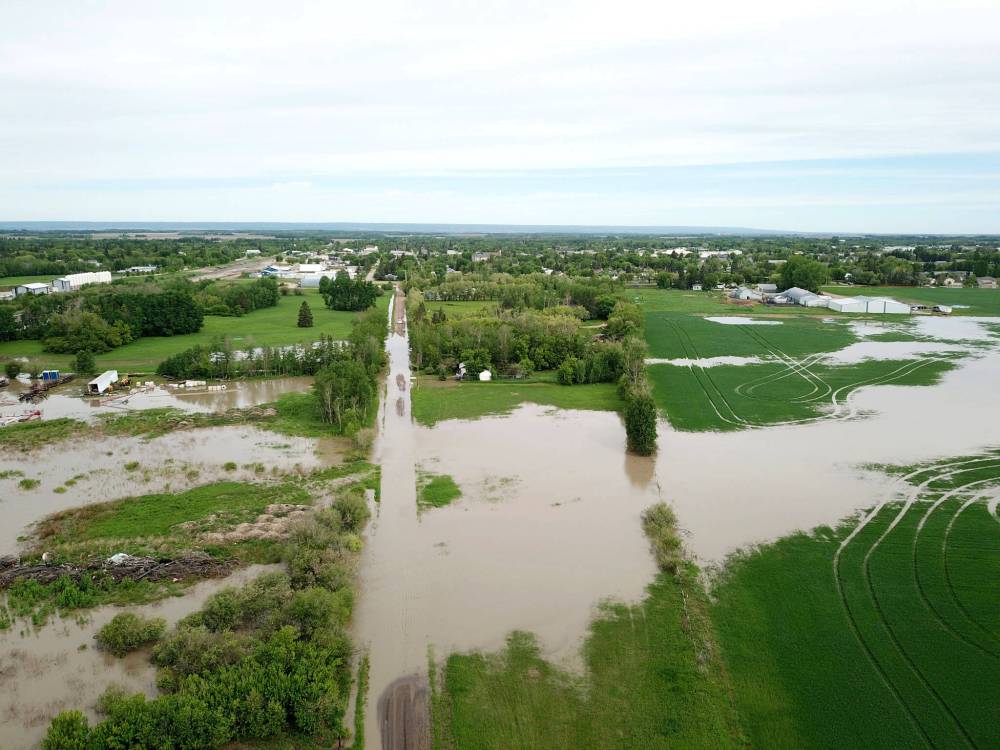
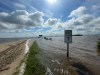
Drone image of the Swan River Valley area on Tuesday. Manitoba Agricultural Services Corp. was logging more than 310 calls a day this week.
Agriculture Minister Ron Kostyshyn visited Swan River and Minitonas with Premier Wab Kinew and Infrastructure Minister Lisa Naylor on Wednesday. He met with farmers.
“It’s pretty alarming to see the amount of water out on … the land,” Kostyshyn said.
He urged producers who’ve lost crops to tap into crop insurance and contact a Manitoba Agricultural Services Corp. office. As of Tuesday, 93 per cent of eligible acres had been seeded, he said.
The corporation’s standard is to return voicemails within 24 hours, but it’s generally able to respond on the same day, a spokesperson said.
Henry Holtmann plans to use crop insurance. He clocked 11 inches (279 mm) of rain at his Rosser dairy farm this week. He has 600 cows to feed, but roughly half of his corn crop and 40 per cent of his alfalfa is “drowned out.”
“We have to … wait for it to dry and then try to figure out if we can do some recovery planting, put some real short-season crops,” Holtmann said, mentioning wheat. “Otherwise, we have to purchase feed. But we pride ourselves on growing enough feed for ourselves and for all our cows.”
Crop insurance doesn’t cover replacement feed, and with the price of fertilizer this year, there’s little money to go around, Holtmann said. Fertilizer and diesel costs skyrocketed as conflict unfurled in Iran and the Strait of Hormuz, where one-fifth of the world’s crude oil ships through.
Holtmann has been farming for more than 40 years. This amount of rainfall is new, he said.
“We take it in stride,” he said. “You’ve got to look at the cup being half-full. That carries you through some of these extraordinary events.”
Danielle Boonstra is hoping her 2026 and 2027 strawberry fields recover from the rain and hail dump in Stonewall. Boonstra Farms has 36 acres of strawberries for picking (12 won’t be ready until next year).
Water pooled between rows of plants. The berries may be saved because they grow on hills above ground level, Boonstra said as she walked through the patches.
Boonstra Farms may open for picking in the first week of July. Last year, picking began the last week of June.
SUPPLIED
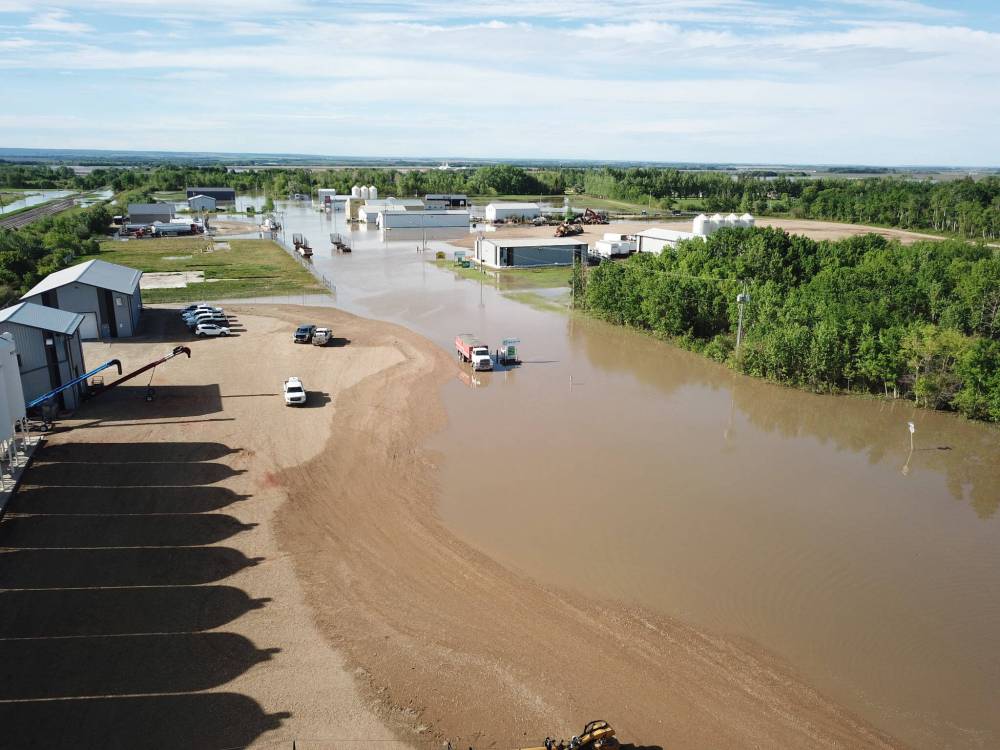
Swan River Vally area.
Ian Smith was among the producers facing a power outage Thursday morning. He hadn’t left his house to check his cows because he’d been running a generator on the Argyle-area homestead for 43 hours.
“It’s just going to be a disaster of a summer, I’m afraid,” he said. “You can’t even say ‘Go to Plan A, Plan B, Plan C’… you just live by the moment, it seems.”
He said his 160-acre farm got more than 250 mm of rain this week. He expected he’d be able to reach his cattle.
Some Manitoba herds have been isolated. Swan River and Interlake animals seem to be most impacted, said Carson Callum, chief executive of the Manitoba Beef Producers.

Cows can graze on grass, but if isolation is prolonged, feed may need to be airlifted, Callum said. Government staff have been finding lost cattle via aircraft, he added.
Staff are working daily to find “alternative means” of moving cattle and providing feed, Kostyshyn said.
Ayre noted these times are stressful for farmers. He pointed to the Manitoba Farmer Wellness Program, which offers free mental health counselling for farmers and their families.
Manitoba Farm, Rural and Northern Support Services has a mental health helpline (1-866-367-3276).
gabrielle.piche@winnipegfreepress.com
Gabrielle Piché reports on business for the Free Press. She interned at the Free Press and worked for its sister outlet, Canstar Community News, before entering the business beat in 2021. Read more about Gabrielle.
Every piece of reporting Gabrielle produces is reviewed by an editing team before it is posted online or published in print — part of the Free Press‘s tradition, since 1872, of producing reliable independent journalism. Read more about Free Press’s history and mandate, and learn how our newsroom operates.
Our newsroom depends on a growing audience of readers to power our journalism. If you are not a paid reader, please consider becoming a subscriber.
Our newsroom depends on its audience of readers to power our journalism. Thank you for your support.
Gabrielle Piché reports on business for the Free Press. She interned at the Free Press and worked for its sister outlet, Canstar Community News, before entering the business beat in 2021. Read more about Gabrielle.
Every piece of reporting Gabrielle produces is reviewed by an editing team before it is posted online or published in print — part of the Free Press‘s tradition, since 1872, of producing reliable independent journalism. Read more about Free Press’s history and mandate, and learn how our newsroom operates.
Our newsroom depends on a growing audience of readers to power our journalism. If you are not a paid reader, please consider becoming a subscriber.
Our newsroom depends on its audience of readers to power our journalism. Thank you for your support.
Related Articles
Financial help available for residents of flood-ravaged communities: premier


Advertisement Advertise With Us
Advertisement Advertise With Us