

Punishment after trauma
Winnipeg woman who has accused massage therapist of sexual assault says difficult situation made worse by absence of authority to regulate industry in Manitoba

Advertisement
Read this article for free:
or
Already have an account? Log in here »
To continue reading, please subscribe:

Digital Subscription
One year of digital access for only $205*
- Enjoy unlimited reading on winnipegfreepress.com
- Read the E-Edition, our digital replica newspaper
- Access News Break, our award-winning app
- Play interactive puzzles
*First annual payment billed as $205.00 + GST for one year. This annual subscription will automatically renew at $233.00 + GST every 52 weeks (10% off the regular annual price of $259.35). Offer available to new and qualified returning subscribers only. Cancel any time.
To continue reading, please subscribe:
Add Free Press access to your Brandon Sun subscription for only an additional
$1 for the first 4 weeks*
- Enjoy unlimited reading on winnipegfreepress.com
- Read the E-Edition, our digital replica newspaper
- Access News Break, our award-winning app
- Play interactive puzzles
*Your next Brandon Sun subscription payment will increase by $1.00 and you will be charged $17.95 plus GST for four weeks. After four weeks, your payment will increase to $24.95 plus GST every four weeks.
Read unlimited articles for free today:
or
Already have an account? Log in here »
When a Winnipeg woman reported being sexually assaulted by a massage therapist this year, she couldn’t have expected the traumatizing battle that would follow, which she says was made worse by lax regulations in the industry in Manitoba.
The woman, who is not being named by the Free Press, said she booked a Jan. 30 massage through a service that facilitates last-minute appointments.
She said the massage therapist pulled down her underwear without her consent and removed the cover she had been given, leaving most of her body exposed. She called the therapist’s actions “violating.”
She said he proceeded to give her a gluteal (buttocks) massage that she did not ask for and she described it as “sexual” in nature.
“I was laying there, frozen, and the whole time just trying to figure out what to do, but I couldn’t speak, because I was so scared.”
She said she froze. At no point did he check in, she said, and did not acknowledge her when she, still frozen, shed a tear.
“I was terrified,” she said Friday. “I was laying there, frozen, and the whole time just trying to figure out what to do, but I couldn’t speak, because I was so scared.”
The woman, who said she regularly receives massages, said she knew immediately she’d been assaulted. She reported the incident to police on Jan. 31, and was interviewed by officers the next day.
Jason Brasher was arrested on April 14 and charged with one count of sexual assault. Brasher, who has no prior charges on his record, is set to appear in court July 20. His charge has not been proven in court.
On June 16, the Manitoba government took the first step toward regulating massage therapists by including massage therapy in its Regulated Health Professions Act. The government must appoint a transition council whose task is to structure the regulatory body. Currently, in the absence of a regulatory body, the industry has no way for complaints to be investigated or disciplinary action to be handed out. Nor does it have a centralized code of conduct.
The woman, who said she feared the therapist would be able to continue working, submitted complaints to his workplace and to the National Health Practitioners of Canada before he was charged. Her complaints were investigated, but she said neither resulted in meaningful discipline.
“It became really clear to me, as I tried to share this, that it doesn’t feel like these systems were designed to protect the public or to protect me.”
“I think when something traumatic like this happens to you, there’s the impact of the incident itself, those horrible 60 minutes that I spent in that room, then there’s everything that came after, the ways that I continue to be harmed by the systems and engaging to try to protect other people,” she said.
“It became really clear to me, as I tried to share this, that it doesn’t feel like these systems were designed to protect the public or to protect me. I felt like these systems were designed to protect others from liability, and I didn’t feel like I was heard or believed.
Brasher’s workplace retained legal counsel to handle its investigation, according to documentation provided to the Free Press, and concluded sexual assault and professional misconduct allegations were “not substantiated.” The woman said she was asked to sign a confidentiality agreement to participate, which she declined.
While she was interviewed by the NHPC for its investigation, she said she was asked leading questions, including whether she could have done anything differently to prevent the situation. In a decision letter sent to the woman by the NHPC before Brasher’s arrest, the organization acknowledged a breakdown in communication had occurred and said he would be “given the opportunity to voluntarily agree to undertake specific learning and remediation.”
“I would have thought that the bar would be lower for professional misconduct than being charged with sexual assault.”
“The legal system took this seriously enough to press charges, but with the same information, these other two (organizations) did not,” the woman said.
“I would have thought that the bar would be lower for professional misconduct than being charged with sexual assault.”
A spokesperson for Brasher’s workplace said Friday management had “reviewed the matter internally and are co-operating with the Natural Health Practitioners of Canada.”
In an email Thursday, NHPC CEO Tendai Nzuma said the association was aware Brasher had been charged and “is currently dealing with the matter through (its) complaint resolution process.”
Even if her complaints resulted in the NHPC revoking Brasher’s membership, professional associations in Manitoba do not have the ability to revoke a member’s licence.
Tricia Weidenbacher, executive director of the Massage Therapy Association of Manitoba, said the case highlights why the fight for a college of massage therapists — which has gone on since the association was founded in 1973 — is so important.
“There’s no safeguards,” she said.
Ruth Bonneville / Free Press The executive director of the Massage Therapy Association of Manitoba, Tricia Weidenbacher, says that the fight for a college of massage therapists is so important: “There’s no safeguards.”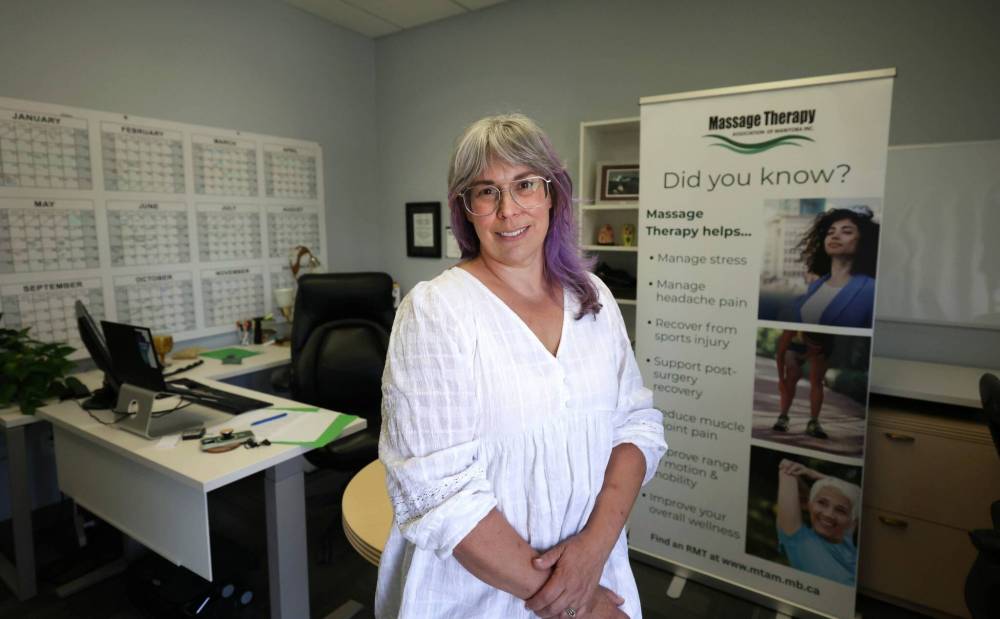
“But with the regulation.… You could look at their registry of practitioners, type in the person’s name or their clinic address, and see, is this person legit? Are they registered? Are they in active status? Have there been complaints lodged in the past? What was the result of those complaints, and the nature of the complaint?
“You can find all of that out, and then make an educated decision on who you’re going to go see.”
She said she’s “frustrated” and concerned about further delay because there’s no timeline to appoint the transition council.
“It helps ensure that Manitobans can have confidence in the massage therapy care that they receive,” she said. “They deserve to know that the professionals providing their care are being held to clear provincial standards.”
A spokesperson for Health Minister Uzoma Asagwara, who is responsible for the appointment of the transition council, declined to comment, citing the media blackout owing to the provincial byelection called in northern Manitoba this week.
“(Manitobans) deserve to know that the professionals providing their care are being held to clear provincial standards.”
Regulations would improve protections for massage therapists, including the Manitoba association’s approximately 1,100 members, Weidenbacher said.
It could give the industry the power to put a dent in the wave of people who falsely advertise themselves as massage therapists on online marketplaces, and could change misconceptions around massage therapists.
“I would say that can be almost a daily occurrence for some of our members, who report getting calls asking about ‘happy endings,’” she said.
The changes will be enacted too late for the woman who came forward, whose voice shakes when she describes the aftermath of that day. She missed work and cancelled plans with friends in the following days, and has since sought therapy for symptoms of post-traumatic stress disorder.
Manitoba’s unregulated massage therapy industry caused its own pain, she said.

Without a regulatory body that has disciplinary power, she was forced to relive her assault multiple times to advocate for herself, and for others who may not have the resources to come forward.
“I don’t know how somebody (could come forward) without the resources that I have. I’m so lucky that I can afford therapy, and that I have people that care for me, and that I can afford to work less, and that I can prioritize looking after myself in these ways, and let myself heal,” she said.
She doesn’t regret coming forward, and hopes regulating the industry isn’t “so punishing” on anyone else who chooses to do so.
“I hope that they design this well, so that people don’t have to go through what I’ve been going through when they’re trying to get justice.”
malak.abas@freepress.mb.ca
Malak Abas is a city reporter at the Free Press. Born and raised in Winnipeg’s North End, she led the campus paper at the University of Manitoba before joining the Free Press in 2020. Read more about Malak.
Every piece of reporting Malak produces is reviewed by an editing team before it is posted online or published in print — part of the Free Press‘s tradition, since 1872, of producing reliable independent journalism. Read more about Free Press’s history and mandate, and learn how our newsroom operates.
Our newsroom depends on a growing audience of readers to power our journalism. If you are not a paid reader, please consider becoming a subscriber.
Our newsroom depends on its audience of readers to power our journalism. Thank you for your support.
Malak Abas is a city reporter at the Free Press. Born and raised in Winnipeg’s North End, she led the campus paper at the University of Manitoba before joining the Free Press in 2020. Read more about Malak.
Every piece of reporting Malak produces is reviewed by an editing team before it is posted online or published in print — part of the Free Press‘s tradition, since 1872, of producing reliable independent journalism. Read more about Free Press’s history and mandate, and learn how our newsroom operates.
Our newsroom depends on a growing audience of readers to power our journalism. If you are not a paid reader, please consider becoming a subscriber.
Our newsroom depends on its audience of readers to power our journalism. Thank you for your support.
Advertisement Advertise With Us
Advertisement Advertise With Us