

Joyal would bring compassion, empathy to Canada’s high court

Advertisement
Read this article for free:
or
Already have an account? Log in here »
To continue reading, please subscribe:

Digital Subscription
One year of digital access for only $205*
- Enjoy unlimited reading on winnipegfreepress.com
- Read the E-Edition, our digital replica newspaper
- Access News Break, our award-winning app
- Play interactive puzzles
*First annual payment billed as $205.00 + GST for one year. This annual subscription will automatically renew at $233.00 + GST every 52 weeks (10% off the regular annual price of $259.35). Offer available to new and qualified returning subscribers only. Cancel any time.
To continue reading, please subscribe:
Add Free Press access to your Brandon Sun subscription for only an additional
$1 for the first 4 weeks*
- Enjoy unlimited reading on winnipegfreepress.com
- Read the E-Edition, our digital replica newspaper
- Access News Break, our award-winning app
- Play interactive puzzles
*Your next Brandon Sun subscription payment will increase by $1.00 and you will be charged $17.95 plus GST for four weeks. After four weeks, your payment will increase to $24.95 plus GST every four weeks.
Read unlimited articles for free today:
or
Already have an account? Log in here »
There is no easy way to describe the career of the latest Supreme Court of Canada nominee.
Glenn Joyal entered the legal profession nearly 40 years ago, and serving as a prosecutor and private counsel specializing in criminal and constitutional law. He has been a judge for nearly three decades, with the last half of that time as the chief justice of the Court of King’s Bench of Manitoba.
Over his time on the bench, he has overseen cases involving the most contentious issues of our time, including assisted death, COVID-19 restrictions and a long list of constitutional dilemmas.
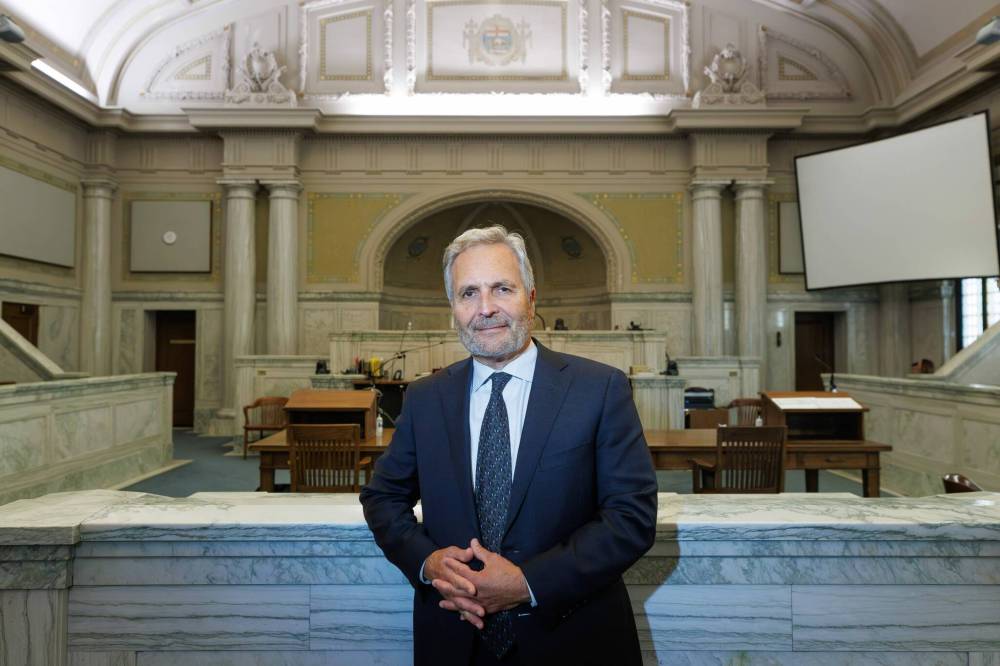
MIKE DEAL / FREE PRESS FILES
As chief justice of Manitoba’s Court of King’s Bench, Glenn Joyal has been the author of remarkable moments of compassion and empathy.
Legal scholars from across the country applauded Prime Minister Mark Carney’s decision to nominate Joyal to the high court, noting his many years of loyal service and fair-mindedness.
For many in Manitoba’s legal profession, Joyal has been the author of remarkable moments of compassion and empathy. While there are many moments that one could reference to prove that point, two stand out.
The first took place in 2023, when Joyal presided over an extraordinary hearing called to review a historic case involving Brian Anderson and Allan John (A.J.) Woodhouse. The two Indigenous men were wrongfully convicted in 1974 of first-degree murder of restaurant worker Ting Fong Chan. Innocence Canada was able to prove the confessions on which the convictions were based had been fabricated by Winnipeg police.
Then-federal justice minister David Lametti quashed the convictions in 2023, setting the stage for a hearing before Joyal. Ultimately, Manitoba Justice decided against re-trying the two men and admitted that based on new evidence from Innocence Canada, there was no doubt the confessions were fabricated.
Innocence Canada sought a declaration that both men were innocent.
It was a difficult moment for any judge.
First, because in wrongful conviction cases, the entire justice system is on trial, and many within that system will fight strenuously to defend it. It’s also difficult because the system technically and traditionally only recognizes “guilty” and “not guilty.” Innocence is simply not accepted language.
Joyal, however, seized the moment to make history.
“You are innocent,” Joyal told the men before the court in October 2024, with both Anderson and Woodhouse and their families looking on in astonishment.
Naysayers might be tempted to point out that Joyal’s comments do not, in and of themselves, qualify as jurisprudence. Factual innocence or legal exoneration remains outside the strict confines of criminal law. As such, it could be argued that Joyal’s gesture was more symbolic than precedent-setting.
And yet, a judge of Joyal’s stature making this kind of statement does seem to have resonated through Canada’s legal community.
It is noteworthy that two other men wrongfully convicted in the same case were also exonerated.
Clarence Woodhouse appeared in Winnipeg before Joyal in the fall of 2024. As was the case with Anderson and A.J. Woodhouse, Joyal wasted no time in declaring him “innocent.”
These hearings set the stage for federal Justice Minister Sean Fraser, who in the fall of 2025 ordered a posthumous appeal hearing for Russell Woodhouse, the fourth man convicted of the Chan murder. Russell Woodhouse died of cancer in 2011. Although an appeal date has yet to be set, this remains the first posthumous review of a case of wrongful conviction in Canadian legal history.
In all of these events, Joyal functions as both an agent of change, and a catalyst for changes in others who control the levers of the justice system.
Which brings us to a second, extraordinary event in August 2025, when Joyal agreed to hold a special hearing to allow the family of Ashlee Shingoose an opportunity to speak about the impact her murder had had on them. Shingoose was one of four First Nations women murdered by serial killer Jeremy Skibicki.
The innovative aspect of his hearing was that it was happening almost one year after Joyal presided over Skibicki’s trial and sentenced him to life in prison.
Shingoose, who had not been identified at the time of Skibicki’s trial, had been referred to as Mashkode Bizhiki’ikwe, or Buffalo Woman. Police were able to identify Shingoose as the fourth victim in the spring of 2025.

The decision to hold a special hearing post-sentencing to allow victim impact statements from Shingoose’s family made national headlines, and caused quite a bit of debate among legal experts who felt it might open the door to all kinds of procedural mayhem.
Joyal, who has taken broad strides to introduce Indigenous cultural traditions into court proceedings, said the hearing was “both appropriate and necessary.”
“The court has had to reflect on both the legal parameters and institutional duties and opportunities that this situation presents for the purpose of providing a fair process,” Joyal said at the time.
It is unclear whether Joyal will have opportunities to demonstrate the same compassion and empathy he exhibited at the helm of the Court of King’s Bench, should he be confirmed to the Supreme Court of Canada. However, he would arrive at a time when both commodities are badly needed in this country, including in the highest court in the land.
dan.lett@freepress.mb.ca
Dan Lett is a columnist for the Free Press, providing opinion and commentary on politics in Winnipeg and beyond. Born and raised in Toronto, Dan joined the Free Press in 1986. Read more about Dan.
Dan’s columns are built on facts and reactions, but offer his personal views through arguments and analysis. The Free Press’ editing team reviews Dan’s columns before they are posted online or published in print — part of the our tradition, since 1872, of producing reliable independent journalism. Read more about Free Press’s history and mandate, and learn how our newsroom operates.
Our newsroom depends on a growing audience of readers to power our journalism. If you are not a paid reader, please consider becoming a subscriber.
Our newsroom depends on its audience of readers to power our journalism. Thank you for your support.
Dan Lett is a columnist for the Free Press, providing opinion and commentary on politics in Winnipeg and beyond. Born and raised in Toronto, Dan joined the Free Press in 1986. Read more about Dan.
Dan’s columns are built on facts and reactions, but offer his personal views through arguments and analysis. The Free Press’ editing team reviews Dan’s columns before they are posted online or published in print — part of the our tradition, since 1872, of producing reliable independent journalism. Read more about Free Press’s history and mandate, and learn how our newsroom operates.
Our newsroom depends on a growing audience of readers to power our journalism. If you are not a paid reader, please consider becoming a subscriber.
Our newsroom depends on its audience of readers to power our journalism. Thank you for your support.
Related Articles
Nominee Glenn Joyal tells MPs he wants to uphold public confidence in Supreme Court


Advertisement Advertise With Us
Advertisement Advertise With Us
History
Updated on Monday, June 29, 2026 5:40 PM CDT: Some details edited for clarity.
Updated on Monday, June 29, 2026 6:01 PM CDT: Updates headline