Japan’s space agency conducts first test flight for experimental reusable rocket

Advertisement

Advertise with us

TOKYO (AP) — Japan's experimental reusable rocket took off and safely landed in a first test flight Saturday as the country seeks to achieve the technology key to cut launch costs and compete in the global space market dominated by SpaceX.

Read this article for free:


or

Already have an account? Log in here »

To continue reading, please subscribe:

Subscribe and receive a limited-edition Free Press branded hat or tote.

Digital Subscription

One year of digital access for only $205*

  • Enjoy unlimited reading on winnipegfreepress.com
  • Read the E-Edition, our digital replica newspaper
  • Access News Break, our award-winning app
  • Play interactive puzzles

*First annual payment billed as $205.00 + GST for one year. This annual subscription will automatically renew at $233.00 + GST every 52 weeks (10% off the regular annual price of $259.35). Offer available to new and qualified returning subscribers only. Cancel any time.

To continue reading, please subscribe:

Add Free Press access to your Brandon Sun subscription for only an additional

$1 for the first 4 weeks*

  • Enjoy unlimited reading on winnipegfreepress.com
  • Read the E-Edition, our digital replica newspaper
  • Access News Break, our award-winning app
  • Play interactive puzzles
Start now

*Your next Brandon Sun subscription payment will increase by $1.00 and you will be charged $17.95 plus GST for four weeks. After four weeks, your payment will increase to $24.95 plus GST every four weeks.

TOKYO (AP) — Japan’s experimental reusable rocket took off and safely landed in a first test flight Saturday as the country seeks to achieve the technology key to cut launch costs and compete in the global space market dominated by SpaceX.

The RV-X rocket lifted off, hovered and moved horizontally before landing during its less than one-minute flight at the Japan Aerospace Exploration Agency’s Noshiro Testing Center in northeastern Japan, which was livestreamed by the NVS, a group of space fans.

The rocket flew as planned, rising 11 meters (36 feet) and moving horizontally 16 meters (52 feet) while keeping its upright position before landing, Takashi Ito, JAXA’s reusable rocket project manager, said in an online briefing from the test center.
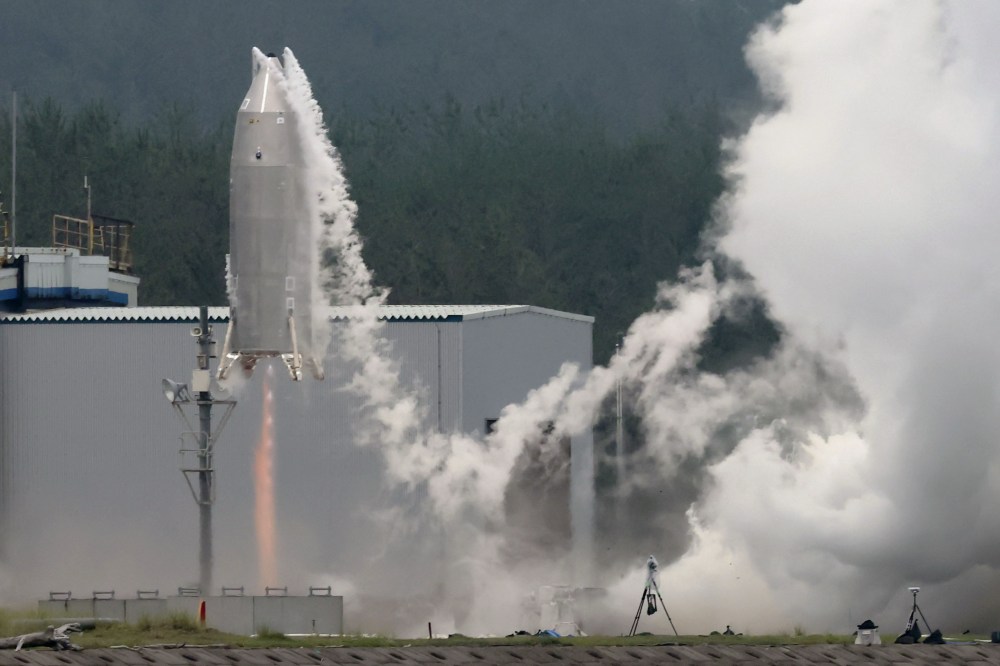
The Reusable Vehicle eXperiment, known as RV-X, is seen in a test launch at the Noshiro Rocket Testing Center of the Japan Aerospace Exploration Agency in Noshiro, northern Japan, Saturday, July 11, 2026. (Naoki Kawano/Kyodo News via AP)

Japan seeks to catch up with the technology Elon Musk’s SpaceX has been using for several years to cut launch costs of delivering payloads into space.

Saturday’s flight is a step forward for Japan in achieving the technology needed to develop a lower cost successor to the country’s current mainstay, single-use H3 series.

The flight comes one day after state media in China reported the country achieved its first successful recovery of the first stage of a rocket after a liftoff.

Japan’s H3 rocket is designed to be more cost effective than its predecessor H-2A series, which had a near-perfect success record, but still needs further cost cuts to compete in the global space market.

The Japanese government says a stable, commercially competitive transport capability is key to the country’s space program and national security.

JAXA and Mitsubishi Heavy Industries have been co-developing the RV-X, which is 1.8 meters (5.9 feet) in diameter and 7.3 meters (23.9 feet) long and equipped with an engine with enhanced durability and four shock-absorption landing gear.

The “hardworking” engine has so far withstood 165 combustion tests, Ito said.

JAXA, which is jointly developing reusable rockets with France and Germany, plans to send the RV-X rocket to a higher altitude of about 100 meters (218 feet) in future test flights.
Report Error Submit a Tip

More Stories

Putting together annual fashion show takes many hard-working hands

AV Kitching 8 minute read Preview

Putting together annual fashion show takes many hard-working hands

AV Kitching 8 minute read 2:00 AM CDT

A frenzy of activity is taking place behind the closed doors of WAG-Qaumajuq on Monday. It’s the day before Crafted on the Catwalk, the gallery’s annual fashion and design show, and the clock is ticking.

There’s less than 30 hours before the big event and it’s all hands on deck.

A steady stream of people walk in and out of the Memorial Boulevard entrance towards the main hall, which glows in soft hues as technicians test out lighting equipment.

The ground floor is teeming with people lugging chairs and pushing trolleys. A stream of white material unravelling from its roll prompts a shouted “OK to step on this?” and receives an equally loud ‘No!” in reply, voices raised above the metallic buzz of a drill as staff from a local production company put together seats.

Read
2:00 AM CDT

Trade war fuelling spike in city costs

Joyanne Pursaga 4 minute read Preview

Trade war fuelling spike in city costs

Joyanne Pursaga 4 minute read Yesterday at 2:01 AM CDT

A trade war between the U.S. and Canada could cost the City of Winnipeg millions of dollars more than was anticipated during the budget process for this year’s expenditures and beyond.

Read
Yesterday at 2:01 AM CDT

Letters, Sept. 16

7 minute read Preview

Letters, Sept. 16

7 minute read Updated: 8:06 AM CDT

Decades ago, we were told mining and other economic development in the North could be “balanced” with protecting caribou habitat. We’ve seen how that worked out. Fortunes were made. Caribou herds declined, and now some populations are teetering on the brink of extinction.

Read
Updated: 8:06 AM CDT

Wind and batteries the best bet

James Wilt 5 minute read Preview

Wind and batteries the best bet

James Wilt 5 minute read 2:01 AM CDT

For years, Manitoba Hydro has claimed that we can’t rely on wind turbines during multi-day or even multi-week cold snaps.

Read
2:01 AM CDT

Suspension on the horizon for Hellebuyck as pre-season set to start

Ken Wiebe 7 minute read Preview

Suspension on the horizon for Hellebuyck as pre-season set to start

Ken Wiebe 7 minute read Yesterday at 6:21 PM CDT

In this high stakes game of chicken, Kevin Cheveldayoff, Connor Hellebuyck or any of the potential suitors for the Winnipeg Jets franchise netminder appear ready to blink.

Read
Yesterday at 6:21 PM CDT

Rogers, Telus deny blame for June twister alert barrage

Malak Abas 3 minute read Preview

Rogers, Telus deny blame for June twister alert barrage

Malak Abas 3 minute read Updated: Yesterday at 7:21 AM CDT

Telecom companies say they aren’t to blame for the barrage of tornado alerts Manitobans received during severe thunderstorms in early June.

The Canadian Radio-television and Telecommunications Commission announced in August it would investigate the unusually high number of alerts, and called on the Pelmorex Corp., which operates the national Alert Ready system, along with telecom companies Bell, Rogers and Telus to respond to a number of questions.

They were given until last Friday to describe their possible roles in the creation, receipt, processing or distribution of alerts issued from Environment and Climate Change Canada in the midst of the June 9 storm.

Telus said in its response that it received 133 alert requests targeted to Manitoba created by Environment Canada and forwarded by Pelmorex between 2:35 p.m. June 9 and 3:29 a.m. the following day. While the majority of those messages contained identical information and were automatically suppressed, 17 were ultimately sent out as alerts in Winnipeg.

Read
Updated: Yesterday at 7:21 AM CDT