Forbidden no more
Artist Bistyek enjoys the freedom of living a creative life in full colour

Advertisement
Read this article for free:
or
Already have an account? Log in here »
To continue reading, please subscribe:

Digital Subscription
One year of digital access for only $205*
- Enjoy unlimited reading on winnipegfreepress.com
- Read the E-Edition, our digital replica newspaper
- Access News Break, our award-winning app
- Play interactive puzzles
*First annual payment billed as $205.00 + GST for one year. This annual subscription will automatically renew at $233.00 + GST every 52 weeks (10% off the regular annual price of $259.35). Offer available to new and qualified returning subscribers only. Cancel any time.
To continue reading, please subscribe:
Add Free Press access to your Brandon Sun subscription for only an additional
$1 for the first 4 weeks*
- Enjoy unlimited reading on winnipegfreepress.com
- Read the E-Edition, our digital replica newspaper
- Access News Break, our award-winning app
- Play interactive puzzles
*Your next Brandon Sun subscription payment will increase by $1.00 and you will be charged $17.95 plus GST for four weeks. After four weeks, your payment will increase to $24.95 plus GST every four weeks.
Read unlimited articles for free today:
or
Already have an account? Log in here »
In pants nearly as wide at the ankle as a downtown sidewalk, Bistyek cuts a striking silhouette on his daily marches through the Exchange District, an area the painter has made his muse since arriving in Winnipeg nine years ago.
He likes it here, loves it even, but as he’s established himself as one of the city’s most vibrant visual artists — with a street-honed style that pays homage to both Japanese anime series Dragon Ball Z and graffiti-inspired American painter Jean-Michel Basquiat — Bistyek won’t forget where he came from: he can’t.
Though the 30-year-old has built an enviable life here, he’s eminently aware that his circumstances are defined as much by sheer luck as they are by determination or talent. When he was growing up in Afrin, a village in Syria, his family was torn apart by civil war and discrimination against the Kurdish minority under the rule of dictator Bashar al Assad.
MIKAELA MACKENZIE / FREE PRESS Bistyek says he’s constantly inspired by the Exchange District.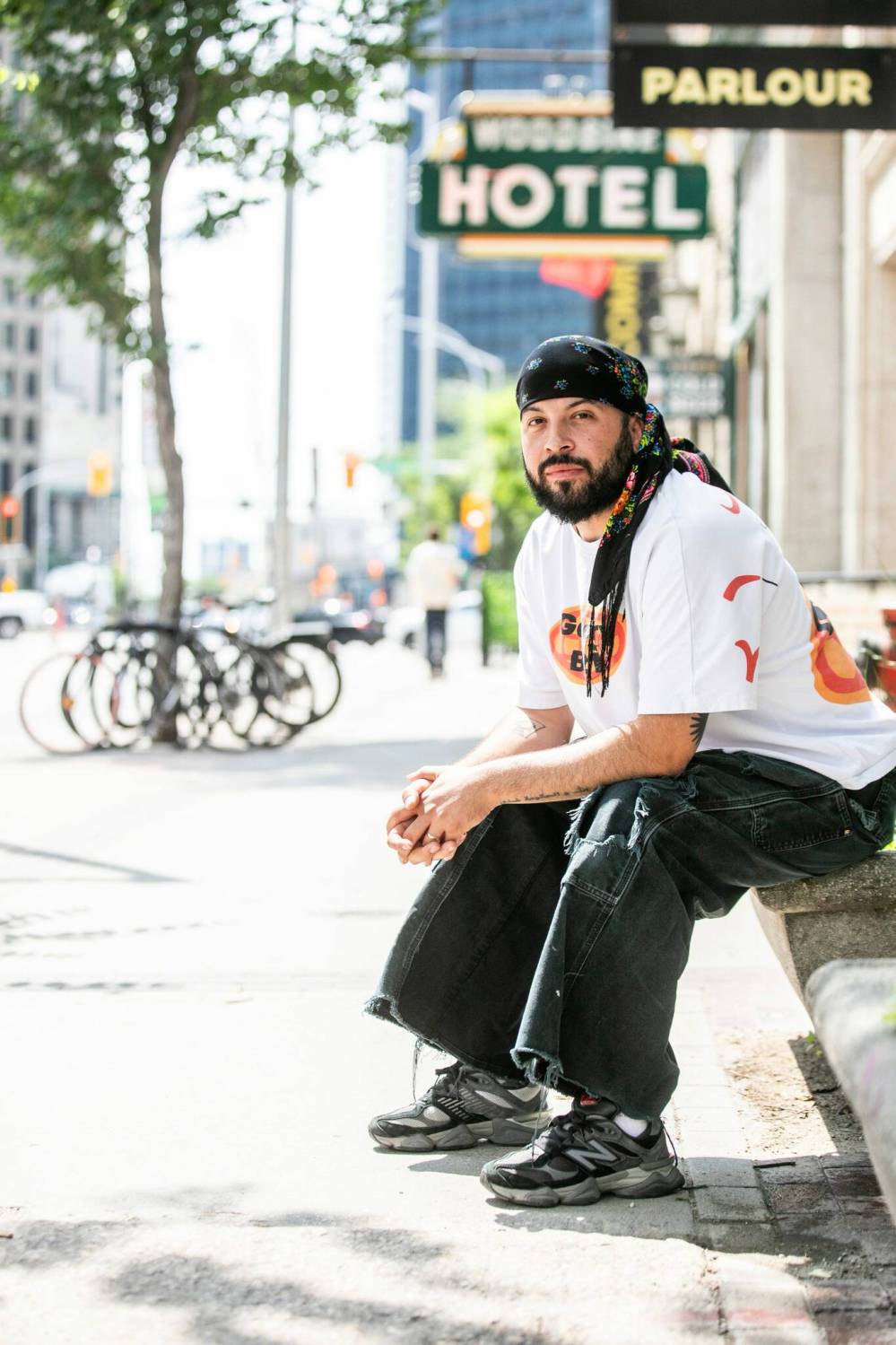
“I was living in Lebanon as a refugee for seven years, with a big group of friends, but day after day they started to cross the sea from Turkey or Greece. Some of them made it, some of them did not,” says the artist born Ormeya Zagros. “I turned to Mom and said, ‘I want to go across the sea. I cannot stay here. I don’t see a future here. I don’t see opportunities. There is so much discrimination and racism. I cannot build a life.’”
A United Nations sponsorship allowed for Bistyek, his mother and one of his brothers to make a safer passage, migrating to Winnipeg in 2017 and leaving most of the family behind, strewn throughout refugee camps in Northern Africa and the Middle East. Upon his arrival in Canada, Bistyek worked with resettlement services for Kurdish youth and eventually found work as a Starbucks barista.
But before long, inspiration struck: he quit his job and began painting at an astounding rate, plugging away on vivid memory paintings of war, family and a distant childhood disordered by conflict. Self-taught as an artist in his youth by using castoff materials such as cardboard or discarded containers, Bistyek for the first time had access to canvases and new material: at gallery shows in both Winnipeg and Toronto, his works sold in the thousands to collectors and newfound patrons.
Supplied Bistyek’s art features the colours of the flag of Kurdistan, a stateless nation in West Asia.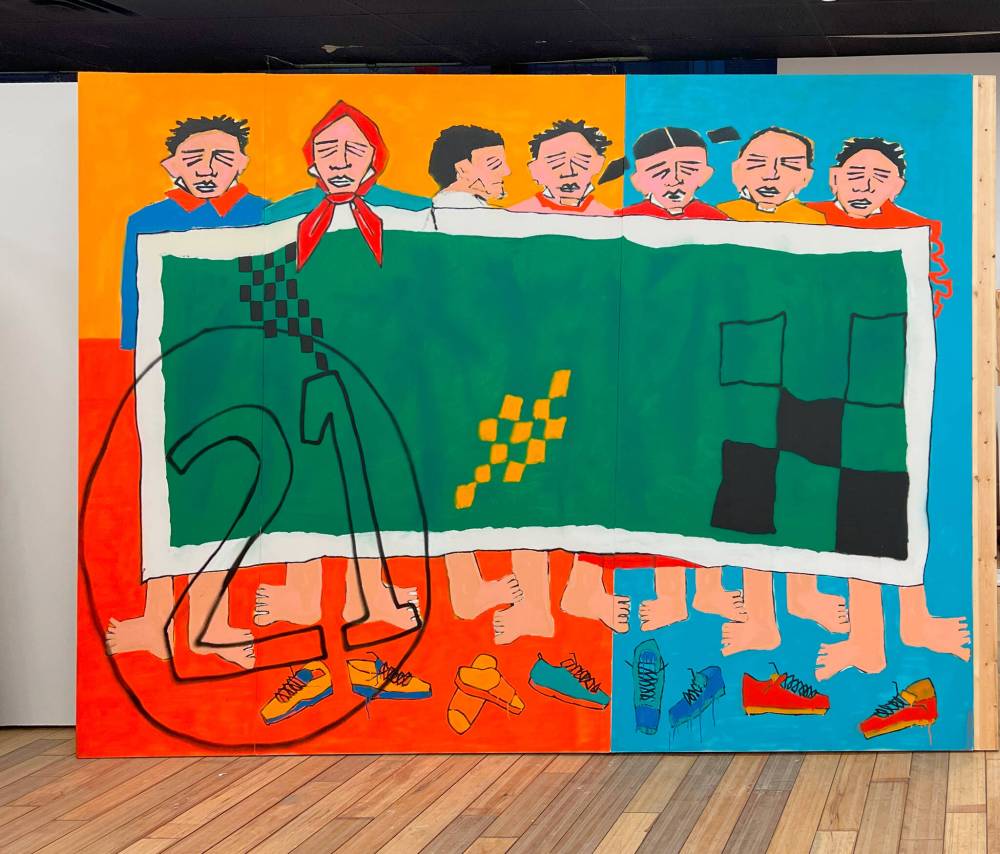
Of course, the artist put some of the proceeds toward his living expenses and his expansive practice, which includes clothing design and furniture-making, but Bistyek’s ultimate goal couldn’t be contained within any mural or inside any frame: he was motivated to reunite his family.
His first exhibition in Winnipeg enabled Bistyek to sponsor the safe arrival in 2023 of his brother Basil, who’d been living in a refugee camp in Iraq; the festivities at the James Armstrong Richardson International Airport went well beyond the standard hug and kiss, as dozens of members of the local Kurdish community sang, danced and drummed with bouquets of roses twirling near baggage claim.
The work continued, and earlier this summer, Bistyek was able to sponsor the immigration of his older brother, his sister-in-law and their four children; the artist hadn’t seen his brother since 2012.
The artist was able to show how far they’d come, bringing his family to the Winnipeg Art Gallery, which is hosting his solo exhibition, Forbidden Colours, through August. “They were very happy. My mother — over the moon,” he says. “I’ve definitely seen some tears in their eyes.”
The exhibition, like the lion’s share of Bistyek’s visual practice, is grounded in experiences of forced motion and suppressed expression under the boot of a totalitarian regime. The show’s title makes reference to an early, painful memory of classroom bullying.
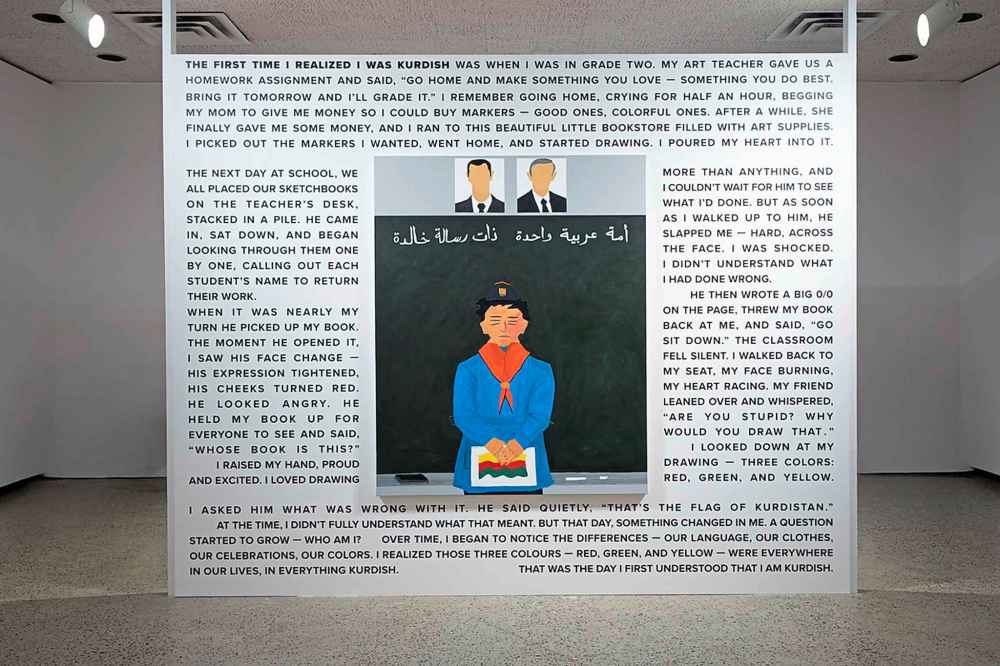
“In second or third grade, my art instructor asked us to go home and draw something we liked, and when I came back the next day — I remember I was the only kid who really cared about drawing — he went through the pictures to mark them. Eventually he got to mine, and his face changed,” Bistyek remembers. “I raised my hand because I thought I had done a great job — I thought he was going to compliment the work — but when I got close enough, he slapped me in the face. I was very shocked. And then he threw the book at me after marking it with a zero.”
His friend explained the transgression. “He asked me why I would draw something like that. That is the flag of Kurdistan,” Bistyek says. “But the thing is, what I had done was put three colours — red, green and yellow — next to each other. That combination of colours threatens that teacher, but those colours were everywhere in our celebrations, our weddings, our homes, our Nowruz (new year) parties. It wasn’t a flag — there were no details — and from that day I started to question myself. What is Kurdistan? Who are the Kurds?”
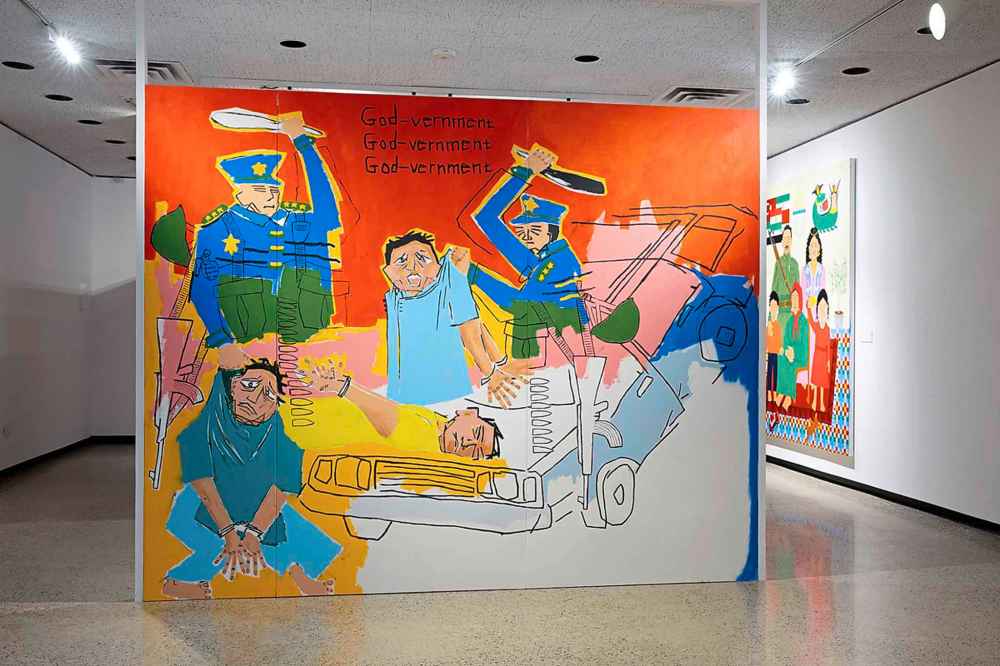
Until then, red was red, green was green and so forth. In Forbidden Colours, the artist explores the same palette from a mature perspective.
The largest component of the exhibition is called the Room, an eight-by-10 reimagining of the quarters he shared with his mother and siblings at an uncle’s house in Aleppo, where the family moved when Bistyek’s father died in 1997; the artist was only nine months old.
“He gave us this tiny room, with a door that opened to the street, and that room was everything for us,” Bistyek says.
It was inside that room where Bistyek first drew out the possibilities of a peaceful elsewhere.
“I’d look at neighbours’ TVs, collecting papers from the streets. My brother started school and gave me my first pencil, so I started to draw all of the cartoon characters. At night, when I couldn’t sleep, I would sketch everything surrounding me — my mom, my brother. As a kid, I had this thinking that anything could be canvas.”
Winnipeg Art Gallery-Qaumajuq The Room is part of the Forbidden Colours exhibition at WAG-Qaumajuq.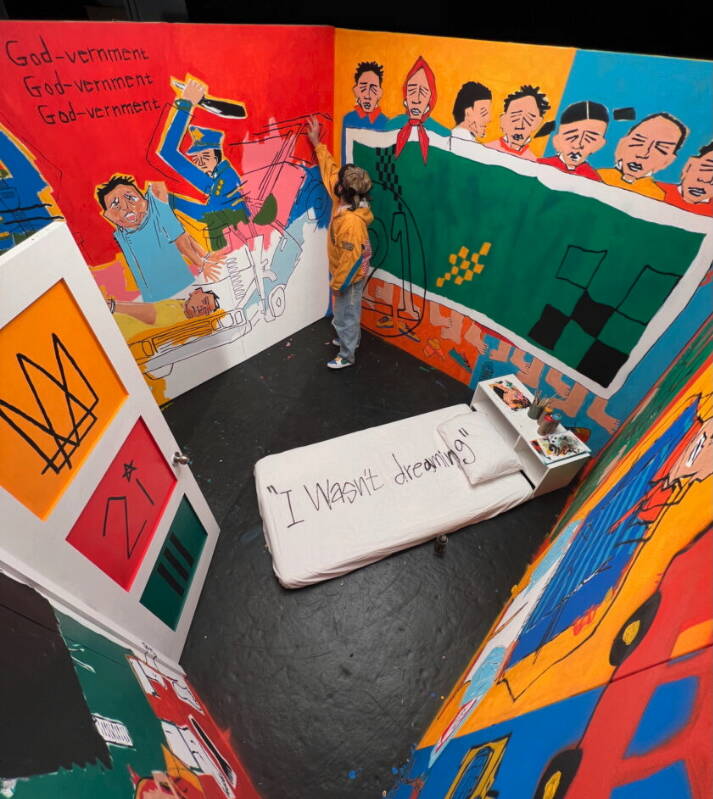
Inside the Room, that means the walls, the window shades and the mattress on the ground, which reads in black letters, “I wasn’t dreaming.”
With his own personal artistic practice in bloom, Bistyek says he’s now more devoted to providing mentorship to emerging and newcomer artists in Winnipeg.
At the new Exchange District café Passage — a next-door offshoot to the now-shuttered Main Street café Parlour — the artist is working to establish a collective gallery for visual art and furniture. Meanwhile, he and his two Winnipeg-based brothers have begun a housewares studio called 3B out of their mother’s St. Boniface garage; several of their sleek, tiled sidetables and display pieces are on view in the café.
The artist credits Winnipeg, and the constant inspiration of the Exchange District, for his climb to success.
“Being in this community has pushed me and helped me to be where I am today. There are many people in my life who I am here because of — my mom, my wife, my brother, my friends — and Winnipeg in general,” he says. “It’s a small community, but it’s a great one. If you need help, I think people here really step in.”
ben.waldman@winnipegfreepress.com
Ben Waldman is a National Newspaper Award-nominated reporter on the Arts & Life desk at the Free Press. Born and raised in Winnipeg, Ben completed three internships with the Free Press while earning his degree at Ryerson University’s (now Toronto Metropolitan University’s) School of Journalism before joining the newsroom full-time in 2019. Read more about Ben.
Every piece of reporting Ben produces is reviewed by an editing team before it is posted online or published in print — part of the Free Press‘s tradition, since 1872, of producing reliable independent journalism. Read more about Free Press’s history and mandate, and learn how our newsroom operates.
Our newsroom depends on a growing audience of readers to power our journalism. If you are not a paid reader, please consider becoming a subscriber.
Our newsroom depends on its audience of readers to power our journalism. Thank you for your support.
Art preview
Bistyek: Forbidden Colours
● WAG-Qaumajuq
● To August
● Information at wag.ca
Ben Waldman is a National Newspaper Award-nominated reporter on the Arts & Life desk at the Free Press. Born and raised in Winnipeg, Ben completed three internships with the Free Press while earning his degree at Ryerson University’s (now Toronto Metropolitan University’s) School of Journalism before joining the newsroom full-time in 2019. Read more about Ben.
Every piece of reporting Ben produces is reviewed by an editing team before it is posted online or published in print — part of the Free Press‘s tradition, since 1872, of producing reliable independent journalism. Read more about Free Press’s history and mandate, and learn how our newsroom operates.
Our newsroom depends on a growing audience of readers to power our journalism. If you are not a paid reader, please consider becoming a subscriber.
Our newsroom depends on its audience of readers to power our journalism. Thank you for your support.
Advertisement Advertise With Us
Advertisement Advertise With Us
History
Updated on Tuesday, July 14, 2026 1:25 PM CDT: Adds more photos.