Faint new planet is revealed around a young star after a decade in hiding

Advertisement

Advertise with us

CAPE CANAVERAL, Fla. (AP) — Astronomers have discovered a faint, elusive planet orbiting a young star after more than a decade of cosmic hide-and-seek.

Read this article for free:


By clicking the button above, an account will be created and you will begin to receive some of our recommended newsletters. You may opt out of any newsletter by visiting your Email and Communication Preferences page or by clicking "unsubscribe" at the bottom of any email.

or

Already have an account? Log in here »

To continue reading, please subscribe:

Digital Subscription

One year of digital access for only $1.44 a week*

  • Enjoy unlimited reading on winnipegfreepress.com
  • Read the E-Edition, our digital replica newspaper
  • Access News Break, our award-winning app
  • Play interactive puzzles

*Billed as $5.77 plus GST every four weeks. After 52 weeks, price increases to the regular rate of $19.95 plus GST every four weeks. Offer available to new and qualified returning subscribers only. Cancel any time.

To continue reading, please subscribe:

Add Free Press access to your Brandon Sun subscription for only an additional

$1 for the first 4 weeks*

  • Enjoy unlimited reading on winnipegfreepress.com
  • Read the E-Edition, our digital replica newspaper
  • Access News Break, our award-winning app
  • Play interactive puzzles
Start now

*Your next Brandon Sun subscription payment will increase by $1.00 and you will be charged $17.95 plus GST for four weeks. After four weeks, your payment will increase to $24.95 plus GST every four weeks.

CAPE CANAVERAL, Fla. (AP) — Astronomers have discovered a faint, elusive planet orbiting a young star after more than a decade of cosmic hide-and-seek.

In an unusual twist, two groups working independently detected the cold gas giant a few days apart late last year using different telescopes. It’s the dimmest planet ever directly imaged from Earth, scientists reported Wednesday.

A Scottish and German-led team spied the new planet around the star Beta Pictoris using the European Southern Observatory’s Very Large Telescope in Chile, then dug through archives to confirm its orbit. The planet had remained hidden in the data all this time, overshadowed by its considerably brighter star and two companion planets.
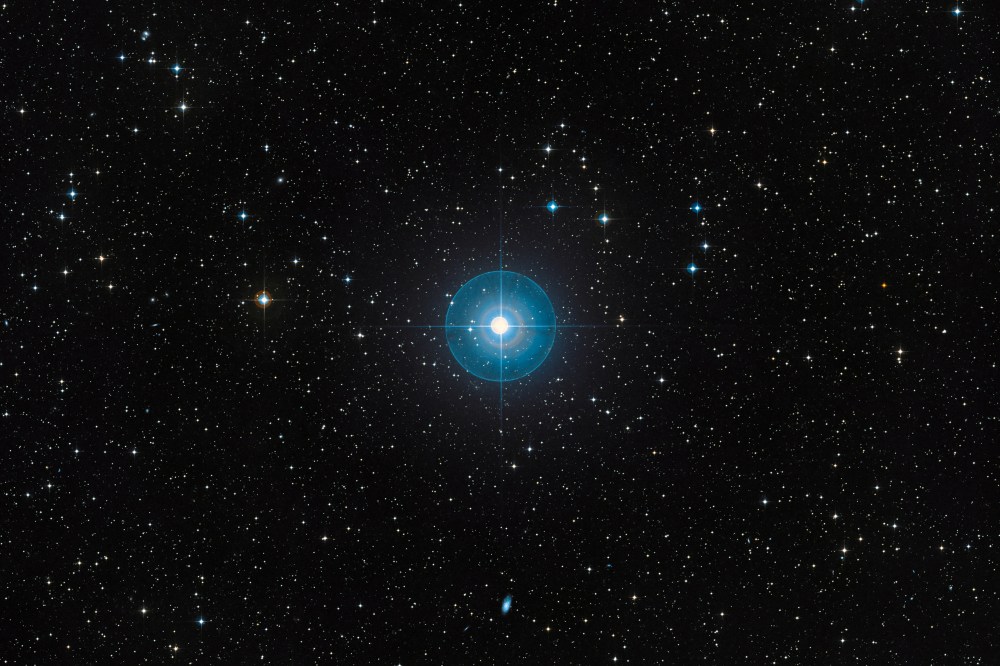
This image provided by the European Southern Observatory shows the Beta Pictoris region on March 6, 2014. (ESO/Digitized Sky Survey 2 via AP)

“It was very much playing hide-and-seek for 11 years,” said the European Southern Observatory’s Markus Bonse, co-leader of the first team.

The California-led team made the discovery with NASA’s Webb Space Telescope. Two observations were all it took with Webb, the biggest and most powerful telescope ever launched into space. Both teams reported their findings in the Astrophysical Journal Letters.

The find was serendipitous. Each team was studying one of the star’s already identified planets when they spotted a less massive one — 100 times fainter — lurking farther out. They deliberately kept their work from one another so as not to bias the results.

The new planet is slightly bigger than Jupiter and takes 91 years to orbit its star, a little longer than it takes Uranus to orbit our sun. Born into a star system that’s barely 20 million years old — a kid compared to the sun’s 4.5 billion-year-old neighborhood — the planet is probably similar to a much younger Jupiter, said the University of California San Diego’s Aidan Gibbs, who led the second team.

“The giant planets have formed, but smaller terrestrial planets could still be forming,” Gibbs said in an email. Beta Pictoris “is probably our best look at a planetary system just after it has formed and is still in the process of stabilizing” from hurtling asteroids and comets.

Beta Pictoris is located in the easel-shaped southern constellation Pictor, or painter, and 63 light-years from Earth. A light-year is nearly 6 trillion miles (more than 9 trillion kilometers).

Fewer than 100 of the more than 6,000 confirmed exoplanets — planets around other stars — have been detected through direct imaging, according to NASA. Most were found while passing in front of their star, briefly dimming it.

“We’ve now built a picture of this planet,” the University of Edinburgh’s Ben Sutlieff said in an email, “and we are very excited to see what more can be learned about it.”

___

The Associated Press Health and Science Department receives support from the Howard Hughes Medical Institute’s Department of Science Education and the Robert Wood Johnson Foundation. The AP is solely responsible for all content.

Report Error Submit a Tip

More Stories

Manitoba First Nation taking federal government, department to court over damage to sturgeon population

Morgan Modjeski 5 minute read Preview

Manitoba First Nation taking federal government, department to court over damage to sturgeon population

Morgan Modjeski 5 minute read Yesterday at 11:27 AM CDT

A remote Manitoba First Nation is taking the federal government to court over claims a Manitoba Hydro project is hurting the sturgeon population in the lower Churchill River.

In an Oct. 15 statement of claim filed in Manitoba’s Court of King’s Bench, Tataskweyak Cree Nation said the Churchill River diversion operated by Manitoba Hydro has had widespread ecological effects and damaged sturgeon populations in the area.

The lawsuit alleges Ottawa has breached its treaty obligations to protect the community’s right to harvest the fish.

The lawsuit names both His Majesty the King in Right of Canada, the minister of fisheries and Oceans Canada as defendants.

Read
Yesterday at 11:27 AM CDT

Henderson crosswalk has glaring safety gap, say researchers months after pedestrian killed

Maggie Macintosh 5 minute read Preview

Henderson crosswalk has glaring safety gap, say researchers months after pedestrian killed

Maggie Macintosh 5 minute read 2:00 AM CDT

Six months after a fatal collision at a crosswalk on Henderson Highway, two traffic safety researchers question why the intersection remains an outlier that is missing key flashing lights.

The City of Winnipeg is being urged to install “backflashers” to better protect road users moving in all directions at the intersection where a 32-year-old father died in the spring.

“It’s these little, mundane, non-sexy engineering problems that can cause everything right up to fatality,” said Curt Pankratz, an associate professor at the University of Winnipeg who studies traffic engineering and policymaking.

On April 19, shortly before sunrise, Gabe Beardy was struck when he was crossing the six-lane thoroughfare at Neil Avenue.

Read
2:00 AM CDT

A bigger police force won’t guarantee less crime

Tom Brodbeck 5 minute read Preview

A bigger police force won’t guarantee less crime

Tom Brodbeck 5 minute read 1:09 PM CDT

Public safety was front and centre at two Winnipeg mayoral debates Wednesday, with candidates promising more police officers, tougher responses to crime and a safer city.

But while there was plenty of talk about adding cops, there was less discussion about a more complicated question: will hiring more police officers actually reduce crime?

It’s an important distinction for voters to consider as they head to the polls Oct. 28.

Winnipeg needs more police officers. The number of officers per capita has fallen significantly over the past decade, and the police service needs adequate staffing to respond to calls, investigate offences and hold criminals accountable.

Read
1:09 PM CDT

Puzzles Palace

1 minute read Friday, Oct. 16, 2026

To solve our puzzles, please subscribe with this special offer: |

Winnipeg business closure scare leads Hydro to reschedule planned outage

Free Press staff 2 minute read Updated: Yesterday at 8:19 PM CDT

Manitoba Hydro has cancelled a planned River Heights neighbourhood outage after a miscommunication led to area businesses fearing unexpected closure.

Hydro had planned to shut down power along Lanark and Renfrew streets between Corydon Avenue and John Brebeuf Place on Friday.

Overhead electrical maintenance work can only be done with the power off, during the day, for safety reasons, Hydro spokesman Peter Chura said. It chose Friday from 9 a.m. to 3 p.m. because St. John Brebeuf School had an in-service day.

However, the affected area houses a strip of businesses including a Royal Bank of Canada, eateries, shops, services such as physiotherapy and a medical centre.

Today’s horoscope

Georgia Nicols 4 minute read Preview

Today’s horoscope

Georgia Nicols 4 minute read 2:00 AM CDT

MOON ALERT: Avoid shopping (except food and gas) and important decisions after 10 p.m. today. The moon is in Pisces.

ARIES (March 21-April 19)

This is a great day to make art, which is good news for your sign as so many of you are artisans. (You can do anything with your hands, even without training.) Enjoy time alone and give yourself the luxury of doing what you want to do.

TAURUS (April 20-May 20)

Read
2:00 AM CDT