

Climate change consequences keep piling up
Advertisement
Read this article for free:
or
Already have an account? Log in here »
To continue reading, please subscribe:

Digital Subscription
One year of digital access for only $205*
- Enjoy unlimited reading on winnipegfreepress.com
- Read the E-Edition, our digital replica newspaper
- Access News Break, our award-winning app
- Play interactive puzzles
*First annual payment billed as $205.00 + GST for one year. This annual subscription will automatically renew at $233.00 + GST every 52 weeks (10% off the regular annual price of $259.35). Offer available to new and qualified returning subscribers only. Cancel any time.
To continue reading, please subscribe:
Add Free Press access to your Brandon Sun subscription for only an additional
$1 for the first 4 weeks*
- Enjoy unlimited reading on winnipegfreepress.com
- Read the E-Edition, our digital replica newspaper
- Access News Break, our award-winning app
- Play interactive puzzles
*Your next Brandon Sun subscription payment will increase by $1.00 and you will be charged $17.95 plus GST for four weeks. After four weeks, your payment will increase to $24.95 plus GST every four weeks.
Read unlimited articles for free today:
or
Already have an account? Log in here »
Has Mother Nature slapped you around enough yet, or are you finally starting to see the big picture?
Manitoba has seen floods and large, damaging hail already this summer, as has Alberta. Roads are still closed in the Parkland area of Manitoba because of flood damage. The insurance industry is talking about record-breaking claims — and that’s just among those who actually had insurance. Many didn’t have coverage for things such as overland flooding. Residents of affected areas are slowly finding out that, while governments talk a good game about helping people recover from disasters, the help is limited and rarely covers the full extent of damages.
Forest fires in Ontario have sent smoke plumes deep into the United States, and have caused a series of evacuations and air quality warnings in that province. Social media abounds with eerie photos of orange, smoke-filled skies in Thunder Bay, Toronto and places in between.
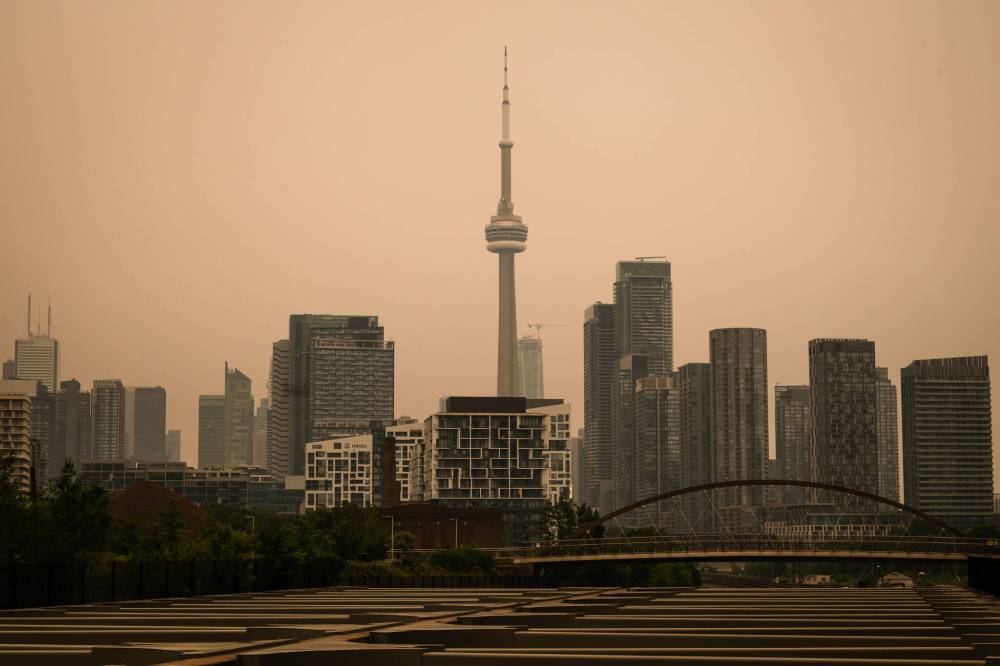
Laura Proctor / THE CANADIAN PRESS
The CN Tower amid wildfire smoke.
As recently as July 9, the federal government was reasonably optimistic about the number and extent of forest fires in the country, saying that fires had burned 1.4 million hectares — considerably less than last year. But in just one week — between July 9 and 16 — an additional one million hectares of forest burned, with 859 active forest fires now burning across Canada. This brings the amount of forest burned this year to the third-highest level trailing only 2023 and 2025.
It’s a tough time to look for help from our neighbours, too. As the Canadian Wildland Fire Information System reports, “The United States is at preparedness level 4, indicating shared resources are heavily committed and there is a heavy demand for available resources.”
Level 4, by the way, is the second-highest level of fire preparedness. At level 5, national fire agencies have their firefighting resources fully committed.
In fact, with a significantly greater number of acres already burned in the U.S. in 2026 than in a typical year, firefighting services are bringing in military air support.
At least three regions in the U.S. — the Great Basin, the Pacific Northwest and the Rocky Mountains — are under fire advisories because climate-change-related drought has brought dry conditions to the stage usually reached only in mid-August.
Temperature records were broken across the U.S. during the last week as a result of a heat wave that even reached Manitoba. Billings, Mont., hit 44 C — almost two full degrees higher than its all-time record, as more records were broken across Montana, Wyoming and Utah.
The problems extend further, as well.

Europe is undergoing high temperatures in sequential heat domes, to the point that people are dying from the heat: “More than 2,700 people are thought to have died from heat-related causes during the May and June heatwaves in England and Wales. Of those, it’s estimated that 42 per cent died as a result of the extra heat caused by human-induced warming,” the British Met Office said in a statement on July 13. France saw 1,000 more deaths than usual during the hottest days of a June heatwave; Germany 5,500.
The high European temperatures also led to forest fires in that region, already coming off its worst year of forest fire damage.
Weather is becoming more extreme with increases in global temperatures, and that extreme weather is leading to more and more damage and deaths.
People who aren’t going to be alive to see what comes next are making decisions to drill for more oil, build more pipelines, even burn coal for energy.
But it’s those who are left who will have to deal with the personal and financial consequences.