DNA from the skull of an unknown Revolutionary War soldier reveals more than his name
Advertisement
Read this article for free:
or
Already have an account? Log in here »
To continue reading, please subscribe:

Digital Subscription
One year of digital access for only $205*
- Enjoy unlimited reading on winnipegfreepress.com
- Read the E-Edition, our digital replica newspaper
- Access News Break, our award-winning app
- Play interactive puzzles
*First annual payment billed as $205.00 + GST for one year. This annual subscription will automatically renew at $233.00 + GST every 52 weeks (10% off the regular annual price of $259.35). Offer available to new and qualified returning subscribers only. Cancel any time.
To continue reading, please subscribe:
Add Free Press access to your Brandon Sun subscription for only an additional
$1 for the first 4 weeks*
- Enjoy unlimited reading on winnipegfreepress.com
- Read the E-Edition, our digital replica newspaper
- Access News Break, our award-winning app
- Play interactive puzzles
*Your next Brandon Sun subscription payment will increase by $1.00 and you will be charged $17.95 plus GST for four weeks. After four weeks, your payment will increase to $24.95 plus GST every four weeks.
Read unlimited articles for free today:
or
Already have an account? Log in here »
After 246 years, Pvt. John Pumphrey is unknown no more.
Through DNA testing and old-fashioned sleuthing, the Maryland teenager who died in one of the last big battles of the American Revolution can now take his place in history, just in time for the 250th birthday of the nation he fought to create.
“There was a sense of divine timing, I guess,” said Allison Peacock, founder of FHD Forensics, a company that helped with the search. “I don’t know what else you want to call it.”
Pumphrey died Aug. 16, 1780, at the Battle of Camden, South Carolina. It was one of the Continental Army’s most devastating defeats, where British Gen. Charles Lord Cornwallis routed patriot forces under Maj. Gen. Horatio Gates.
Many of the 900 killed were left where they fell, abandoned to the predations of wild animals, South Carolina’s scorching heat and its ruinous humidity.
Bones emerge from a Revolutionary War battlefield
Archaeologists surveying the area in 2020 came across human bones protruding from the ground. Eventually, 14 sets of remains were identified — 12 of them Continental soldiers. The others were determined to be connected to the British side and were reburied at the battlefield.
The Richland County Coroner’s Office had worked with Texas-based FHD Forensics on modern-day cases and asked for their help. Peacock took to calling it the case of “America’s oldest John Doe.”
“What we did is pretty much the same as what we do with any other John Doe case,” she said. “Nobody really knew for sure whether we could get genetic profiles suitable for a genealogy investigation on 240-plus-year-old remains. But we got lucky.”
Unlike most, Pumphrey and four comrades received a cursory burial beneath a thin layer of dirt. He was dubbed “Camden 9B,” because his were the second set of remains retrieved from burial nine. The remains were examined and cataloged.
The 12 Continentals were later reinterred with full military honors. Camden 9B’s headstone read: “UNKNOWN. REV WAR. BATTLE OF CAMDEN. AUG 16 1780.”
DNA unlocks a centuries-old mystery
Meanwhile, samples from two of the soldiers were sent to Astrea Forensics in California for DNA extraction and sequencing.
“Typically, in a case like this, we work with teeth, because teeth are in the jaw and are protected, the roots are protected,” said Peacock. “In this case, they were just coming up with nothing on the teeth.”
With remains this old, it’s often difficult to separate the human DNA from all the other genetic material in the grave, said Astrea co-founder and scientific adviser Kelly Harkins Kincaid.
“It gets colonized by the microbial environment in the soil and the water in the environment,” she said.
Although she’s worked with DNA samples as old as 10,000 years, this was the oldest sample her company has ever used to try to reconstruct a family tree.
From a petrous portion of the temporal bone, a delicate structure behind the ear at the base of the skull, they successfully extracted DNA that generated Pumphrey’s entire genome. Peacock’s team then uploaded the data to FamilyTreeDNA and GEDmatch to trace three types of DNA matches: autosomal, X chromosome and Y chromosome.
“We got 20,000 matches to work with,” she said. “So, it was a lot to kind of comb through.”
An orphan soldier’s life comes into focus
One of those matches, from the maternal line, was Russ Hudson.
The retired federal agent in Gettysburg, Pennsylvania, offered to help do archival research. A profile began to emerge of a young orphan from Maryland’s Anne Arundel County, dispossessed and looking for his way in life.
“I learned that probably when he was 13, he went to Baltimore and he enlisted in the militia,” Hudson said. “And who knows what his story was? What did he accomplish in order to become a member of the militia at such a young age?”
Because no birth record has been found, it’s unclear how old Pumphrey was when he went to war. He signed his reenlistment papers with an “X.” But he was young enough that, when he died, the growth plates around his knees had not yet fully closed, Peacock said.
A witness to history
Researchers now know Pumphrey and his comrades from the 7th Maryland Regiment were with George Washington in the snows at Valley Forge, Pennsylvania. Peacock said his unit was involved in some of the major contests in the Northern Theater, including the battles of Brandywine, Germantown and Monmouth.
She figures he had marched 1,000 miles (1,600 kilometers) before he met his end in the pinelands of South Carolina.
“We don’t really know what John Pumphrey’s cause of death was because they did not find a particular injury on his body,” she said. “It’s possible that he had a soft tissue injury, like a bayonet injury, but it’s a little hard to tell after 246 years.”
An unexpected twist and an emotional reunion
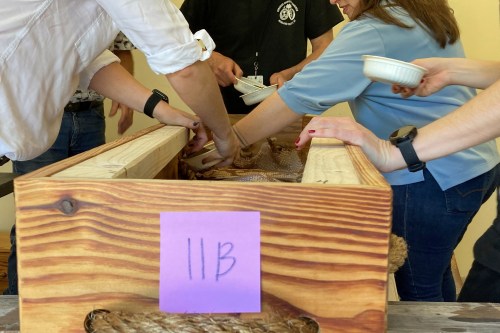
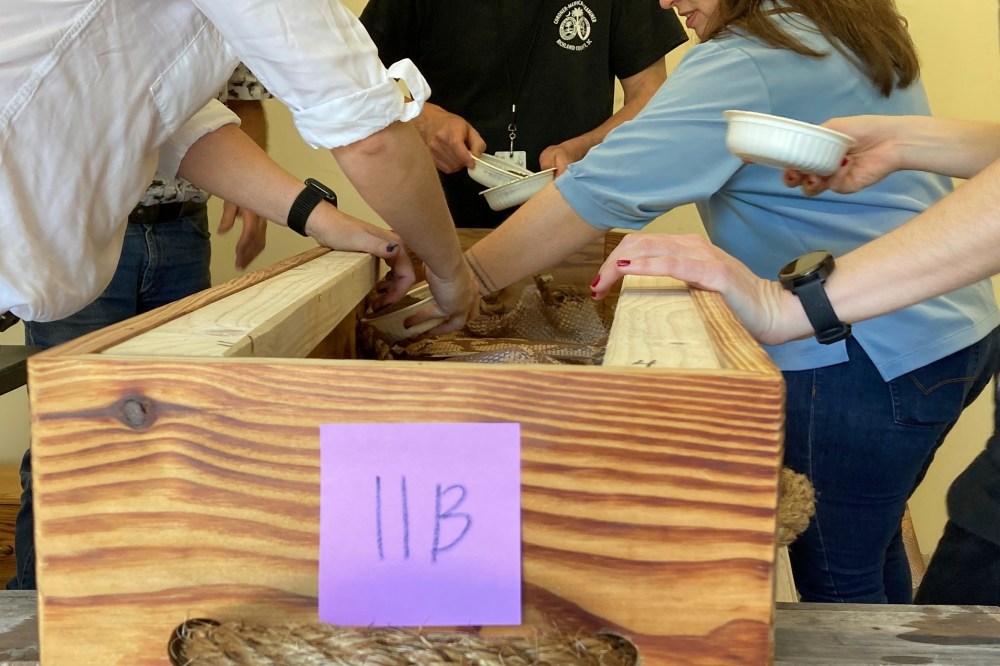
Work continues on the other set of remains, Camden 11A. One thing is certain: Peacock is related to him.

“One of the first things I do when I take on a case is I run my DNA against the remains to see if it’s somebody I’m related to, just on the wild chance that it might be,” she said. “It’s never happened before, but I am related to Camden 11A. So, I’m very motivated to get him identified.”
Last month, Peacock was confident enough in the research to put a name to Camden 9B. Relatives wept during an emotional ceremony at the 19th-century Benson-Hammond House in Anne Arundel County.
“The fact that some archaeologists just happened to stumble on bones that were protruding from the earth, and knowing that it would be difficult to identify those people by DNA, I just found it really exciting,” Becky Berman of Daytona Beach, Florida, Pumphrey’s first cousin, several times removed, told The Associated Press.
For Hudson, the retired federal agent, the story won’t be over until the U.S. government confirms the research and replaces his fifth great-uncle’s “UNKNOWN” gravestone. He said America owes it to John Pumphrey.
“He sacrificed himself, along with some others,” Hudson said, his eyes tearing up, “for the sake of this new nation.”