

New U.S. tariffs ‘more bluster than bite’
Manitoba’s export numbers slide in early 2026; provincial business leaders seek government action to secure certainty
Advertisement
Read this article for free:
or
Already have an account? Log in here »
To continue reading, please subscribe:

Digital Subscription
One year of digital access for only $205*
- Enjoy unlimited reading on winnipegfreepress.com
- Read the E-Edition, our digital replica newspaper
- Access News Break, our award-winning app
- Play interactive puzzles
*First annual payment billed as $205.00 + GST for one year. This annual subscription will automatically renew at $233.00 + GST every 52 weeks (10% off the regular annual price of $259.35). Offer available to new and qualified returning subscribers only. Cancel any time.
To continue reading, please subscribe:
Add Free Press access to your Brandon Sun subscription for only an additional
$1 for the first 4 weeks*
- Enjoy unlimited reading on winnipegfreepress.com
- Read the E-Edition, our digital replica newspaper
- Access News Break, our award-winning app
- Play interactive puzzles
*Your next Brandon Sun subscription payment will increase by $1.00 and you will be charged $17.95 plus GST for four weeks. After four weeks, your payment will increase to $24.95 plus GST every four weeks.
Read unlimited articles for free today:
or
Already have an account? Log in here »
Manitoba businesses are watching with weary eyes as the United States threatens new 50 per cent tariffs on a variety of Canadian products.
However, should the levies come into effect Aug. 19, the effect on Manitoba’s GDP could be “pretty small,” said Fletcher Baragar, a University of Manitoba economics professor who researches the provincial economy.
Honey, furniture and printing materials leaving the province are among the tariff-exposed. The U.S. administration released a list of items Monday that would be hit by the levy in 30 days’ time.
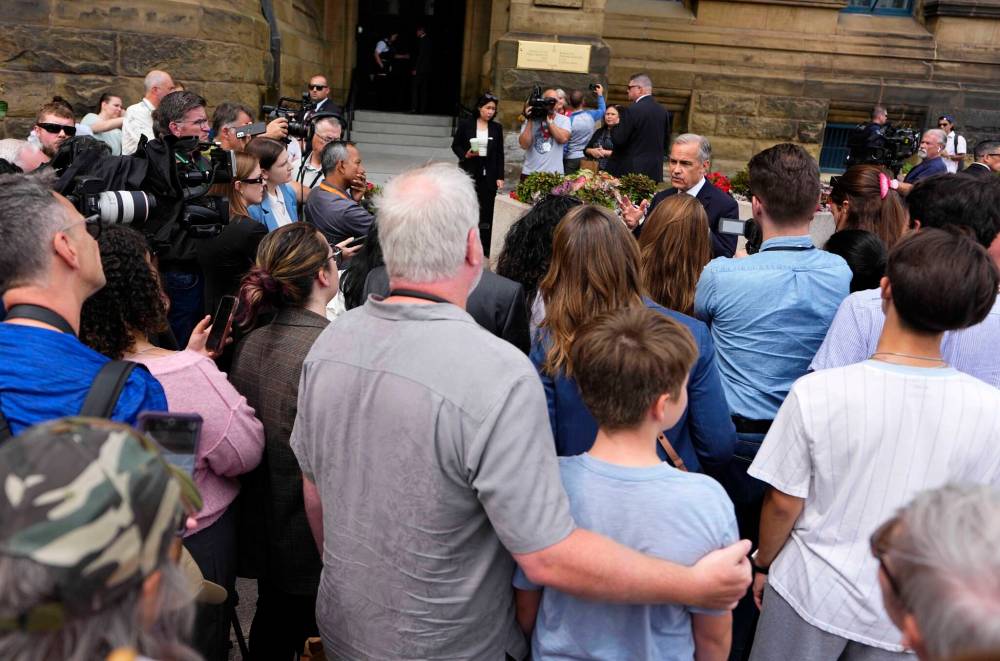
Justin Tang / THE CANADIAN PRESS
Visitors to downtown Ottawa and Parliament Hill listen as Prime Minister Mark Carney takes questions from journalists outside the Office of the Prime Minister on Tuesday.
Across Canada, $28 billion worth of annual exports to the U.S. could be affected, a Bank of Montreal note says. That’s 0.8 per cent of Canada’s economy.
“In terms of materially changing the economic patterns of trade, and in terms of a hit or a shock to the Canadian economy, I would say that this is more bluster than bite,” Baragar said.
Still, the measure won’t help Manitoba’s income, he added.
“It’s going to hurt very much,” said Walter Gross, manager of Whiteshell Chairs.
The River Hills-based manufacturer ships goods to North Dakota and Minnesota. Gross said Tuesday he wasn’t sure how the new levy would impact his business. He expected to split the cost with American clients.
Whiteshell Chairs has been shielded from tariffs by the Canada-United States-Mexico Agreement on trade signed during U.S. President Donald Trump’s first term.
However, CUSMA offers no protection from the new tariffs.
Meantime, the U.S. remains Manitoba’s largest trading partner, though export numbers are dropping.
Local companies shipped $4.9 billion worth of goods to the U.S. in the January through May time period. It’s an 18.9 per cent year-over-year drop from 2025.
The province’s overall exports declined 14.6 per cent year-over-year during the same period. It’s likely a sign of trade gains with other countries, Baragar said.
“Manitoba businesses are sort of pivoting and repositioning themselves,” he said, adding 30 days until the new tariffs deadline is too short a time for businesses to revamp supply chains.
Both the Winnipeg and Manitoba chambers of commerce are calling for government action.
A renewed CUSMA, “end to the hostilities” and non-tariff trade dispute mechanism would help ease business uncertainty, said Loren Remillard, president of the Winnipeg chamber.
“It’s what happens the day after the agreement is signed,” he said. “Will there be assurance that the agreement will continue to be the defining guidebook for our trade relations?”
Chuck Davidson, president of the Manitoba Chambers of Commerce, met with premiers and counterparts from other provinces in Prince Edward Island on Tuesday.
The eastern province hosted a Council of the Federation meeting.
Chamber leaders urged premiers to prioritize Canada’s relationship with the United States. They discussed how government and business groups could promote internal and international trade, Davidson said.
“It’s important that the premiers are aligned, in terms of what the focuses are and how they’re going to make it easier for businesses to continue to operate in Canada,” Davidson said.
In Winnipeg, even though Shrugging Doctor Beverage Co. doesn’t export Manitoba wine to the U.S., its founder expects to be impacted by the 50 per cent fee. “Depending on what the tariff is at any given time … our supplies have gone up in prices,” Willows Christopher said.
He orders glass bottles from China and Europe. They arrive in California, get a tariff added and are shipped to B.C. before landing in Manitoba.
Cork seals and other inputs costs have also increased, Christopher said.
He noted a boost in Shrugging Doctor brand wine sales after U.S. labels were removed from Manitoba Liquor Mart shelves in early 2025.

American alcohol will stay away until there’s a “fair deal,” Premier Wab Kinew wrote on social media Tuesday.
The Manitoba government will reconvene its U.S. trade council to learn how businesses are responding to the tariff threat, Finance Minister Adrien Sala said in a statement.
A 50 per cent tariff will hurt Americans and Canadians. Importers will have to pay the tariff, which could result in U.S. companies turning away from Canadian brands, said Irwin Lipnowski, a University of Manitoba economics professor.
— with files from The Canadian Press
gabrielle.piche@winnipegfreepress.com
Related Articles
'Vicious cycle': What you need to know about Trump's Great Depression-era tariff tool
Advertisement Advertise With Us
Advertisement Advertise With Us