Pyrocumulus clouds from wildfire in Fraser Canyon loom high over B.C.

Advertisement

Advertise with us

VANCOUVER - Photos of giant, cauliflower-like clouds are popping up on Vancouver-area social media feeds that experts say are pyrocumulus clouds produced by a wildfire more than 200 kilometres away.

Read this article for free:


or

Already have an account? Log in here »

To continue reading, please subscribe:

Subscribe and receive a limited-edition Free Press branded hat or tote.

Digital Subscription

One year of digital access for only $205*

  • Enjoy unlimited reading on winnipegfreepress.com
  • Read the E-Edition, our digital replica newspaper
  • Access News Break, our award-winning app
  • Play interactive puzzles

*First annual payment billed as $205.00 + GST for one year. This annual subscription will automatically renew at $233.00 + GST every 52 weeks (10% off the regular annual price of $259.35). Offer available to new and qualified returning subscribers only. Cancel any time.

To continue reading, please subscribe:

Add Free Press access to your Brandon Sun subscription for only an additional

$1 for the first 4 weeks*

  • Enjoy unlimited reading on winnipegfreepress.com
  • Read the E-Edition, our digital replica newspaper
  • Access News Break, our award-winning app
  • Play interactive puzzles
Start now

*Your next Brandon Sun subscription payment will increase by $1.00 and you will be charged $17.95 plus GST for four weeks. After four weeks, your payment will increase to $24.95 plus GST every four weeks.

VANCOUVER – Photos of giant, cauliflower-like clouds are popping up on Vancouver-area social media feeds that experts say are pyrocumulus clouds produced by a wildfire more than 200 kilometres away.

BC Wildfire Service said the Anderson Creek fire was discovered by aircraft responding to one of the other nearby fires on Tuesday and it quickly flared up, fanned by strong winds. 

Matt Loney, a meteorologist with Environment Canada, says each fire generates a lot of heat, and the Anderson Creek fire looks like it “really took off.”
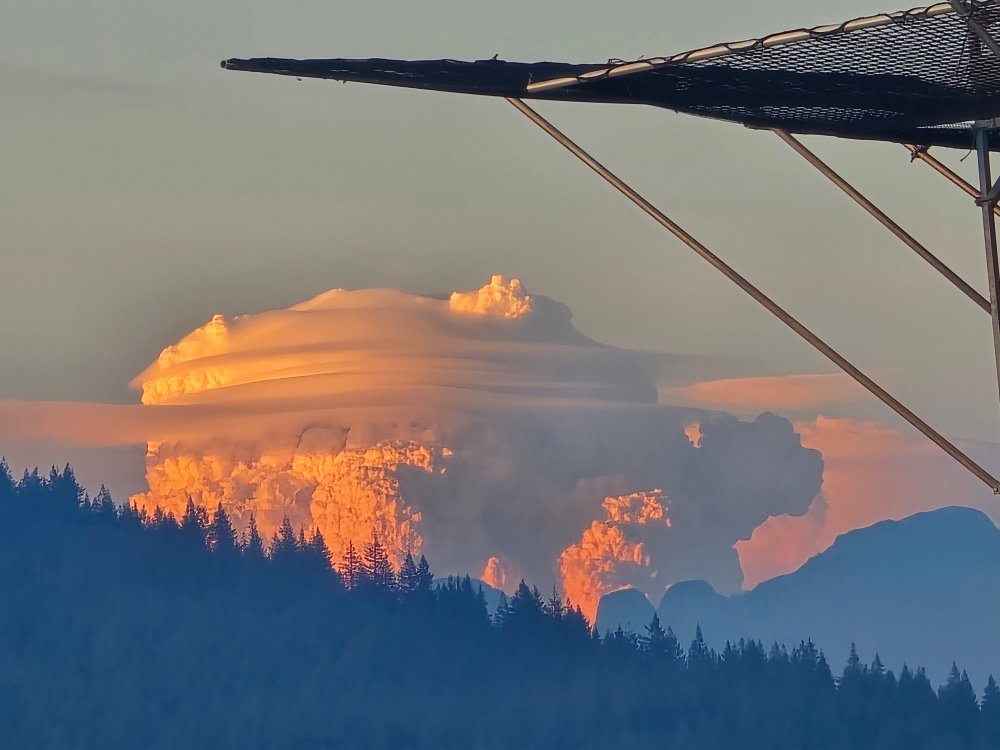
Pyrocumulus clouds forming from wildfires in the area of Boston Bar, B.C., are shown in this handout photo posted on social media on Tuesday, July 21, 2026. THE CANADIAN PRESS/Handout — Brad Atchison (Mandatory Credit)

Photos circulated across social media platforms on Tuesday show the tall cumulus clouds hovering over darker smoke plumes in the sky and they were taken as far away as Coquitlam, about 220 kilometres away. 

Loney says anything hot enough to produce strong convection currents will give rise to the clouds, which are produced by hot air rising quickly as the moisture condenses. 

He says an example would be opening your freezer door on a scorching hot summer day and the fog billows towards the ground. 

“Basic science tells you that heat rises in the atmosphere, and cold air will sink,” Loney says. 

“The heat wants to go up because that’s trying to seek stability because it’s less dense,” he says. 

Loney says the clouds have all kinds of particulates in them, from burning embers and dust to ashes. 

“All that is visible to the naked eye, and then once it gets to a level where it’s warm enough — so that it doesn’t rise any higher — it’ll just spread out into the horizontal,” said Loney. 

The natural phenomenon from the Boston Bar-area fire indicates not only the intensity of heat, but also how unstable the atmosphere is, because the cloud grew vertically rather than horizontally, making it visible from many directions, says Loney. 

Rachel White, an assistant professor of atmospheric sciences at the University of British Columbia, says photos of clouds from the Fraser Canyon are both impressive and scary. 

White says she hasn’t seen these pyrocumulus clouds, although she would be interested to see one scientifically. 

“And it would also be really quite a scary and intense experience to really see the power of these wildfires,” said White. 

She says a crazy fact is that the clouds can produce thunderstorms with lightning, which may initiate more wildfires. 

“So, that’s a particularly dangerous part of it. Again, exactly whether a cloud system will (create lightning) is really dependent on the specifics of what’s happening in that area,” said White. 

This report by The Canadian Press was first published July. 23, 2026. 
Report Error Submit a Tip

More Stories

Puzzles Palace

1 minute read Monday, Jul. 27, 2026

To solve our puzzles, please subscribe with this special offer: |

A mission to make hearing care easier to access

Aaron Epp 5 minute read Preview

A mission to make hearing care easier to access

Aaron Epp 5 minute read 2:00 AM CDT

Armando Di Lello was four years old when he was diagnosed with hearing loss in both ears and received his first hearing aids. He doesn’t remember that moment, but he recalls moments that followed.

“Going through elementary, middle school, high school — it was definitely something that was not a positive experience for me,” he said.

Di Lello’s hearing aids were big, bulky and noisy, and he chose not to wear them much of the time.

“I didn’t perceive the benefit as a kid,” he said. “No kid wants to appear different.”

Read
2:00 AM CDT

Gridlock by design: no excuses for bed backlog

Jason M. Sutherland 5 minute read 2:00 AM CDT

Imagine waking up in a hospital bed and being told by a doctor that you are well enough to leave, only to discover you cannot. Not because you want to stay, but because there is nowhere safe for you to go. No home-care support, no rehabilitation space, no long-term care bed.

This is unfortunately the daily reality for thousands of Canadians.

Being stuck in a hospital bed is a crisis from coast to coast. Our acute care hospitals are functioning as wildly expensive beds for vulnerable citizens awaiting a more suitable place to take them in.

A decade ago, policymakers fretted over this exact issue. Today, despite an aging population with increasingly complex needs and higher demand for hospital beds, the crisis has only deepened.

Poilievre’s simplistic bluster a desperate bid for attention in a serious moment for nation

Tom Brodbeck 5 minute read Preview

Poilievre’s simplistic bluster a desperate bid for attention in a serious moment for nation

Tom Brodbeck 5 minute read Yesterday at 12:35 PM CDT

Conservative Leader Pierre Poilievre’s suggestion that Mark Carney needs more “backbone” to negotiate with Donald Trump would be easier to take seriously if anyone had actually figured out how to negotiate with the U.S. president.

Read
Yesterday at 12:35 PM CDT

Mom grieves loss of daughter, 4, on Long Plain First Nation

Morgan Modjeski 4 minute read Preview

Mom grieves loss of daughter, 4, on Long Plain First Nation

Morgan Modjeski 4 minute read Yesterday at 7:29 PM CDT

The mother of a four-year-old girl killed and two other children injured on Long Plain First Nation said she raised concerns about their care months before her daughter’s death.

Read
Yesterday at 7:29 PM CDT

AI bio-weapons loom

Gwynne Dyer 4 minute read 2:00 AM CDT

‘Artificial intelligence’ based on large language models is shaping up to be the most efficient destroyer of value since the South Sea Bubble. After “the Crash”, which is inevitably coming, some specific functions of AI will eventually turn out to be genuinely revenue-generating, and a lot of jobs will duly disappear. But the biggest winner (and potentially biggest loser) is medical science.

Dr. Brian Hie, a chemical engineer at Stanford University in California, has just revealed that his team has made the first viruses designed by artificial intelligence. They are ‘bacteriophages’, viruses that only infect bacteria and are widely used to treat people with infections that resist other treatments.

However, natural bacteriophages sometimes fail, so Dr. Hie used generative AI to design new ones that might do the job. The AI generated thousands of designs for new genomes that more or less fit the bill, and he chose around 300 of them to build in the lab. It’s hard work, not magic, but he ended up with 16 ‘novel’ bacteriophages that might work.

He applied them to petri dishes containing two harmful strains of E. coli, a common bacteria that lives in the human gut, and they killed the bacteria off. It’s still early days, but if it is truly becoming possible to tailor-make bacteriophages that target specific bacteria, then we may be getting a major new weapon in the struggle against antibiotic resistance.