

Automation reaches new heights on farm

Advertisement
Read this article for free:
or
Already have an account? Log in here »
To continue reading, please subscribe:

Digital Subscription
One year of digital access for only $205*
- Enjoy unlimited reading on winnipegfreepress.com
- Read the E-Edition, our digital replica newspaper
- Access News Break, our award-winning app
- Play interactive puzzles
*First annual payment billed as $205.00 + GST for one year. This annual subscription will automatically renew at $233.00 + GST every 52 weeks (10% off the regular annual price of $259.35). Offer available to new and qualified returning subscribers only. Cancel any time.
To continue reading, please subscribe:
Add Free Press access to your Brandon Sun subscription for only an additional
$1 for the first 4 weeks*
- Enjoy unlimited reading on winnipegfreepress.com
- Read the E-Edition, our digital replica newspaper
- Access News Break, our award-winning app
- Play interactive puzzles
*Your next Brandon Sun subscription payment will increase by $1.00 and you will be charged $17.95 plus GST for four weeks. After four weeks, your payment will increase to $24.95 plus GST every four weeks.
Read unlimited articles for free today:
or
Already have an account? Log in here »
LANGHAM, Sask. — The thousands of farmers from across the Prairies who flock to the annual Ag in Motion show every July seem oblivious to the possibility the technology on display could one day replace many of them.
Families with children in tow, Hutterite colony workers, grandparents and young couples just starting out roamed through the 600 or more exhibitor displays, amazed at how everything about farming just keeps getting bigger, more efficient and increasingly more automated.
It’s now possible to seed using a 100-foot-wide drill — a 12-foot jump over the widest available a few years ago — provided the farmer can afford a tractor with enough horsepower to pull it. Those sell for around $850,000 and up.
Laura Rance-Unger
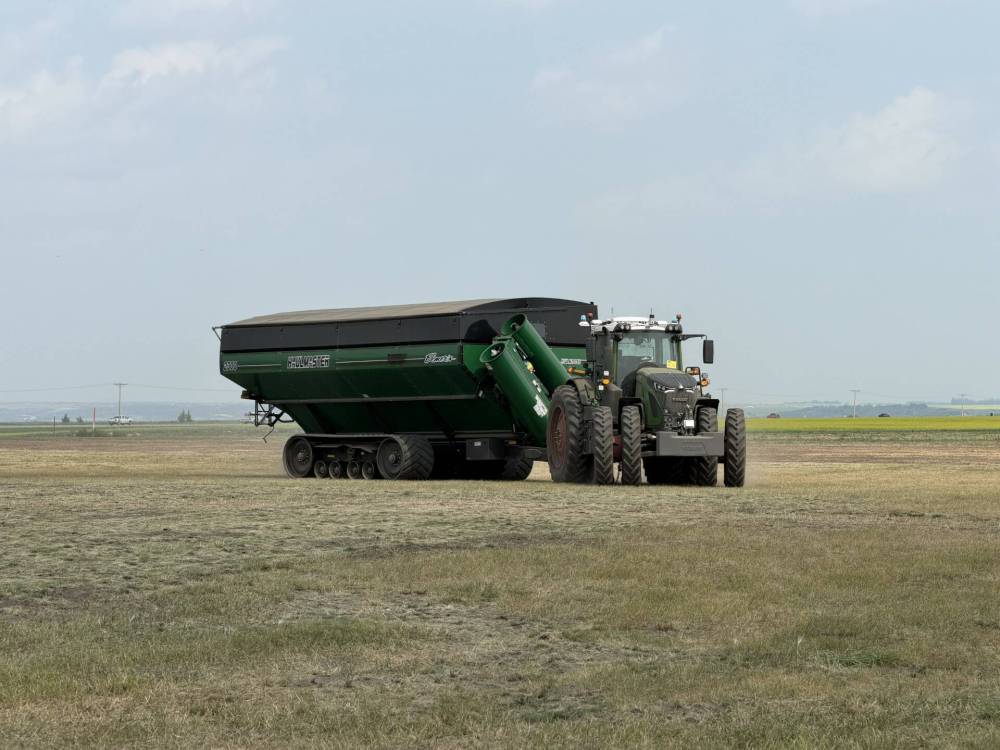
This tractor and grain cart have no driver. The unit is operated remotely and is called to the combine when it is time to unload the hopper.
Granted, the number of farms with enough acres to justify that kind of width and drawing power is still relatively small, but farms continue to grow. And it’s no secret the number of people who have the interest, skills and financial wherewithal to run them continues to shrink.
So, it’s a chicken-and egg situation; the shortage of labour drives scale and efficiency, which in turn makes the industry less accessible to human workers.
It’s the advancement of AI systems — so-called machine learning — that has positioned autonomous field equipment for rapid and widespread commercialization, said Scott Garvey, a journalist who has tracked the evolution of technology in field crop production for Glacier FarmMedia publications over the past 20 years.
Major manufacturers have known how to make machines that operate autonomously for decades, but they weren’t confident these machines were “smart” enough to take over large field operations safely.
“For example, if the autonomous system sees something in front of it. That tractor has to know: ‘Is that just a deer running past me? I can slow down, let the deer go and then proceed or is that a big boulder that I can’t run over? Is this a problem that I can deal with myself or do I need to stop and wait for a human to come out and rescue me.’ So that was where AI has made the difference,” Garvey said.
Farm show visitors this week could witness a driverless tractor towing a massive grain cart following a combine harvester through a demonstration course, with the combine operator running the controls for both.
That’s not new. What is new is people are no longer viewing it as a marvel but rather technology that might have practical application on their farms.
“We have two companies launching commercialized versions of a fully autonomous technology to put in those massive machines,” Garvey said.
“So not only are we getting by with bigger, with one farm worker covering more acres per hour, but we’re getting to the point where no farm worker covers even more acres per hour. That’s an astonishing trend if you look back even one or two decades.”
Markus Weber, CEO and founder of LandView Drones, is seeing the transformation in farmers’ attitudes unfold in real time. He’s been at Ag in Motion talking about agricultural drones, which also continue to get bigger, since the show began in 2015.
This year is different, he said.
“The nature of the conversations changed,” Weber said between drone-training sessions running several times a day.
“Nobody sees them as toys anymore. They come to the session, and they see them as tools, and they want to understand how that tool is going to work and how they can make it work for their farm.”

Jarrett Chambers, founder and president of ATP Nutrition, a Manitoba company focused on improving nutrient-use efficiency, is excited by the capabilities AI offers agriculture, but he’s also cautious about how it is perceived.
“As we move forward as an industry, we still need the same number of people, but the skill set is going to change,” he said.
Some like to think AI will provide all the answers. It won’t. Rather, AI supports better decisions, he said.
“We have to actually get smarter to let AI work for us.”
Laura Rance-Unger is editor emeritus for Glacier FarmMedia. She can be reached at lrance@farmmedia.com
Laura Rance is editorial director at Farm Business Communications.
Our newsroom depends on a growing audience of readers to power our journalism. If you are not a paid reader, please consider becoming a subscriber.
Our newsroom depends on its audience of readers to power our journalism. Thank you for your support.
Laura Rance is editorial director at Farm Business Communications.
Our newsroom depends on a growing audience of readers to power our journalism. If you are not a paid reader, please consider becoming a subscriber.
Our newsroom depends on its audience of readers to power our journalism. Thank you for your support.
Advertisement Advertise With Us
Advertisement Advertise With Us