

Federal agricultural science facility in Brandon dealing with Assiniboine River flood damage
Advertisement
Read this article for free:
or
Already have an account? Log in here »
To continue reading, please subscribe:

Digital Subscription
One year of digital access for only $205*
- Enjoy unlimited reading on winnipegfreepress.com
- Read the E-Edition, our digital replica newspaper
- Access News Break, our award-winning app
- Play interactive puzzles
*First annual payment billed as $205.00 + GST for one year. This annual subscription will automatically renew at $233.00 + GST every 52 weeks (10% off the regular annual price of $259.35). Offer available to new and qualified returning subscribers only. Cancel any time.
To continue reading, please subscribe:
Add Free Press access to your Brandon Sun subscription for only an additional
$1 for the first 4 weeks*
- Enjoy unlimited reading on winnipegfreepress.com
- Read the E-Edition, our digital replica newspaper
- Access News Break, our award-winning app
- Play interactive puzzles
*Your next Brandon Sun subscription payment will increase by $1.00 and you will be charged $17.95 plus GST for four weeks. After four weeks, your payment will increase to $24.95 plus GST every four weeks.
Read unlimited articles for free today:
or
Already have an account? Log in here »
BRANDON — Recent flooding along the Assiniboine River damaged test fields and disrupted scientific work at the Brandon Research and Development Centre.
The flooding — which inundated lands around the centre earlier this month — affected 390 acres of research test fields and breeding materials, an official said.
The BRDC is a federal agricultural science facility that focuses on crop production, soil and land resource management and sustainable prairie agriculture.
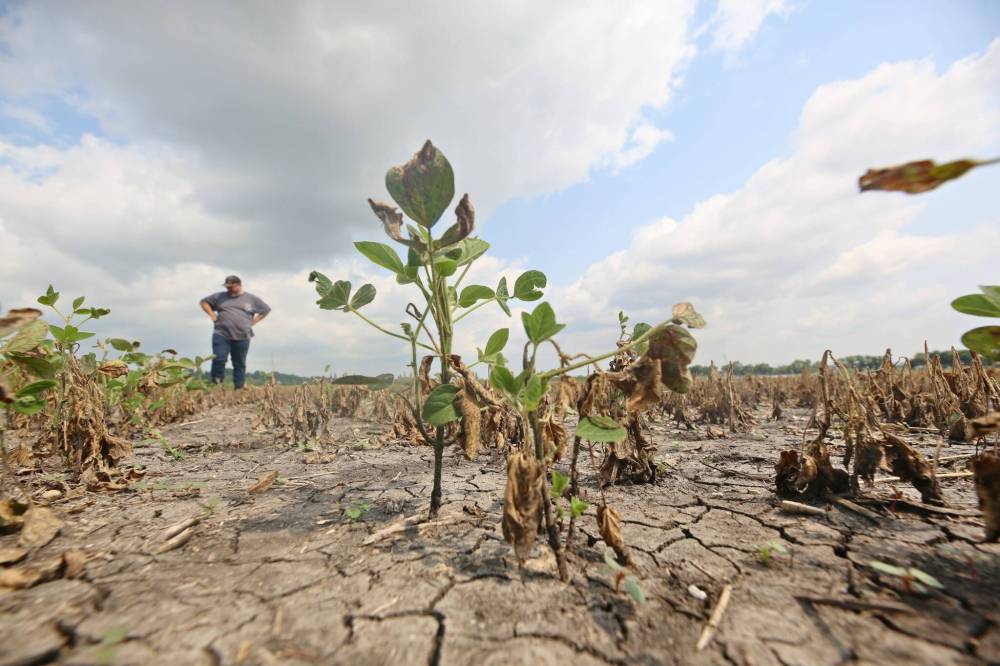
The receding flood water along the Assinboine River has left destruction in its wake. Jeff Griffith, farm operations manager with the Brandon Research and Development Centre, looks at a field of flood-damaged soybeans that lies along Grand Valley Road on research centre land, during a tour of the flood damage on Monday. (Matt Goerzen/The Brandon Sun)
Floodwaters destroyed experimental barley and soybean plots, leaving a visible trail of damage as the river receded.
Some fields were completely submerged, while others marked the point where the floodwaters stopped short.
The damage “is disrupting both short- and long-term data collection and field-based studies,” Ana Badea, the acting associate director of research, development and technology, said in an email.
“Disruptions to field operations and harvest schedules are expected to delay some research activities and cultivar development timelines.”
There were no impacts on the centre’s research buildings or laboratories, but employees used an alternate route to get to the facility because of flooding on the main access road.
Badea said researchers launched emergency recovery efforts before and during the flooding to preserve valuable breeding populations and genetic resources.
“Those materials are now being grown out in our greenhouses and at other on-site facilities, allowing some of the research to continue,” she said, adding lessons learned from the major Assiniboine River floods of 2011 and 2014 helped the centre respond more effectively this time.
“The floods of 2011 and 2014 reinforced that flooding on the Assiniboine River is highly unpredictable,” she said. “(With) advance warning from the Manitoba government and the City of Brandon, teams at the centre were able to safely remove and protect some valuable research materials before floodwaters arrived.”
Although this year’s flood was less severe than the previous events, Badea described it as another rare “summer flood,” unlike the more common spring flooding that typically causes planting delays rather than widespread field losses.
“This event highlights the vulnerability of field-based research and infrastructure to extreme weather events and reinforces the value of conducting research over multiple years and locations,” she said.
This and similar experiences contribute to the broader understanding of resilience and adaptation, considerations that are reflected in departmental and government-wide discussions on future agricultural and environmental research directions.
As floodwaters continue to recede, recovery efforts are now underway.
Farm operations crews will remove debris left behind by the river and manage the flooded land before tilling affected fields to incorporate organic matter into the soil. Planning is also beginning for the 2027 growing season, Badea said.
The centre will also review the flood response to identify opportunities to improve water management and better protect critical research infrastructure from future flood events.
City of Brandon emergency manager Tobin Praznik said the research facility was informed as soon as forecasts indicated rising risks.
“We let them know the types of impact and the mitigation strategies that we are going to be looking at based on the flood forecast,” he said.
The city, he said, also co-ordinated with the centre on road closures, protection of wastewater infrastructure and other flood-mitigation measures, while ensuring the facility had timely information to prepare for the river’s rise.
Praznik said the main access road will remain closed until floodwaters have fully receded and inspections by Manitoba Transportation and Infrastructure and other agencies confirm it is safe to reopen.

He said that recovery efforts will continue even after the water returns to the riverbanks, with crews inspecting infrastructure, clearing debris, removing silt and sludge and assessing damage.
Badea said while flooding along the Assiniboine River cannot be prevented, the centre “will continue to look for practical ways to improve flood resilience and minimize the impact of future events on its research operations.”
aodutola@brandonsun.com
X: @AbiolaOdutola
— Brandon Sun