Japan’s horror master Kurosawa’s first samurai film arrives at North American theaters
Advertisement
Read this article for free:
or
Already have an account? Log in here »
To continue reading, please subscribe:

Digital Subscription
One year of digital access for only $205*
- Enjoy unlimited reading on winnipegfreepress.com
- Read the E-Edition, our digital replica newspaper
- Access News Break, our award-winning app
- Play interactive puzzles
*First annual payment billed as $205.00 + GST for one year. This annual subscription will automatically renew at $233.00 + GST every 52 weeks (10% off the regular annual price of $259.35). Offer available to new and qualified returning subscribers only. Cancel any time.
To continue reading, please subscribe:
Add Free Press access to your Brandon Sun subscription for only an additional
$1 for the first 4 weeks*
- Enjoy unlimited reading on winnipegfreepress.com
- Read the E-Edition, our digital replica newspaper
- Access News Break, our award-winning app
- Play interactive puzzles
*Your next Brandon Sun subscription payment will increase by $1.00 and you will be charged $17.95 plus GST for four weeks. After four weeks, your payment will increase to $24.95 plus GST every four weeks.
Read unlimited articles for free today:
or
Already have an account? Log in here »
TOKYO (AP) — Kiyoshi Kurosawa, the Japanese director known as “the master of horror,” was a bit nervous about how viewers might react to his first samurai film.
He needn’t have worried.
“The Samurai and the Prisoner,” opening in New York and Los Angeles on July 31, followed by a rollout in select North American cities through August, received an enthusiastic response when it premiered at the Cannes Film Festival in May.
It’s turning out to be Kurosawa’s most popular film to date, if its reception in Japan, where it opened earlier this year, is any indication.
That’s saying a lot for a director who counts to his credit dozens of respected works, including the 2020 Venice Film Festival ’s Silver Lion-winning “Wife of a Spy.” His 2008 “Tokyo Sonata,” about heartbreaking family conflict, won Un Certain Regard Jury Prize at Cannes.
“Filmmaking remains a mystery for me,” Kurosawa said.
It’s a complex undertaking that requires bringing together the real world, or what’s being filmed, and what’s not real, the story that must be depicted, he said.
“I don’t understand it. And that’s why I keep making films,” he told The Associated Press in a recent online interview from New York.
Why can’t I do what Yasujiro Ozu did? Why can’t I do what Alfred Hitchcock did? Those are the questions he keeps asking himself, he said.
Kurosawa’s past films, like his 1997 “Cure,” starring Koji Yakusho playing a detective chasing a serial killer, tend to be driven by a frightening creepiness that unfolds in a mundane world.
But the samurai genre already presupposes a fictitious otherworldly place, and everyday normalcy simply doesn’t exist there, Kurosawa said.
The story of “The Samurai and the Prisoner” centers around a rivalry between warlords, those familiar Shakespearean plot twists that characterize samurai films.
“There is, first of all, power. A feudalistic society is built on a hierarchical relationship of those at the top and those at the bottom. Then there’s betrayal,” said Kurosawa.
“People try to grab power, and in so doing get thrown into confusion. That exists in any society, historically and perhaps even today. And so this is also about what’s eternal.”
Kurosawa acknowledged he didn’t know what to expect in tackling a samurai movie, starting with the basics like how to direct the actors. Unlike modern dramas, he felt there were no predefined parameters on how actors’ lines should be delivered, for instance.
It’s common wisdom that a director doing something new ends up disappointing fans, who tend to want more of the same. Adding to the challenge was the fact that, these days, even many Japanese find the old-style samurai genre alien as much as does the Westerner.
But everything fell in place, once things got started. It happened naturally. The set, costumes, props, wigs and makeup all worked together to transport the actors to that otherworldly spot. He was lucky to be able to shoot in old temples and castles in Kyoto.
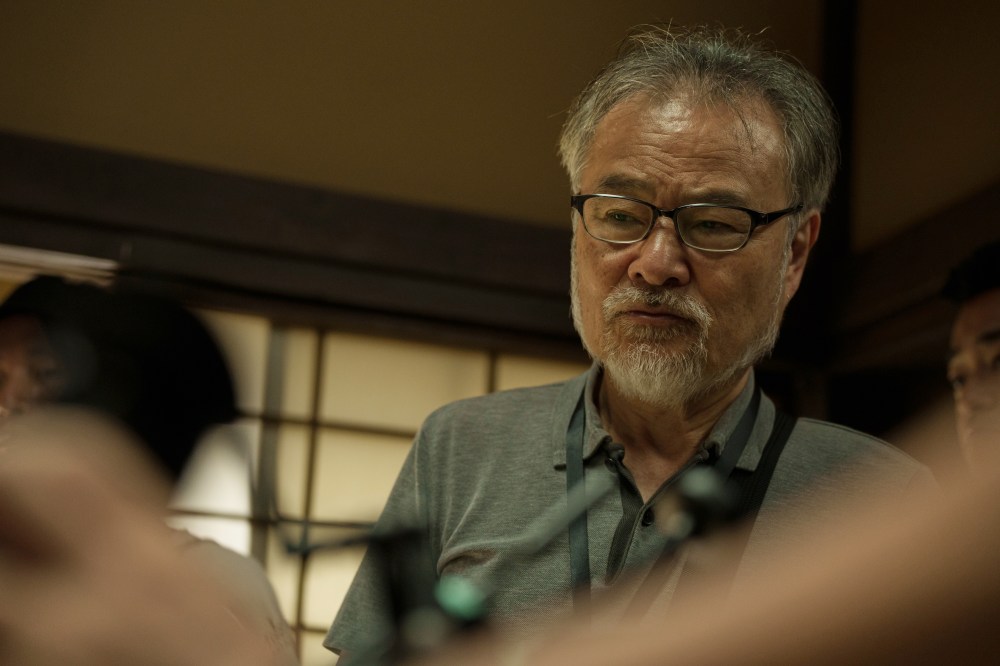
Kurosawa kept his trademark long shots and almost claustrophobic dialogue scenes, in which nothing appears to be happening but chills shoot up the viewers’ spine in anticipation of what unimaginably horrific thing might happen next.
His latest has all the look of an orthodox samurai film, known here as “jidaigeki,” staying true to its legacy of depicting the horrors and pathos of war.
There are even wide shots of warriors in armor lined up on a hilltop, evocative of “Ran” and “Kagemusha” by Akira Kurosawa, who is not related to Kiyoshi Kurosawa.
Making “The Samurai and the Prisoner” was so fun, Kurosawa would like to make another samurai film, this time with more spectacular sword-fighting scenes a la “Zatoichi,” a popular film series of the 1960s and 1970s about a heroic blind swordsman.
He also wants to tackle new genres, perhaps a musical. And he promised to keep making horror films, if people aren’t bored with his style of having nothing happen for what feels like forever.
He’s worried that may appear dated.
The works popular these days, both in Japan and elsewhere, have one explosive thing happening after another, to keep the audience on the edge of their seats.
“A scary thing generally doesn’t happen every five minutes in my films,” Kurosawa said.
“But if that’s OK, then I’d like to make my film.”
___
Yuri Kageyama is on Threads: https://www.threads.com/@yurikageyama
Related Articles
A child humanoid leads Japanese director Hirokazu Kore-eda’s latest film

Advertisement Advertise With Us
Advertisement Advertise With Us