Human-caused climate change made Spanish, French fires much more likely, scientists calculate

Advertisement

Advertise with us

Climate change's fingerprints are all over the extreme fire weather that sparked this week's devastating wildfires in Spain and France and has spiked Southern Europe's burning the past eight years, two new studies conclude.

Read this article for free:


or

Already have an account? Log in here »

To continue reading, please subscribe:

Subscribe and receive a limited-edition Free Press branded hat or tote.

Digital Subscription

One year of digital access for only $205*

  • Enjoy unlimited reading on winnipegfreepress.com
  • Read the E-Edition, our digital replica newspaper
  • Access News Break, our award-winning app
  • Play interactive puzzles

*First annual payment billed as $205.00 + GST for one year. This annual subscription will automatically renew at $233.00 + GST every 52 weeks (10% off the regular annual price of $259.35). Offer available to new and qualified returning subscribers only. Cancel any time.

To continue reading, please subscribe:

Add Free Press access to your Brandon Sun subscription for only an additional

$1 for the first 4 weeks*

  • Enjoy unlimited reading on winnipegfreepress.com
  • Read the E-Edition, our digital replica newspaper
  • Access News Break, our award-winning app
  • Play interactive puzzles
Start now

*Your next Brandon Sun subscription payment will increase by $1.00 and you will be charged $17.95 plus GST for four weeks. After four weeks, your payment will increase to $24.95 plus GST every four weeks.

Climate change’s fingerprints are all over the extreme fire weather that sparked this week’s devastating wildfires in Spain and France and has spiked Southern Europe’s burning the past eight years, two new studies conclude.

Human-caused climate change made the hot and dry conditions responsible for Spain’s record-sized inferno 20 times more likely to happen, and it doubled the chances of extreme fire conditions for the flames in France, scientists at World Weather Attribution calculated in a rapid analysis Thursday, conducted while fires were still burning. Warming in the past 26 years has tripled the odds of the severe fire risk conditions in Spain and increased the chances in France 40%, the same report found.

At the same time, researchers published a separate study on Thursday — written and edited long before this week’s fires began — that found the number of days that Southern Europe’s weather reached extreme fire-prone levels has more than doubled compared to decades ago.
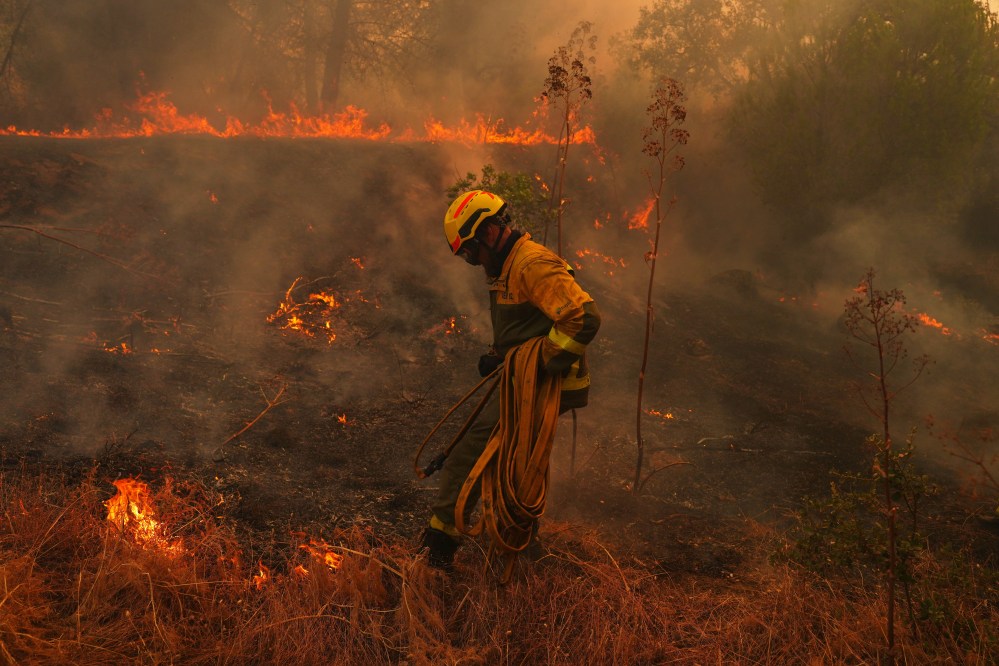
FILE - A firefighter carries a hose while battling a wildfire in San Martin de Valdeiglesias, west of Madrid, Spain, July 26, 2026. (AP Photo/Manu Fernandez, File)

Both studies examined changes in the weather that creates fire-prone conditions. The measurements factor in air temperature, drought conditions, humidity and wind.

“The change in these fire weather conditions in Spain is really extremely strong and is, I think, one of the largest changes that I’ve seen,” said Friederike Otto, an Imperial College of London climate scientist who coordinates World Weather Attribution. Spain is having its hottest summer on record, after an incredibly wet January that allowed plants to grow before a severe drought hit, a combination that increased wildfire fuel, the report said.

Spain also had the added problem of land abandonment, which left unmanaged plants and trees to dry out, Otto said. France’s Bordeaux region, meanwhile, had thick groves of pines that also burn well when a fire starts, she said.

World Weather Attribution — an international collaboration of scientists who examine extreme events to determine climate change’s role, if any — did that study so quickly, the report didn’t get peer reviewed, which is the scientific gold standard. But Otto and her colleagues used techniques that are scientifically accepted, and many of their reports are published in peer-reviewed journals later.

Warming world means fires ignite ‘more explosively’

Otto’s team calculated how much climate change — from the burning of coal, oil and gas — increased the chances for fires of this intensity to happen. They did so by comparing fire weather severity levels to past measurements for the region and to what they would be if the world was 2.5 degrees (1.4 degrees Celsius) cooler. That is how much Earth has warmed since pre-industrial times.

“This study makes sense and provides numbers to confirm what fire scientists already knew,” said Syracuse University fire scientist Jacob Bendix, who wasn’t part of either research. “We have always known that fires ignite more easily and spread more explosively under conditions of extreme heat and drought. And we’ve known for decades that extreme heat and drought are becoming more common due to anthropogenic climate change. So the general outline of these events, if not all the details, was tragically predictable.”

Thursday’s other study, in the journal Scientific Reports, finds that there were about 10 extreme fire weather days a year in Southern Europe in earlier decades, but it is now up to around 25 a year, said study author Raúl Cordero, a climate scientist at the University of Groningen in the Netherlands. And it is not just more frequent bad fire weather days. Those days are about 50% more intense than they were from 1981 to 2010, his study said.

Fires were decreasing until climate change overwhelmed gains

The number of Southern European fires and amount of land burned had decreased quite a bit from the 1980s to 2018, mostly because of better fire suppression and management techniques, Cordero said. But then things quickly got worse fast because climate change overwhelmed that improvement, he said.

“It doesn’t matter how many resources or how much money you have, you just cannot stop the propagation of a fire when the weather is so extreme,” Cordero said. “The climate forcing is so extreme nowadays that it’s just amazing.”

University of California Merced fire scientist John Abatzaglou, who also wasn’t part of either research, said, “these findings make clear that climate change is not just a future problem, it’s already here.”

“We need to stop burning fossil fuels,” Otto said. “Because as long as we keep burning fossil fuels, temperatures will increase globally. And that will mean that these fire weather conditions will get worse and worse and worse. And there are hard limits to what we can adapt to.”

___

The Associated Press’ climate and environmental coverage receives financial support from multiple private foundations. AP is solely responsible for all content. Find AP’s standards for working with philanthropies, a list of supporters and funded coverage areas at AP.org.

Report Error Submit a Tip

More Stories

Man who tried to kill pregnant woman pleads guilty

Tessa Adamski 4 minute read Preview

Man who tried to kill pregnant woman pleads guilty

Tessa Adamski 4 minute read Yesterday at 2:00 AM CDT

A 21-year-old man has pleaded guilty to attempted murder for cutting a pregnant woman’s throat and repeatedly stabbing her during a home invasion in Erickson in 2023.

Read
Yesterday at 2:00 AM CDT

News briefs for Thursday, August 27, 2026

1 minute read Updated: 10:09 AM CDT

A collection of breaking news briefs filed on Thursday, August 27, 2026

Arrest made in Dollarama stabbing

10:09 AM

A suspect has been arrested after a security guard was stabbed in a St. James Dollarama Tuesday.

Security guard, 22, stabbed by shoplifter at Dollarama store

Malak Abas 4 minute read Preview

Security guard, 22, stabbed by shoplifter at Dollarama store

Malak Abas 4 minute read Yesterday at 2:44 PM CDT

A security guard was stabbed as he tried to stop a shoplifter at a Dollarama store in Winnipeg Tuesday, the latest in a string of violent incidents at the discount chain.

Winnipeg police were called to the outlet in the Courts of St. James, at 2727 Portage Ave., around 4 p.m.

Police said the guard, who is employed by Impact Security, had confronted a man suspected of shoplifting and directed him to leave the store. The suspect pulled out a sharp-edged weapon and stabbed the guard in the upper body before fleeing with stolen merchandise.

The guard, 22, was seriously injured and was taken to hospital in unstable condition. He was later upgraded to stable condition.

Read
Yesterday at 2:44 PM CDT

Don’t get tangled up in ‘no-strings’ affair

Maureen Scurfield 5 minute read 2:00 AM CDT

DEAR MISS LONELYHEARTS: I almost made it to the end of summer without calling my hot ex-girlfriend. She will sometimes take me in for an afternoon of fun and sex, just for old times sake! I feel guilty for a while afterwards because I’m married — but a guy needs a break once in a while, right?

My problem? This ex has no steady guy in her life right now, so she asked if we could start seeing each other regularly on Sunday afternoons “no strings attached” until she finds a new partner. Yikes! Free sex with her once a week? Oddly enough, this does not strike me as a smart idea.

I know she would never out me to my wife, but things are bound to get emotional if we start a seeing each other a lot again — plus she’s feeling lonely. I know her personality, and she can kick up a fuss. She’s quite emotional and I can’t afford to get in her line of fire.

On the other hand, I have a wife and kids who have such busy lives they don’t even seem to notice I’m there anymore. What do I say to this ex?

What’s up: Deep Purple, Sarper Güven, and Taste of Manitoba, Maryland Music, Must Be Nice Indigenous Comedy and Corn and Apple fests

7 minute read Preview

What’s up: Deep Purple, Sarper Güven, and Taste of Manitoba, Maryland Music, Must Be Nice Indigenous Comedy and Corn and Apple fests

7 minute read 6:00 AM CDT

Must Be Nice Indigenous Comedy FestivalDevil May Care Brewing Company, 155-A Fort St.Friday & Saturday, 7 p.m.Tickets $23 at EventbriteTreaty 1 comedians Jeff Gobeil and Kaitlynn Brightnose have had big, busy summers.

Gobeil, a member of Poplar River First Nation, is fresh off performing The Crown Witness Is a Stand-Up Comedian? at this year’s Winnipeg Fringe Theatre Festival. The hour-long solo show, which earned four stars from the Free Press, details how he reported his childhood sexual abuser to police and served as the Crown witness during the man’s trial, “with Gobeil striking a breathtaking balance between his harrowing life story and the comedic observations that have resulted,” according to our review.

He and Brightnose, who grew up between Pukatawagan and Cranberry Portage and is a regular at the Bannock Bums showcases at the Winnipeg Comedy Festival, also performed at the Indigenous Comedy Showcase before headliner Jim Gaffigan’s set at the Great Outdoors Comedy Festival in July, along with fellow comedian Noah Robinson.

On Friday, they’ll headline the first night of Must Be Nice Indigenous Comedy Festival, a two-night showcase featuring Indigenous comedians from across Treaty territories. Robinson will also perform at the fest, along with a slate of other comics including Stephan Meechas, Sherry McKay, Issa Kixen and others. Single-night and weekend passes are available at Eventbrite.

Read
6:00 AM CDT

Thirteen accused in gun, drug trafficking network in rural Manitoba

Erik Pindera 4 minute read Preview

Thirteen accused in gun, drug trafficking network in rural Manitoba

Erik Pindera 4 minute read Tuesday, Aug. 25, 2026

RCMP and Winkler police have arrested more than a dozen people allegedly connected to a drug-and-gun trafficking network that operated in rural Manitoba.

The joint investigation began in December 2024, when officers from the Winkler Police Service asked the Mounties for help after learning kilograms of cocaine were being imported to a Winkler-area truck repair business, said RCMP Supt. Jeff Asmundson, who oversees the force’s Manitoba integrated law enforcement team.

Mounties and Winkler police gathered evidence for 19 months and expanded the probe, dubbed Project Dolor, as investigators learned other types of illicit substances and firearms were being trafficked by the network in a number of southern Manitoba communities, said Asmundson, whose team investigates serious and organized crime.

“It started as a cocaine trafficking investigation, and obviously, as we move along in a project or a file, evidence is gathered and an opportunity arose and we wanted to ensure public safety,” he told reporters Tuesday. “We were able to secure some firearms.”

Read
Tuesday, Aug. 25, 2026