Health care for guerrillas
Book gives patients tools for getting treatment they need
Advertisement
Read this article for free:
or
Already have an account? Log in here »
To continue reading, please subscribe:

Digital Subscription
One year of digital access for only $205*
- Enjoy unlimited reading on winnipegfreepress.com
- Read the E-Edition, our digital replica newspaper
- Access News Break, our award-winning app
- Play interactive puzzles
*First annual payment billed as $205.00 + GST for one year. This annual subscription will automatically renew at $233.00 + GST every 52 weeks (10% off the regular annual price of $259.35). Offer available to new and qualified returning subscribers only. Cancel any time.
To continue reading, please subscribe:
Add Free Press access to your Brandon Sun subscription for only an additional
$1 for the first 4 weeks*
- Enjoy unlimited reading on winnipegfreepress.com
- Read the E-Edition, our digital replica newspaper
- Access News Break, our award-winning app
- Play interactive puzzles
*Your next Brandon Sun subscription payment will increase by $1.00 and you will be charged $17.95 plus GST for four weeks. After four weeks, your payment will increase to $24.95 plus GST every four weeks.
Read unlimited articles for free today:
or
Already have an account? Log in here »
More than a few of us have been known to complain about the Canadian health-care system: the lack of staffing, the long ER waits, the challenge of finding a family physician, the lengthy waiting lists for specialized tests and surgeries. There’s been an outcry for answers for a long time.
The publication of The Canadian Health Care Guerrilla Handbook: How to Fight for What You Need is welcome news for anyone seeking those answers.
Written by Michael Decter, who served as cabinet secretary in Manitoba before his move to Ontario — and Mike McCarthy, patient advocate and consultant who brings a personal story of living with hemophilia, the book is a must-have, packed with answers to commonly asked questions that will help the reader navigate a complex and fractured system.
Supplied The Canadian Health Care Guerrilla Handbook is widely available.
The book, written in plain language, talks about how to get what you want and need: a family doctor, diagnostic tests, appropriate medications, a second opinion, long-term care, home care, mental-health care — all of that and more is easily accessible in its 217 pages.
Decter’s relationship with health care began as a child, accompanying his father on hospital rounds in Winnipeg.
“My father was an orthopedic surgeon,” he says. “On Saturdays I would go with him to six or seven hospitals. My first experience was following him around and understanding that the system was broader than doctors and nurses — sometimes physio is what’s going to get you back.”
Decter’s perspective is the result of not only those up-close-and-personal early years in hospitals but from decades of working inside Canada’s health-care system — as Ontario’s deputy minister of health, a consultant, board chair and adviser to health organizations across the country.
He has written extensively about health policy and system reform, including co-authoring the popular Navigating Canada’s Health Care: A User Guide to Getting the Care You Need.
The Canadian Health Care Guerrilla Handbook was the logical next step.
“We felt very strongly that a book like this was needed,” says Decter of the guide, which offers step-by-step tools to help Canadians find their way to much-needed information.
Supplied Mike McCarthy, left, and Michael Decter co-authored the book to provide Canadians with the tools and information they need to navigate a complex and fractured health-care system.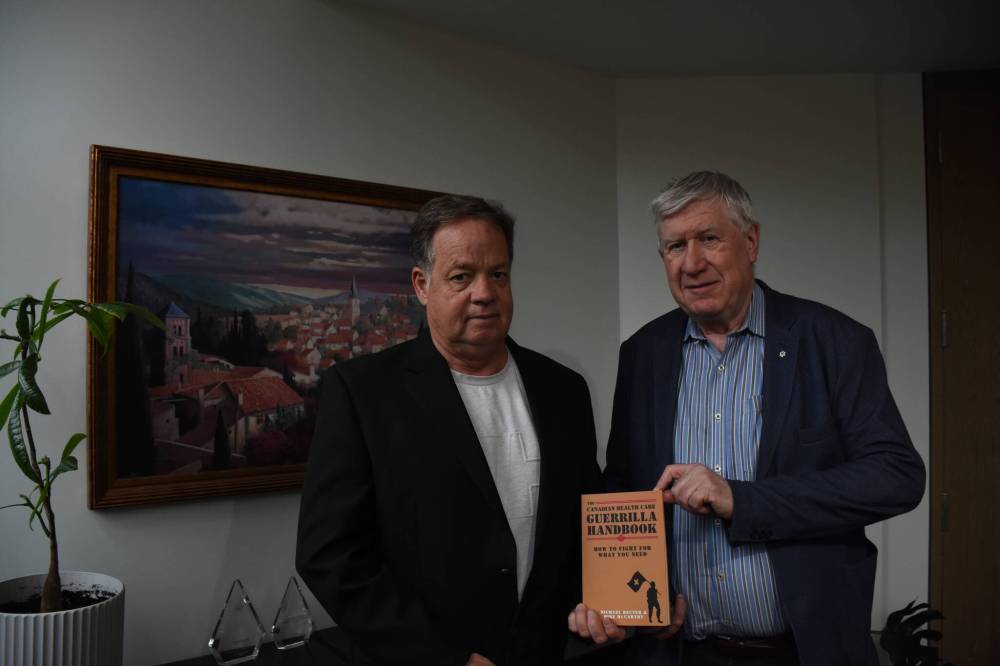
Born and raised in Winnipeg, Decter attended Kelvin High School. Then came Harvard University — where he studied economics — before he returned to Manitoba to work for the province as cabinet secretary in the ’80s. He started a consulting firm, managing people’s investments while remaining involved in health care, serving on a number of boards at the national and provincial levels.
“The truth about health care is: when you’re healthy and young, you’re not thinking about it,” Decter says.
“As we age, we have more and more engagement with the health system. A lot of clients and friends are boomers — you need a new hip or new knee. In the more terrifying cases, you’ve got cancer,” he continues.
“The story of health care is: on the one hand that we’ve made huge advances. The technology and progress of pharmaceuticals is dramatic. We cure a lot of things. There’s the driving technology revolution. On the other side we’ve got some very old structures and a resistance to change.”
Investing in ways to stay healthy and out of the health-care system for as long as possible is a good idea, say the authors. Here’s some advice from the book:
Don’t smoke. Reduce drinking. Exercise at least three times a week (walk 7,500 steps a day). Eat a healthy diet. Get enough sleep. Get vaccinated. Avoid falls. Manage stress. Prioritize an active social life. Take care of your brain. Take a first aid course.
Michael Decter’s book is packed with answers to commonly asked questions that will help the reader navigate a complex and fractured system. (Supplied)
If you do require medical attention from any health-care provider, Decter says there are simple things we can do to facilitate the experience.
“You should never go alone. Take someone with you to write down what you’re told. Someone from within the family who can go along for appointments, be the scribe, ask some questions — or a neighbour or friend. Getting support is really important.”
Accessing assistance from pharmacists can also be effective.
“A lot of people that I know have befriended pharmacists. They walk in with a rash and ask, ‘Do I need a doctor?’ The answer is, ‘Aisle 3, if it doesn’t clear in three or four days, go to your doctor.’ Pharmacists can do a meds review, write prescriptions. They have a lot of access to data — they can tell what conditions you’re dealing with. Sometimes people are on too many medications.”
And if you need to go to the ER, Decter says going on the website to check the wait times and the number of people in line is worthwhile.
When it comes to specialized tests that can have wait times of nine months or longer, Decter encourages people to get in touch with the provider to see about getting in sooner.
“Call and say, ‘If you get a cancellation, I can be there in half an hour.’ Ask a few questions in a friendly way.”
Guerrilla tools and tactics
How to know that you’ve become a capable health-care warrior.
● You have succeeded in finding a family doctor. You have organized your own health-care team, including a pharmacist, a dentist, a nutritionist, a nurse or nurse practitioner, and perhaps a physiotherapist or trainer.
How to know that you’ve become a capable health-care warrior.
● You have succeeded in finding a family doctor. You have organized your own health-care team, including a pharmacist, a dentist, a nutritionist, a nurse or nurse practitioner, and perhaps a physiotherapist or trainer.
● You own health records. You have and understand the details of your prescriptions, treatments and test results. You understand the disease risks and conditions you are managing and the steps you are taking to achieve the best long-term health outcome.
● You are aware of the health-care resources in your area for hospital care, home care, mental-health services and others. You can help others in your family access the health services they need.
● You know how to contact community-based providers such as wound-care specialists and physiotherapists.
● You have planned for your end-of-life care. You have an advance directive for your end-of-life decision-making and care. Your family and close friends are informed of your plans.
● If you have a plan to use Medical Assistance in Dying, you need to be clear on the rules. You need to understand the conditions under which you could activate a physician-assisted death.
● More than any single action you’ve taken, success as a health-care guerrilla should be measured by your improved ability to help family and friends access the care they need in a timely fashion.
And for those who have any private employer health coverage, Decter says it’s important to find out exactly how much you have.
Though the Canadian health-care system has the right principles at its core, the system lags behind other nations in a variety of ways.
“Australia, the U.K., France, have older populations, and they’ve done a far better job of integrating care,” he says
Decter points out that in Denmark, residents are given one number, the same number for health card, driver’s licence, everything.
“You go on a website, put your number in, book online, pick time of appointment — everything flows from there. It’s so well integrated, with such good access,” Decter explains, adding that here, people end up stranded in the system, without a family doctor or ability to access prescriptions or referrals to specialists.
“In other countries, they’ve sort of fixed a lot of that. In the U.K., patients belong to a family-practice group. They don’t have solo-practice doctors; the groups are much better at managing a roster of patients.”
Decter and McCarthy hope the book will make it easier for people to take more control of their health journey and ask more questions.
“The boomers are hitting the system with chronic diseases, and the system is not living up to what I think it should do. I think there’s going to be some profound pressure from patients to make improvements,” Decter says.
“It would be really helpful if patients engaged more and refused to accept bad care.”
arts@winnipegfreepress.com