

Storm left $840M of insured losses across Manitoba, Saskatchewan

Advertisement
Read this article for free:
or
Already have an account? Log in here »
To continue reading, please subscribe:

Digital Subscription
One year of digital access for only $205*
- Enjoy unlimited reading on winnipegfreepress.com
- Read the E-Edition, our digital replica newspaper
- Access News Break, our award-winning app
- Play interactive puzzles
*First annual payment billed as $205.00 + GST for one year. This annual subscription will automatically renew at $233.00 + GST every 52 weeks (10% off the regular annual price of $259.35). Offer available to new and qualified returning subscribers only. Cancel any time.
To continue reading, please subscribe:
Add Free Press access to your Brandon Sun subscription for only an additional
$1 for the first 4 weeks*
- Enjoy unlimited reading on winnipegfreepress.com
- Read the E-Edition, our digital replica newspaper
- Access News Break, our award-winning app
- Play interactive puzzles
*Your next Brandon Sun subscription payment will increase by $1.00 and you will be charged $17.95 plus GST for four weeks. After four weeks, your payment will increase to $24.95 plus GST every four weeks.
Read unlimited articles for free today:
or
Already have an account? Log in here »
Severe weather spanning two days in June — hitting both Manitoba and Saskatchewan — has led to at least $840 million in insured losses.
The June 9 and 10 weather is the latest in an increasing number of “catastrophic” events with major insurance payouts, said Rob de Pruis, the Insurance Bureau of Canada’s national director of consumer and industry relations.
The Insurance Bureau didn’t share a breakdown of insured losses by province. Most of the claims cover hail and flood damage, including sewer backups, de Pruis said.
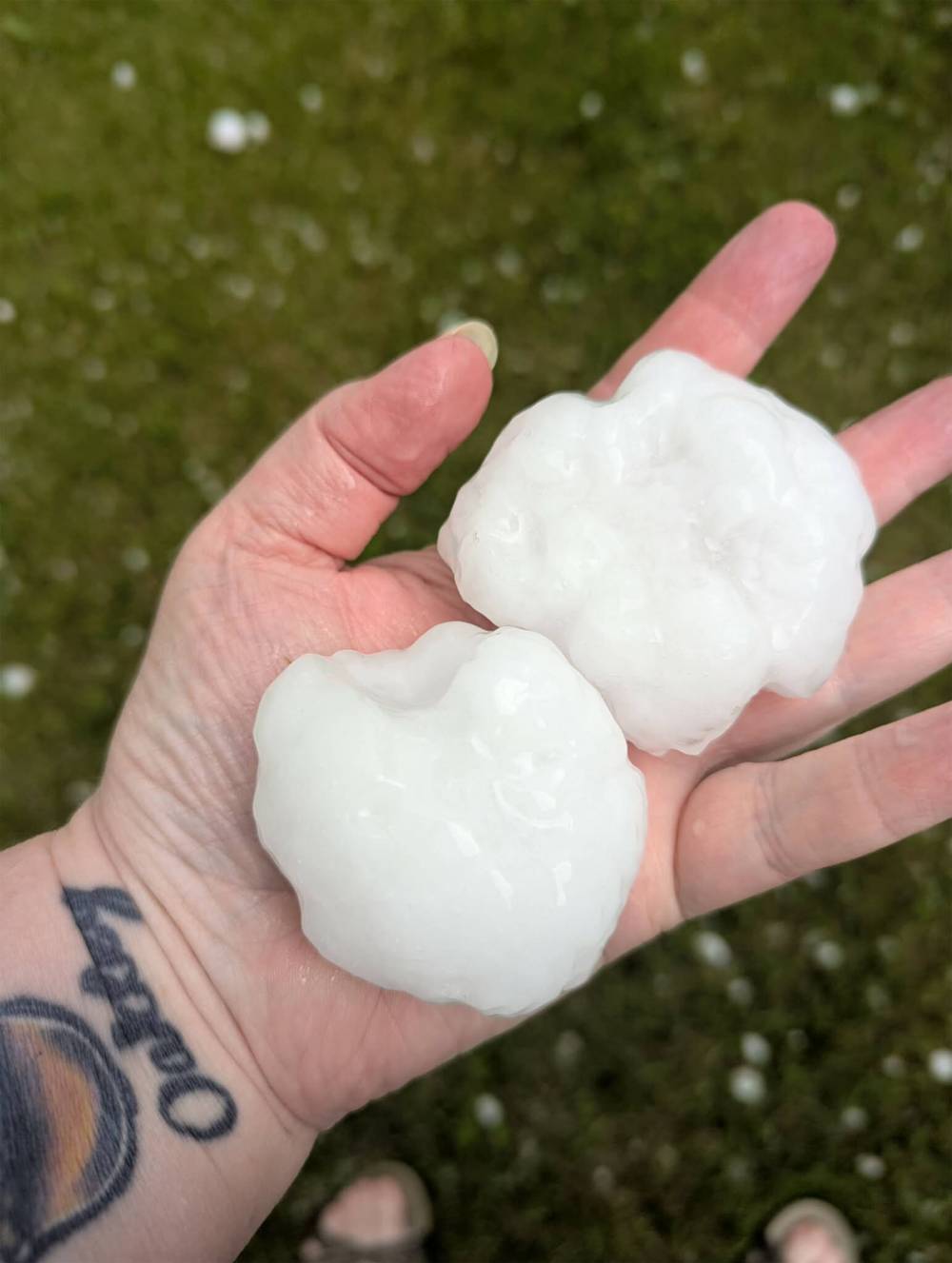
SUSAN OAKLEY PHOTO
Susan Oakley holds two large hailstones that fell in Sanford in early June.
At the time of the storm, Manitoba saw grapefruit-sized hail, torrential downpours and at least one tornado.
Stonewall, Woodlands, Inwood, Petersfield and Selkirk were placed under flood warnings. Some rural municipalities declared states of emergencies.
Tens of thousands of people across Manitoba and Saskatchewan were affected, the Insurance Bureau noted in a news release.
“We’re just seeing more of these events happen, and they’re costing a lot more,” de Pruis said.
The Insurance Bureau deems an event “catastrophic” if it causes at least $30 million in damage. There have been 30 catastrophic events since 2021 — a 140 per cent increase over the previous five years, de Pruis said.
Nationally, the Insurance Bureau has counted 11 catastrophic events in 2026. Five of those have impacted Manitoba and Saskatchewan.
Wildfires, flooding, hail and wind last year led to $760 million in insured losses between the two provinces.
“(It) will absolutely put pressure on people’s insurance premiums in the future,” de Pruis said. “Premiums of the many are paying for the claims of the few.
“But what we’re seeing are those claims of the few are becoming more and more, and those claims are costing more and more.”

Other factors, including a customer’s previous claims, contribute to individual premium prices.
Grant Wainikka, chief executive of the Insurance Brokers Association of Manitoba, said he expects June loss numbers to increase “significantly” once the final figures for the province’s disaster financial assistance program come in.
“Extreme weather is an ongoing concern,” Wainikka wrote in a statement. “This will continue to have a very real and material impact in many families and communities across the province.”
Both he and de Pruis urged loss prevention, such as retrofit incentives, Crown land management and strengthened building codes.
gabrielle.piche@winnipegfreepress.com
Gabrielle Piché reports on business for the Free Press. She interned at the Free Press and worked for its sister outlet, Canstar Community News, before entering the business beat in 2021. Read more about Gabrielle.
Every piece of reporting Gabrielle produces is reviewed by an editing team before it is posted online or published in print — part of the Free Press‘s tradition, since 1872, of producing reliable independent journalism. Read more about Free Press’s history and mandate, and learn how our newsroom operates.
Our newsroom depends on a growing audience of readers to power our journalism. If you are not a paid reader, please consider becoming a subscriber.
Our newsroom depends on its audience of readers to power our journalism. Thank you for your support.
Gabrielle Piché reports on business for the Free Press. She interned at the Free Press and worked for its sister outlet, Canstar Community News, before entering the business beat in 2021. Read more about Gabrielle.
Every piece of reporting Gabrielle produces is reviewed by an editing team before it is posted online or published in print — part of the Free Press‘s tradition, since 1872, of producing reliable independent journalism. Read more about Free Press’s history and mandate, and learn how our newsroom operates.
Our newsroom depends on a growing audience of readers to power our journalism. If you are not a paid reader, please consider becoming a subscriber.
Our newsroom depends on its audience of readers to power our journalism. Thank you for your support.
Advertisement Advertise With Us
Advertisement Advertise With Us