Federal government’s handful of health cut reversals won’t help most refugees: doctors

Advertisement

Advertise with us

TORONTO - The federal government has reinstated full coverage for a handful of health-care services for refugees, but doctors say it's not nearly enough. 

Read this article for free:


By clicking the button above, an account will be created and you will begin to receive some of our recommended newsletters. You may opt out of any newsletter by visiting your Email and Communication Preferences page or by clicking "unsubscribe" at the bottom of any email.

or

Already have an account? Log in here »

To continue reading, please subscribe:

Digital Subscription

One year of digital access for only $1.44 a week*

  • Enjoy unlimited reading on winnipegfreepress.com
  • Read the E-Edition, our digital replica newspaper
  • Access News Break, our award-winning app
  • Play interactive puzzles

*Billed as $5.77 plus GST every four weeks. After 52 weeks, price increases to the regular rate of $19.95 plus GST every four weeks. Offer available to new and qualified returning subscribers only. Cancel any time.

To continue reading, please subscribe:

Add Free Press access to your Brandon Sun subscription for only an additional

$1 for the first 4 weeks*

  • Enjoy unlimited reading on winnipegfreepress.com
  • Read the E-Edition, our digital replica newspaper
  • Access News Break, our award-winning app
  • Play interactive puzzles
Start now

*Your next Brandon Sun subscription payment will increase by $1.00 and you will be charged $17.95 plus GST for four weeks. After four weeks, your payment will increase to $24.95 plus GST every four weeks.

TORONTO – The federal government has reinstated full coverage for a handful of health-care services for refugees, but doctors say it’s not nearly enough. 

On May 1, Canada’s Interim Federal Health Program imposed a 30 per cent co-payment requirement for products and services ranging from wheelchairs to mental health counselling. 

More than a dozen medical, nursing, social work and refugee organizations — including the Canadian Medical Association, the Canadian Nurses Association, the Canadian Paediatric Society and the Canadian Psychiatric Association —warned that refugees can’t afford those co-payments and their physical and mental health would suffer.
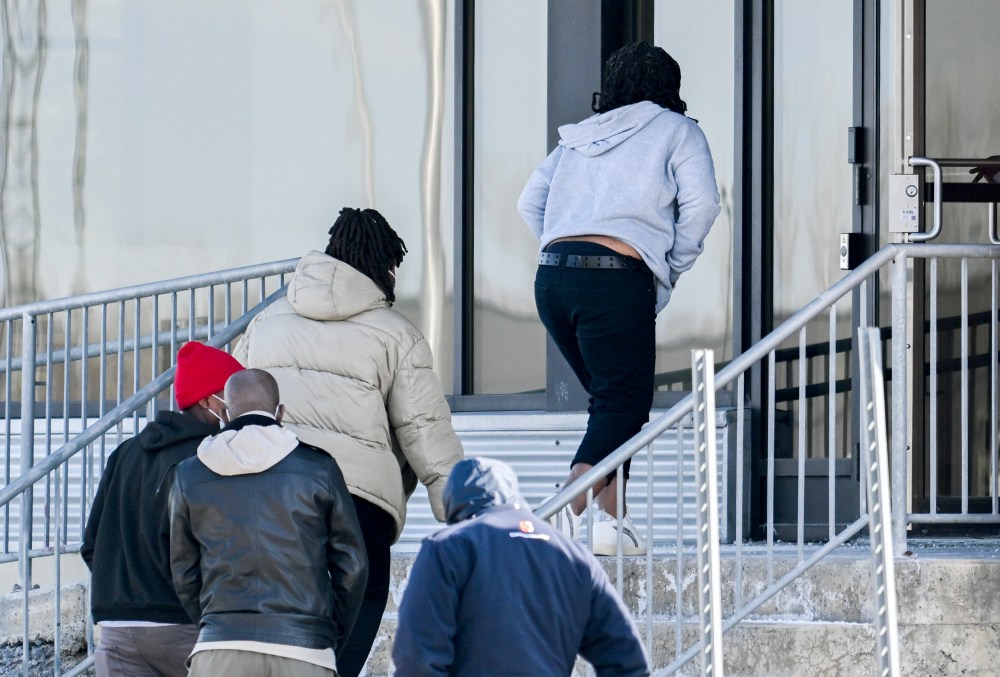
People enter a processing centre at the Canada/US border crossing in Saint-Bernard-de-Lacolle, Que., Thursday, April 10, 2025. THE CANADIAN PRESS/Graham Hughes

As of July 31, the government resumed paying the full cost of some supplies including home oxygen tanks, feeding pumps, sleep apnea monitors, ventilators and implantable hearing aids for children and teens.

It is also covering the cost of long-term care up to a maximum of $1,736 per month.   

But Dr. Parisa Rezaiefar, physician lead of the Ottawa Newcomer Health Centre, says although the move will help some refugees, many more need dental care, eyeglasses, mental health counselling, wheelchairs, catheters and other health services not fully covered. 

“To me, it sounds like a very superficial approach by specific targeting of items that are, yes, of course, very significant, but they apply only to very few people who would need these items,” said Rezaiefar, who is also an associate professor at the University of Ottawa.

Dr. Vanessa Redditt, a family physician at Women’s College Hospital’s refugee clinic in Toronto, welcomed the changes but said those co-payments should never have been implemented in the first place.  

The Interim Federal Health Program (IFHP) also requires refugees and refugee claimants to pay $4 for every prescription — another cost they said many patients can’t cover.

Since May, Redditt and Rezaiefar have been spending a lot of time trying to find suppliers who will waive the pharmacy fees and 30 per cent co-payments, as well as trying to access funding to fill the gap. But many of their patients are doing without essential health-care services because they can’t afford them. 

“We’ve seen children be hospitalized for weeks because they can’t be discharged home because they cannot afford the medical supplies that will keep them safe and healthy at home,” Redditt said. 

“We see individuals who are arriving who require wheelchairs, who cannot access that basic mobility support. (We see) people who have suffered the most horrific sexual violence who are now facing co-payments for essential trauma counseling.”

IFHP pays the full cost of hospital visits and doctor’s appointments. 

But health-care providers say not covering the full cost of drugs and supplementary health services only leads to more expensive care in hospitals when patients’ conditions deteriorate.    

“(I have) newly arrived, government-assisted refugees who decline to see a dentist, despite the fact that they need multiple dental care procedures,” Rezaiefar said. 

“So we’re going to wait until they have complications, they have (an) abscess and then they end up in hospital.”

“It just makes no sense to me.”

Redditt said the federal government’s arguments that the co-payments and fees are cost-saving measures “just don’t hold water.”

“Ultimately when people’s health deteriorates and they end up needing acute care or they suffer long-term complications, that costs our health system more. It means people can’t participate in the workforce. It can have intergenerational effects for families,” she said. 

Health insurance for refugees is provided by Medavie Blue Cross. According to the company’s insurance code guide, patients still need to pay 30 per cent of the cost of regular, non-implantable hearing aids, catheters, wheelchairs, canes and crutches. 

The guide also says that in-hospital physiotherapy, occupational therapy and speech therapy is fully covered. 

But Rezaiefar said that doesn’t help people who need those therapies and aren’t inpatients.

A spokesperson for the minister of Immigration, Refugees and Citizenship Canada said the health services moved back from partial coverage to full coverage are “not a reversal of the measures IRCC introduced in May 2026.”

Taous Ait said the services were moved from the supplemental benefits category to the basic benefits category, which eliminated the 30 per cent co-pay.

Ait said the move is meant to align refugee health coverage with provincial and territorial health benefits.   

“This targeted adjustment affects a very small proportion of current IFHP beneficiaries and largely maintains the approximately $200 million in projected annual savings associated with the May 2026 program changes,” she said in an email on Friday. 

“Fewer than one per cent of the approximately 600,000 people currently eligible for IFHP coverage access these services.” 

Doctors say they will continue their efforts to convince the federal government that cutting funding to the “most vulnerable people” is not the way to save taxpayer dollars, because refugees will become productive members of society if their health-care needs are met.    

“We’re blaming refugees and newcomers for our health-care system that is already struggling and we’re making health care more inequitable,” Rezaiefar said. 

“We’re not done advocating.”

—With files from David Baxter in Ottawa

This report by The Canadian Press was first published Aug. 7, 2026.

Canadian Press health coverage receives support through a partnership with the Canadian Medical Association. CP is solely responsible for this content.


Report Error Submit a Tip

More Stories

El Clásico has become spectacle of hatred between Barcelona and Real Madrid

Jerrad Peters 5 minute read Preview

El Clásico has become spectacle of hatred between Barcelona and Real Madrid

Jerrad Peters 5 minute read 3:24 PM CDT

El Clásico is more than a match. That is, the encounters between Barcelona and Real Madrid, while ostensibly about football, tend to collect all manner of drama, controversy and animus before — and after — the 90 minutes played twice per season in La Liga.

And yet, even by its typical standards, the build-up to Sunday’s showdown at Camp Nou (3 p.m., TSN) has been especially rancorous. From organized labour to name-dropping Joseph Goebbels, there’s not much this Clásico hasn’t touched on, and it’s still some time away.

Rather importantly, it should be noted that, yes, the two sides will actually face one another as scheduled. This was only confirmed Thursday, when it was determined that a workers’ strike would not prevent the game going ahead.

Approximately 60 of Barcelona’s seasonal employees are participating in the action, which began midnight Friday and will extend into Monday. They’re concerned about worsening conditions and task overload caused by understaffing. It’s just the latest organizational issue at a club that seems to lurch from one to the next.

Read
3:24 PM CDT

Today’s horoscope

Georgia Nicols 4 minute read Preview

Today’s horoscope

Georgia Nicols 4 minute read Yesterday at 2:00 AM CDT

MOON ALERT: Avoid shopping (except food and gas) and important decisions after 10 p.m. today. The moon is in Pisces.

ARIES (March 21-April 19)

This is a great day to make art, which is good news for your sign as so many of you are artisans. (You can do anything with your hands, even without training.) Enjoy time alone and give yourself the luxury of doing what you want to do.

TAURUS (April 20-May 20)

Read
Yesterday at 2:00 AM CDT

Federal government’s handful of health cut reversals won’t help most refugees: doctors

Nicole Ireland, The Canadian Press 5 minute read Preview

Federal government’s handful of health cut reversals won’t help most refugees: doctors

Nicole Ireland, The Canadian Press 5 minute read Friday, Aug. 7, 2026

TORONTO - The federal government has reinstated full coverage for a handful of health-care services for refugees, but doctors say it's not nearly enough. 

On May 1, Canada's Interim Federal Health Program imposed a 30 per cent co-payment requirement for products and services ranging from wheelchairs to mental health counselling. 

More than a dozen medical, nursing, social work and refugee organizations — including the Canadian Medical Association, the Canadian Nurses Association, the Canadian Paediatric Society and the Canadian Psychiatric Association —warned that refugees can't afford those co-payments and their physical and mental health would suffer.

As of July 31, the government resumed paying the full cost of some supplies including home oxygen tanks, feeding pumps, sleep apnea monitors, ventilators and implantable hearing aids for children and teens.

Read
Friday, Aug. 7, 2026

Addressing poverty best way to reduce crime, majority of city residents say in survey

Scott Billeck 5 minute read Preview

Addressing poverty best way to reduce crime, majority of city residents say in survey

Scott Billeck 5 minute read 4:22 PM CDT

A majority of Winnipeggers believe tackling poverty is the best way to reduce crime, according to a new poll that also suggests support for addressing the root causes of crime has slipped over the past four years.

The survey, conducted by Abacus Data for the Social Planning Council of Winnipeg, found 56 per cent of residents favour increased spending on poverty reduction, compared with 22 per cent who believe spending more on police is the best solution.

Support for poverty reduction has fallen six percentage points since 2022, while the proportion favouring increased police spending has edged up three points.

“It’s encouraging… because I thought it would be much lower,” Kate Kehler, executive director of the council, said Friday at a safety and well-being seminar at St. John’s High School.

Read
4:22 PM CDT

Hutterite colonies embrace the manufacturing business – while staying faithful to their way of life

Gabrielle Piché 13 minute read Preview

Hutterite colonies embrace the manufacturing business – while staying faithful to their way of life

Gabrielle Piché 13 minute read Yesterday at 5:02 PM CDT

Tucked away at Oak Bluff Hutterite Colony, past rows of communal housing and farm buildings, Aaron Maendel tinkers in a laboratory.

Black-and-white sheets smeared with grey-test formulas cover a counter. A Thermotron — a refrigerator-looking machine — is powered off but standing by to simulate any desired temperature.

Maendel moves to a worktop littered with partly full mixing cups. He pulls out a small, rectangular sample — a sheet showing the drying time of his new fixation, floor coatings.

“Very simple, actually. Very simple machine. Drags a stick through the mud,” Maendel says.

Read
Yesterday at 5:02 PM CDT

Winnipeg Jets trade Connor Hellebuyck to New Jersey Devils

Mike McIntyre 8 minute read Preview

Winnipeg Jets trade Connor Hellebuyck to New Jersey Devils

Mike McIntyre 8 minute read 12:07 PM CDT

Connor Hellebuyck finally got his wish. Kevin Cheveldayoff finally got an offer he couldn’t refuse. And a long-running sports soap opera has finally ended.

The Winnipeg Jets pulled off a blockbuster deal Friday morning, shipping their disgruntled franchise goaltender to the New Jersey Devils for a package including four players and two draft picks.

Although they liked the return, nobody within the organization was popping champagne. This was, in many ways, a dark but necessary day.

“It certainly hasn’t been fun. There’s no question about it. But at the end of the day, Connor made his choice. And, as an organization, we had to act accordingly and we did,” the general manager said during an afternoon news conference inside Canada Life Centre.

Read
12:07 PM CDT