Moving rail lines outside city would make Winnipeg ‘major transportation hub’ Axworthy to lead 90-day study of proposed south bypass along Hydro transmission corridor
Read this article for free:
or
Already have an account? Log in here »
To continue reading, please subscribe:

Digital Subscription
One year of digital access for only $205*
- Enjoy unlimited reading on winnipegfreepress.com
- Read the E-Edition, our digital replica newspaper
- Access News Break, our award-winning app
- Play interactive puzzles
*First annual payment billed as $205.00 + GST for one year. This annual subscription will automatically renew at $233.00 + GST every 52 weeks (10% off the regular annual price of $259.35). Offer available to new and qualified returning subscribers only. Cancel any time.
To continue reading, please subscribe:
Add Free Press access to your Brandon Sun subscription for only an additional
$1 for the first 4 weeks*
- Enjoy unlimited reading on winnipegfreepress.com
- Read the E-Edition, our digital replica newspaper
- Access News Break, our award-winning app
- Play interactive puzzles
*Your next Brandon Sun subscription payment will increase by $1.00 and you will be charged $17.95 plus GST for four weeks. After four weeks, your payment will increase to $24.95 plus GST every four weeks.
Read unlimited articles for free today:
or
Already have an account? Log in here »
After decades of calls to move rail traffic to the outskirts of Winnipeg, a plan that would benefit residents, railways and taxpayers is now on track, says the former Winnipegger leading the way.
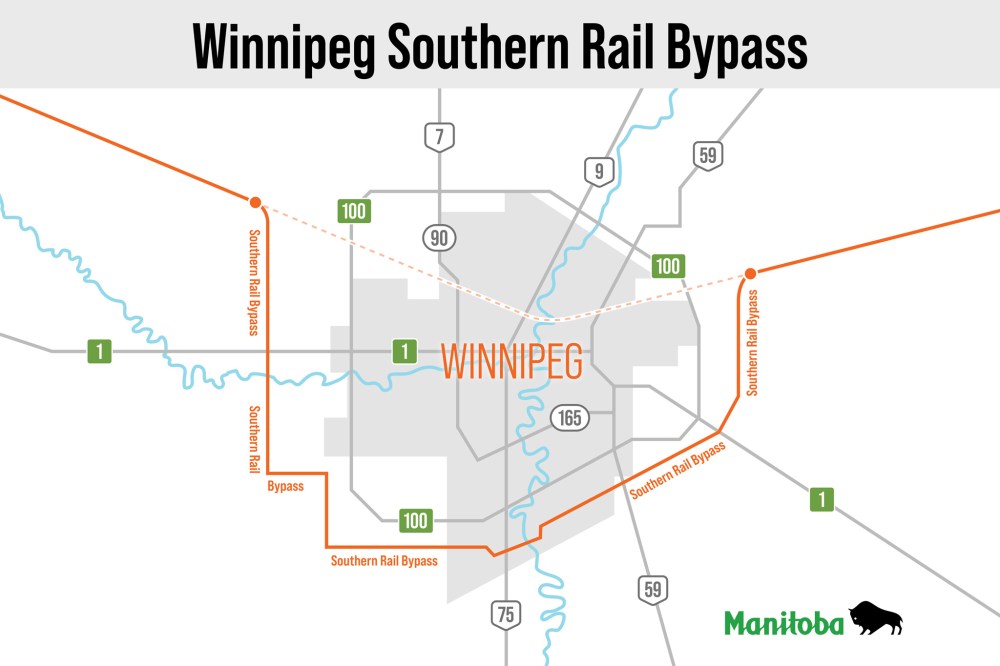
A rail line bypass south of the city, using Crown-owned land and the Manitoba Hydro corridor, would take 20 years to complete, remove 120 railway crossings that are a safety risk and free up about 250 acres of Winnipeg land over time for development, Lloyd Axworthy said Wednesday.
“The visions that we have have to be implemented,” Axworthy said at a news conference announcing the launch of a 90-day feasibility study to move freight rail traffic out of Winnipeg’s urban core along Manitoba Hydro’s southern transmission corridor, connecting east to west along the Perimeter Highway.
The former federal transport minister and Manitoba MP was tasked by Premier Wab Kinew in October 2024 to lead a two-year rail relocation feasibility study.
The new study will zoom in on the proposed bypass route and if it could improve the movement of goods, reduce impacts on residential neighbourhoods and open new opportunities for housing, green space, transportation and economic development.
Lloyd Axworthy, a former federal transport minister and Manitoba MP, was tasked by Kinew in October 2024 with leading a two-year rail relocation feasibility study. 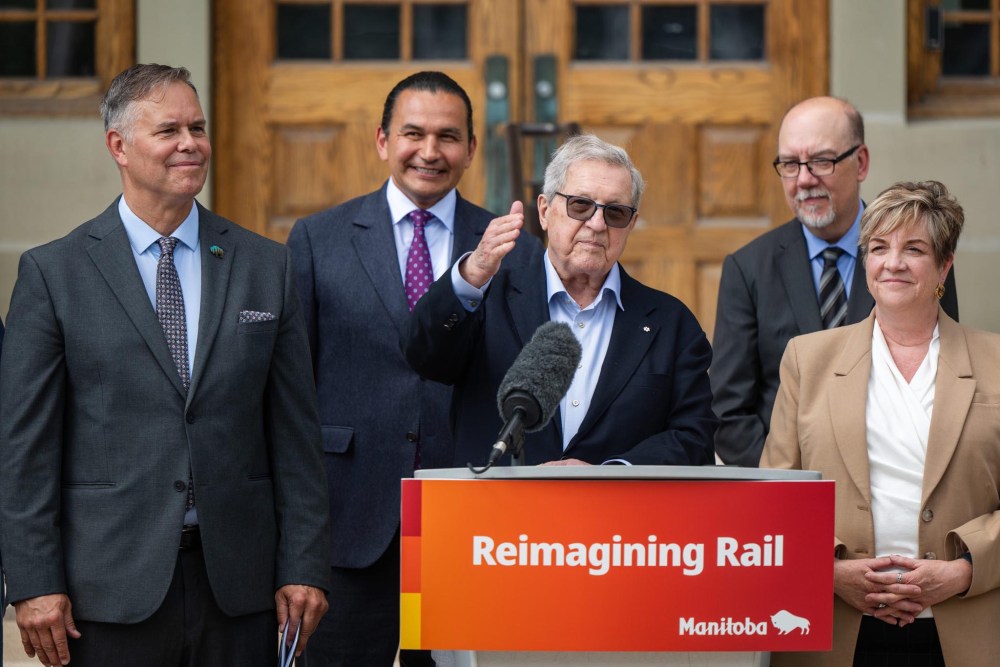
Axworthy said that decades of rail relocation studies have gathered dust, but conditions are right to act now.
Until now, the “big hurdle” has been acquiring private land, he said. The willingness to use public land changes that.
“Here’s an opportunity actually for Winnipeg to take a real jump forward and become a major transportation hub for North America, especially with the north-south axis from Churchill to southern Mexico coming into play,” said Axworthy, who now lives in Ottawa.
“With those kinds of changes and with the market changing, all the debates about new supply chains, the way railways are becoming more sophisticated — using more AI and things of that kind — Winnipeg has a chance to really not just be a classic transportation hub, but also a place where innovations can be done for electric factory rail cars.”
That window of opportunity will close, said Axworthy, who applauded Kinew for pushing rail relocation forward.
“Twenty years from now, instead of being stuck in traffic, counting the graffiti that you see go by on the train cars, maybe we could have something different instead,” Kinew said.
“This idea of dramatically reimagining Winnipeg with an economic corridor going through the area that Manitoba Hydro already owns right now south of the city and opening up more of the lands inside for development — for green space, for life — is a 20-year plan,” the premier said.
“This is not something that we’re looking to make happen in Year 1 or 2. Over the next few years, you might see some first steps towards rail relocation. There’s a rail line near Polo Park, for instance, that we’d like to see converted into green space so people in the inner city and in west Winnipeg can access… there’s a few other more bite-sized projects like that.”
The premier said the rail relocation study group is working with the major railway companies — CN Rail, Burlington Northern Santa Fe and Canadian Pacific Kansas City — to ensure a business case exists for the proposed relocation.
“Fifty to 60 per cent of the freight that goes into downtown Winnipeg, residential Winnipeg, neither originates in Winnipeg nor is delivering anything to Winnipeg.”
Axworthy’s study group is made up of a cross-section of volunteers from industry, business, Indigenous and community organizations. It’s looking at how to accommodate rail operations while protecting Manitoba Hydro infrastructure and examining relocation costs for government partners and railway companies, as well as operational and commercial practicality for railways.
“This is the best bargain you’re ever going to get,” Axworthy quipped at the news conference, thanking the volunteers.
“We’re prepared now to take on that second mandate… a feasibility study to determine exactly to what degree does this concept become a reality, and do it with precaution and proper examination and reassessment that we’ll have ready sometime in November or December.”
The City of Winnipeg has been involved from the start with funding and staff members participating in some of the discussions.
“The goal of the study has been to look at every reasonable option to get traffic moving and make our streets safer, while protecting thousands of rail jobs in Winnipeg,” Mayor Scott Gillingham said Wednesday in a prepared statement.
“A bypass is an interesting concept, and I look forward to seeing what the study tells us about what’s possible and what the next steps would be.”
The railways have no choice but to run through Winnipeg because there is no bypass, Axworthy said.
“Fifty to 60 per cent of the freight that goes into downtown Winnipeg, residential Winnipeg, neither originates in Winnipeg nor is delivering anything to Winnipeg,” he said prior to the news conference.

Trains, which have grown much longer over the years — in some cases consisting of 200 or more rail cars — must travel at slower speeds through the city.
A bypass well outside of Winnipeg would allow them to operate more quickly and efficiently, Axworthy said. “It would also bring a lot of money back into the coffers of the city in terms of increased real estate values and development programs.”
Manitoba’s Crown-owned power company also sees the benefit of sharing its transmission corridor, he said.
“Hydro showed to be very interested in the idea — that the combination of a transmission system and a railway system could actually be very self supporting,” he said. “They’re always concerned about encroachment — people start building close to them and safety and security issues become a risk.”
carol.sanders@freepress.mb.ca

Carol Sanders
Legislature reporter
Carol Sanders is a reporter at the Free Press legislature bureau. The former general assignment reporter and copy editor joined the paper in 1997. Read more about Carol.
Every piece of reporting Carol produces is reviewed by an editing team before it is posted online or published in print — part of the Free Press‘s tradition, since 1872, of producing reliable independent journalism. Read more about Free Press’s history and mandate, and learn how our newsroom operates.
Our newsroom depends on a growing audience of readers to power our journalism. If you are not a paid reader, please consider becoming a subscriber.
Our newsroom depends on its audience of readers to power our journalism. Thank you for your support.


History
Updated on Wednesday, August 12, 2026 6:39 PM CDT: Adds comments, details, fresh photos.
Updated on Wednesday, August 12, 2026 7:33 PM CDT: Adds comment from Mayor Gillingham