The warming climate is forcing marathons to consider changes to keep runners cool
Advertisement
Read this article for free:
or
Already have an account? Log in here »
To continue reading, please subscribe:

Digital Subscription
One year of digital access for only $205*
- Enjoy unlimited reading on winnipegfreepress.com
- Read the E-Edition, our digital replica newspaper
- Access News Break, our award-winning app
- Play interactive puzzles
*First annual payment billed as $205.00 + GST for one year. This annual subscription will automatically renew at $233.00 + GST every 52 weeks (10% off the regular annual price of $259.35). Offer available to new and qualified returning subscribers only. Cancel any time.
To continue reading, please subscribe:
Add Free Press access to your Brandon Sun subscription for only an additional
$1 for the first 4 weeks*
- Enjoy unlimited reading on winnipegfreepress.com
- Read the E-Edition, our digital replica newspaper
- Access News Break, our award-winning app
- Play interactive puzzles
*Your next Brandon Sun subscription payment will increase by $1.00 and you will be charged $17.95 plus GST for four weeks. After four weeks, your payment will increase to $24.95 plus GST every four weeks.
Read unlimited articles for free today:
or
Already have an account? Log in here »
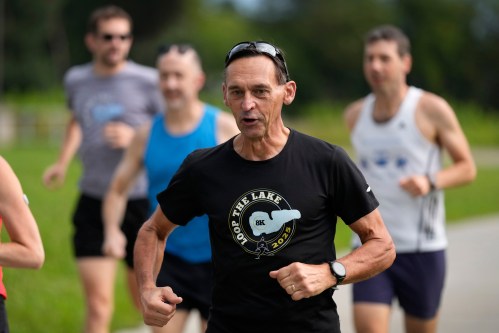
DES MOINES, Iowa (AP) — Paul Grinvalds has completed 114 marathons in all 50 states, but he still wilts when he races in temperatures beyond 60 degrees Fahrenheit (15.5 Celsius).
It’s the same for most runners, as the body can’t cool down during exertion, and heat makes that even harder.
“One thing about marathoners is typically we’re kind of stubborn,” said Grinvalds, 68, from West Des Moines, Iowa, who finds even temperatures in the 50s F (10 C) a bit warm. “So if we have a goal and it’s hot, a lot of times we’re still going to try to do that goal, which is just stupid because you’re almost guaranteed to have a very painful experience.”

Such an experience can also be dangerous, a reality that marathon organizers are having to confront as climate change, caused mostly by the burning of fuels like coal and gasoline, pushes temperatures up. To improve the chances of having the 26.2-mile (42-kilometer) race in cooler weather, organizers are shifting race dates, starting earlier and even giving options for participants to cut their runs short.
Starting in 2027, the Twin Cities Marathon in Minneapolis-St. Paul will shift its more than 40-year tradition of holding the race on the first Sunday in October to later in the month. That decision comes after cancellation of the marathon in 2023 because of record heat and humidity, and starting temperatures near 70 F (21 C) for the 2025 race.
Organizers of the Sioux Falls, South Dakota, marathon last year similarly moved their annual race from August to September after canceling the 2024 race due to hot conditions. And other races, including the Air Force Marathon in Dayton, Ohio, the Little Rock Marathon in Arkansas, and the Long Beach Marathon in Southern California, all moved their start times to earlier in the morning in search of cooler temperatures.
In Los Angeles in March, warm conditions prompted race organizers to give runners the option of stopping after 18 miles and still receiving a finishers medal. Less than 5% of participants opted for the shorter finish and only 14 of roughly 27,000 runners were treated at a hospital, with all released the same day. Still, the move led to some online derision.
“We welcome the feedback and it’s certainly something that caused a lot of discussion, but when we’re grading ourselves on it, it has to do with how safe our runners were on the day of the event and we’re very happy with the outcome,” said Meg Treat, a spokesperson for the marathon.
At the Twin Cities Marathon, race director Ed Whetham called the decision to cancel the 2023 marathon “devastating” for runners and the organization. Whetham said it prompted an extensive analysis of weather patterns that resulted in the decision to permanently delay the race by a couple weeks.
That analysis showed that by holding the race later in October, runners would have a far greater chance of optimal conditions. Given that snow sometimes falls in the Twin Cities in late October, there is a greater chance of chilly conditions, but Whetham said, “We’ll take a 39-degree (4 C) start over a 70-degree (21 C) start.”
Temperatures are expected to keep rising
The contiguous U.S. just had its warmest July ever recorded, and the Earth had its hottest year on record in 2024. The World Meteorological Organization forecasts that between 2025 and 2030 the Earth’s average global temperature will likely rise by more than 1.5 degrees C (2.7 degrees F) compared to the 1800s.
The warming is already making conditions worse for most marathons, according to a study of 221 races by the climate research group Climate Central. By 2045, optimal conditions for recreational runners — in the low 40s (6 or 7 degrees C) — would be less likely at 46 of the 51 U.S. marathons analyzed.
“The ability to go outside, to exercise, to take advantage of your human body and being healthy, that’s something that’s getting challenged by climate change,” said Andy Pershing, who led the Climate Central research.
Jessica Murfree leads a University of North Carolina-Chapel Hill lab studying climate change’s effect on sports. She said organizers of marathons, bicycle races and other competitions — from tennis to college football — increasingly must consider changing event dates and times and adopting other safety measures, as climate change makes the weather hotter and more volatile.
Murfree said the concern extends beyond organized sports to whether people can even get outside on increasingly warm days, pushing people to exercise indoors or opt for activities like swimming.
“If we can’t walk, if we can’t exercise or go for runs, it’s too hot, can we still stay physically active while remaining cool?” she asked.
Marathons are especially hard in warm weather
Any kind of exercising in the heat can be challenging, but running a marathon in warm, humid conditions is especially difficult because it’s hard to prevent overheating when a person keeps pushing themselves for hours. And the faster a person goes, the more heat their body produces.
Chris Minson, a University of Oregon professor who researches how people can adapt to extreme heat and other environmental conditions, said the optimum temperature to run a marathon is about 50 degrees (10 C). As the temperature creeps into the upper 50s and 60s, the body has a tougher time supplying blood to muscles while also keeping the body cool.
“As you get to warmer temperatures you end up having a bigger competition between blood supplying your muscles to keep running, to keep nutrition going, and blood flow to your skin for thermal regulation,” Minson said.
Minson said it takes a tremendous amount of energy to run quickly. But of that energy, only about 25% is used to move the body forward. The rest goes to deal with the heat that is created by rapid movement.
Even worse than high temperatures is high humidity, which prevents sweat from evaporating and cooling the body.
Minson adds, though, that by regularly exercising in warm weather, people can acclimate to high temperatures and perform better in the heat, though likely not as well as they would in cooler conditions. Athletes who acclimate to high heat also can perform better in lower temperatures than if they hadn’t exercised in warm weather, he said.
Some athletes like John Seals even run in the midday heat and endure a sauna after a workout to acclimate their bodies. That all forms part of Seals’ training for an annual 135-mile ultramarathon held in July in Death Valley, California.
“We had a heat wave this week and for me, that’s a great thing,” said Seals, of West Des Moines.

Still, running in the heat can be dangerous without taking precautions.
Douglas Casa, a kinesiology professor who leads the Korey Stringer Institute, which studies sudden deaths in sports, said the Twin Cities Marathon’s change was prudent, especially considering the way in which many runners approach races.
“If someone was smart enough to say, ‘OK, it’s a little hotter today than usual, I’m going to run a 7 minute mile instead of a 6:30 mile,’ then they won’t get any hotter than normal,” Casa said. “It’s just that runners are sometimes very locked into what they normally do and what their goals are.”
___
The Associated Press’ climate and environmental coverage receives financial support from multiple private foundations. AP is solely responsible for all content. Find AP’s standards for working with philanthropies, a list of supporters and funded coverage areas at AP.org.